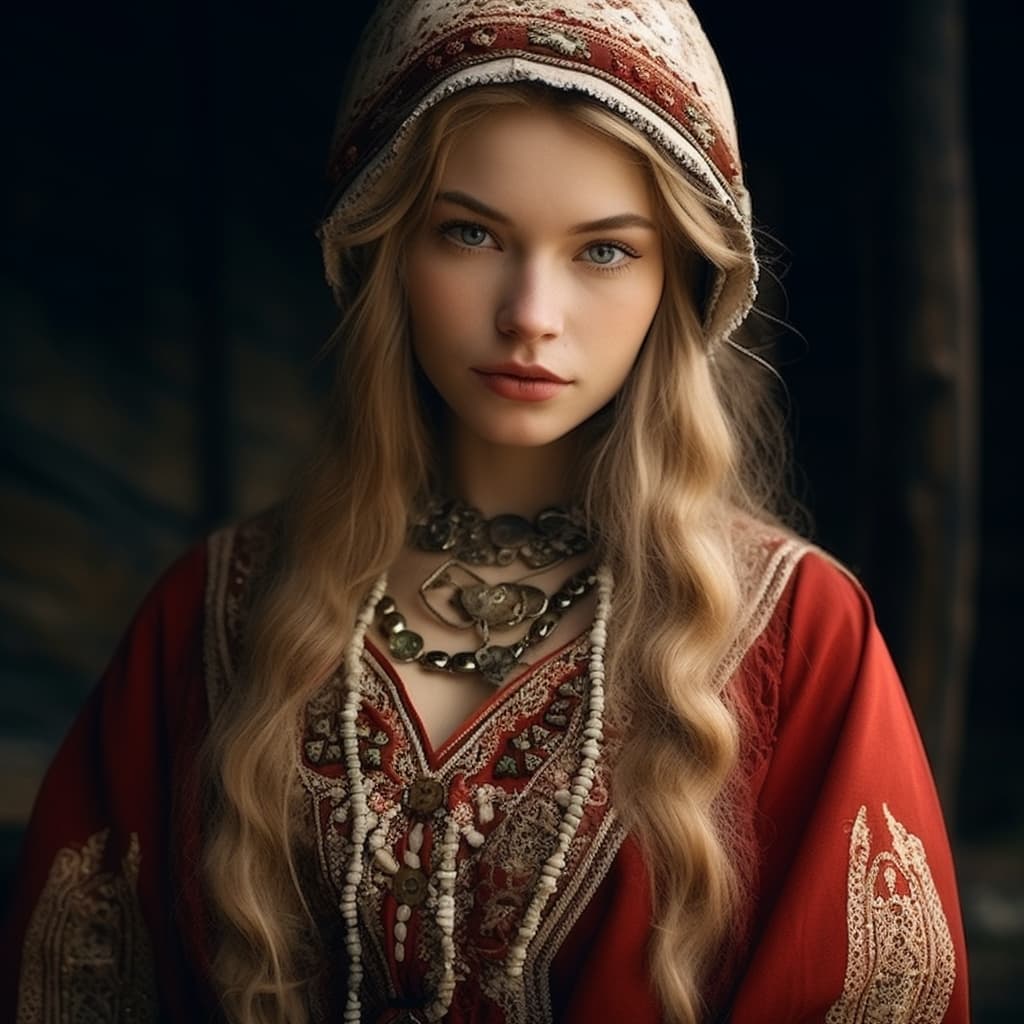
Udmurts Erotic
Udmurtia (Russia)
Uralic / Permic / Udmurt
Christianity / Eastern Orthodoxy
Besermyan
Eastern Europe
About Udmurts People
The Udmurts are a Permic-speaking people of the forested middle Volga–Kama country, concentrated in the Republic of Udmurtia between the Vyatka and Kama rivers in what is now central Russia. Their language is a close cousin of Komi and a more distant relative of Hungarian and Finnish, sitting on the eastern flank of the Uralic family — far enough from the Baltic Finns that the kinship is detectable mainly to linguists, close enough to Komi that the two were once a single tongue. Older Russian sources called them Votyaks, a name they have largely shed; the autonym Udmurt is now standard, and the republic and language carry it.
Russian chroniclers encountered them as a settled forest people of beekeepers, rye farmers, and hunters, and that template still shapes the rural self-image: a quiet, indoor-leaning culture, less demonstrative than its Tatar and Russian neighbors, with a reputation among ethnographers for reserve and for the highest concentration of natural redheads in the world. The Kama basin pulled them into Moscow's orbit by the sixteenth century, and Orthodox Christianity arrived with the empire, layered onto an older animist substrate that never fully went away. Sacred groves — lud and keremet — are still tended in some villages, and household and clan rituals tied to particular trees and springs survived collectivization more or less intact. The result is a population that registers as Orthodox on paper but practices a quieter, syncretic religion at home, with prayers addressed to Inmar, the sky god, alongside the saints.
The Besermyan are the curious branch: a small group in northern Udmurtia who speak Udmurt but are historically Muslim-influenced and culturally tilted toward the Tatar and Chuvash worlds, probably descendants of a medieval Volga Bulgar population that assimilated linguistically without ever quite assimilating otherwise. They are recognized as a distinct people in Russian census categories, and the question of whether they are Udmurts at all is one the community itself answers differently depending on whom you ask. Twentieth-century Soviet policy gave the Udmurts a republic, a literary standard, and a publishing industry, and also accelerated Russification; today the language is in retreat in cities but holds its ground in the villages, where embroidery, polyphonic singing, and a strong tradition of women's choral music remain part of ordinary life rather than staged folklore.
Typical Udmurts Phenotypes
Reference for AI generation — hair, eyes, skin, facial structure, build
The Udmurts are one of the most consistently red-haired populations in the world. Genetic and anthropometric surveys done across Udmurtia in the 20th century repeatedly logged red and red-blond frequencies higher than anywhere outside the British Isles — a recurring claim is that the Udmurts and the Irish trade the title for "reddest people on earth." The redhead share is concentrated, but the more typical Udmurt hair color is a warm ash or strawberry blond shading into light brown, with a fine, soft, straight-to-loosely-wavy texture. True dark brown is uncommon and pure black is rare.
Eyes track the same northern-Uralic palette: blue, blue-grey, and pale green dominate, with hazel less common and dark brown unusual. The eye opening tends to be relatively narrow and slightly slanted, and a mild epicanthic fold appears in a noticeable minority — a soft Uralic signature rather than the pronounced fold seen further east. Brows are often light and sparse to match the hair.
Skin is firmly Fitzpatrick I–II: very fair, often pink-undertoned, freckle-prone, and quick to burn. The face is broad and flat-planed with wide, high-set cheekbones, a short and often slightly concave nasal bridge, narrow alar width, a small mouth with thin to moderate lips, and a recessed, lightly built chin. The overall impression is rounded and softly modeled rather than sharply angular — a face read as finno-permic rather than Slavic, and visibly distinct from neighboring Russians.
Build is short to medium by European standards, with men averaging around 168–172 cm and women correspondingly compact, tending to a stocky, sturdy frame rather than a long-limbed one. The Besermyan minority in the northwest carries a slightly stronger Turkic-Tatar overlay — somewhat darker hair, more frequent brown eyes, marginally more olive skin — but the underlying broad-faced, fair-pigmented Udmurt structure remains recognizable across both branches.
Data depth
51/100Coverage of image-grounded phenotype observations · drives AI generation diversity
- Sample size
- 6/40· 2 images
- Image quality
- 30/30· 100% high
- Confidence
- 15/20· mean 0.80
- Source diversity
- 0/10· wikipedia
- ·No image observations yet
- ·Wikipedia-only source — not population-representative
Explore phenotype categories
Structured taxonomy with peer-reviewed scales · 22 anatomical categories
Notable Udmurts People
2 reference figures — sourced from Wikipedia
- Nicholas B. Suntzeff — American astronomer and cosmologist who is of Udmurt descent
- Albert Razin — Udmurt activist
Generate Udmurts AI Content
Use this ethnicity's phenotype data to create AI-generated content with accurate physical traits and cultural context.
Open Creator Studio