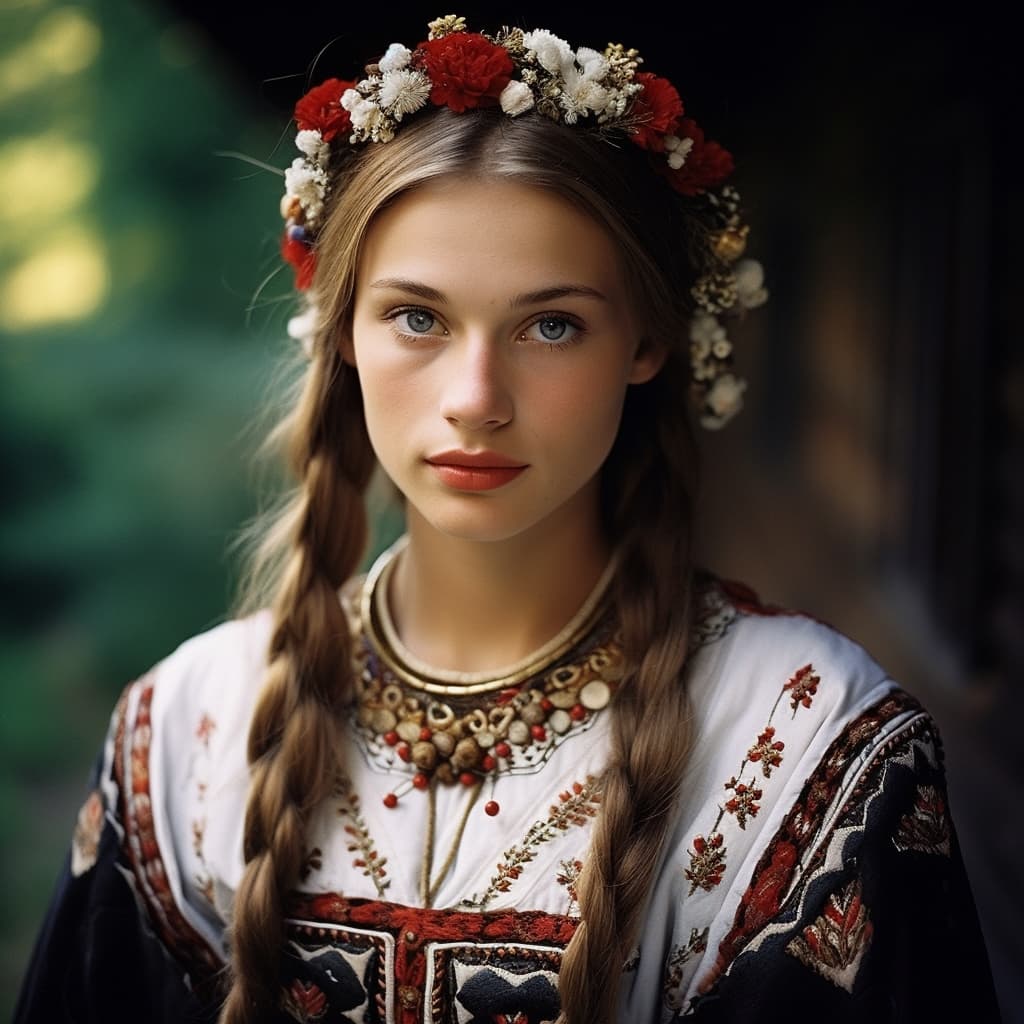
Sorbs Erotic
Lusatia (Germany), (Poland)
Indo-European / Slavic / Sorbian
Christianity?Catholicism
Upper Sorbs, Lower Sorbs
Eastern Europe
About Sorbs People
The Sorbs are the last Slavic people inside Germany — a Western Slavic minority whose ancestors stayed put when the medieval German eastward expansion absorbed or displaced their neighbors. They live in Lusatia (Łužica), a stretch of low country, pine forest and former lignite pits straddling Saxony and Brandenburg, with a thinner presence across the border in Poland. There are perhaps sixty thousand of them, give or take, depending on how you count people who still understand the language versus those who actively use it. They are not immigrants and not a diaspora; they are simply what was left after a thousand years of pressure to assimilate.
The split between Upper Sorbs and Lower Sorbs is not a minor regional flavor but a real internal division. Upper Sorbian, centered on Bautzen (Budyšin) in Saxony, is the healthier of the two languages and is reinforced by a Catholic enclave of villages that has functioned for centuries as a cultural keel — Catholic Sorbs intermarried within their parishes and held their language through generations when Protestant Sorbs further north largely shifted to German. Lower Sorbian, around Cottbus (Chóśebuz) in Brandenburg, is Protestant, more closely fused with German daily life, and considerably more endangered; UNESCO lists it as severely so. The two varieties are close enough to be recognizable as one tradition and far enough apart that speakers do not always understand each other comfortably.
Sorbian customs survive most visibly in the calendar. The Catholic villages still hold the Osterreiten at Easter, where men in black coats and top hats process between parishes on horseback, singing the resurrection in Sorbian. Ptači kwas, the Bird's Wedding on January 25, is a children's festival in which households leave out small pastries shaped like nests. Zapust, a pre-Lenten carnival with embroidered costumes and a procession of unmarried women, is a Lower Sorbian tradition kept alive partly by stubbornness and partly by tourism.
The harder context is geological. Lusatia sits on top of brown coal, and twentieth-century strip mining erased dozens of Sorbian villages outright — people relocated, churches dismantled, dialect pockets dispersed. The German energy transition is closing those mines now, which removes the immediate threat but leaves an open question about whether the rebuilt landscape can hold a community that the old one was actively destroying.
Typical Sorbs Phenotypes
Reference for AI generation — hair, eyes, skin, facial structure, build
The Sorbs are a West Slavic minority embedded in eastern Germany, and their phenotype reads as a softened, lighter-pigmented Slavic profile shaped by a thousand years of contact with surrounding German populations. Hair runs predominantly mid-to-dark blond and light brown in childhood, frequently darkening to ash brown or chestnut by adulthood — a "darkening blond" trajectory typical of West Slavs. Genuine black hair is rare; true red is uncommon but not absent. Texture is straight to lightly wavy, fine to medium in diameter, and often described locally as "flat-falling" rather than voluminous.
Eyes skew light: blue and grey-blue dominate, followed by green and hazel, with fully brown irises a clear minority. Eyelids are flat European with no epicanthic fold, though a mild medial fold and slightly hooded upper lid show up often enough to give some Sorbs a faintly "northeastern" cast. The eye opening tends to be narrow and almond-set rather than round.
Skin is Fitzpatrick II–III: pale with cool pink or neutral undertones, freckling readily on the cheekbones and forearms, tanning to a light wheat in summer rather than going olive. Persistent erythema across the nose and cheeks is common.
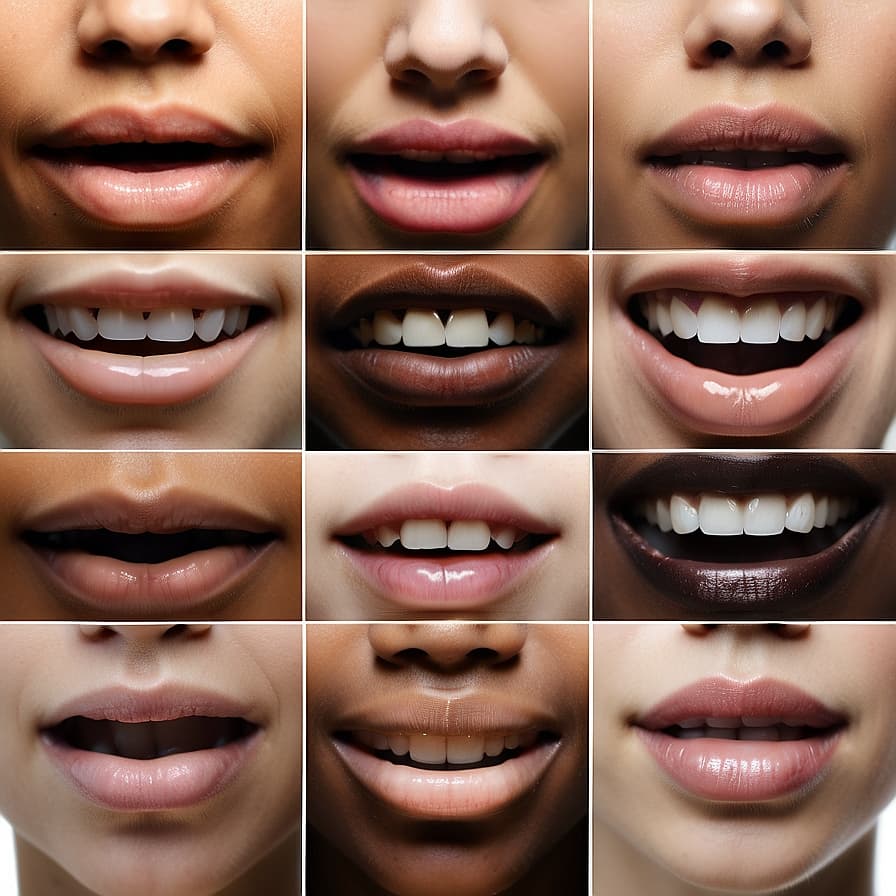
Facially, the structure is broad rather than long. Cheekbones are wide and moderately high, the midface flat, the jaw squared but not heavy. Noses are typically straight or faintly upturned with a narrow bridge and modest alar width — aquiline profiles are unusual. Lips run medium-full, with the lower lip carrying most of the volume; philtrums are short. Margot Robbie, partly Sorb-descended, illustrates the wide-cheekbone, short-philtrum, light-eyed configuration cleanly.
Build is solidly Central European: men average roughly 178–181 cm, women 165–168 cm, with sturdy mesomorphic frames, broad shoulders relative to hips in men, and a tendency toward fuller hips and bust in women. Upper Sorbs (Catholic, hillier Lusatia) and Lower Sorbs (Protestant, flatter Spreewald country) are not visibly distinct — any phenotype difference is swamped by individual variation.
Data depth
44/100Coverage of image-grounded phenotype observations · drives AI generation diversity
- Sample size
- 26/40· 20 images
- Image quality
- 8/30· 15% high
- Confidence
- 10/20· mean 0.62
- Source diversity
- 0/10· wikipedia
- ·Modest sample (n<25)
- ·Mostly low-quality source images
- ·Wikipedia-only source — not population-representative
Observed Distribution — Image Sample
Empirical observations from analyzed photographs · supplementary signal, not population truth
Sample: 20 images analyzed (20 wikipedia). Quality: 3 high, 11 medium, 6 low, 0 very_low. Avg analyzer confidence: 0.62.
Skin tone (Fitzpatrick): II (90%), III (5%), unclear (5%)
Hair color: gray/white (60%), black (25%), dark brown (5%), light/medium brown (5%), blonde (5%)
Hair texture: straight (55%), wavy (35%), bald (5%), covered (5%)
Eye color: blue (20%), brown (10%), dark brown (5%), unclear (65%)
Epicanthic fold: 0% present, 90% absent, 10% unclear
Caveats: Sample size 20 is modest — secondary patterns may not be reliable. Quality skews toward older or low-resolution photos; phenotype detail may be lossy. Sample is 100% Wikipedia notable people — skews toward male, public-life, and modern figures, not population-representative.
Last aggregated: May 7, 2026
Explore phenotype categories
Structured taxonomy with peer-reviewed scales · 22 anatomical categories
Notable Sorbs People
24 reference figures — sourced from Wikipedia
- Czimislav — 839–840) – 9th-century King of the Sorbs
- Jakub Bart-Ćišinski — 1856–1909) – Poet, writer, playwright, and translator
- Jan Kilian — 1811–1884) – Pastor and leader of the Sorbian colony in Texas
- Korla Awgust Kocor — 1822–1904) – Composer and conductor
- Ludwig Leichhardt — 1813–1848) – Explorer and naturalist
- Jan Arnošt Smoler — 1816–1884) – Philologist and writer
- Handrij Zejler — 1804–1872) – Writer, pastor, and national activist
- Pavle Jurišić Šturm — born Paulus Eugen Sturm (1848–1922) – General in the Serbian Army
- Jurij Brězan — 1916–2006) – Writer, novelist, and author of children's books
- Martha Israel — 1905–c. 1967) – member of the Volkskammer
- Jurij Koch — b. 1936) – Writer, editor, and reporter
- John Symank — 1935–2002) – Head coach for Northern Arizona University and the University of…
- Mato Kosyk — 1853–1940) – Poet and minister
- Baldur von Schirach — 1907–1974) – Nazi German politician and convicted war criminal
- Kito Lorenc — 1938–2017) – Writer, lyric poet, and translator
- Kurt Krjeńc — 1907–1978) – East German politician and Chairman of Domowina
- Marie Simon — 1824–1877) – nurse
- Erwin Strittmatter — 1912–1994)
- Stanislaw Tillich — b. 1959)
- Mina Witkojc — 1893–1975)
- Carolina Eyck — b. 1987)
- Margot Robbie — b. 1990), Australian actress of Scottish, German and Sorb heritage.
- Peter Schowtka — 1945–2022) – member of the Landtag of Saxony
- Eva Ursula Lange — 1928–2020) – painter, illustrator, graphic designer, and ceramist


Generate Sorbs AI Content
Use this ethnicity's phenotype data to create AI-generated content with accurate physical traits and cultural context.
Open Creator Studio