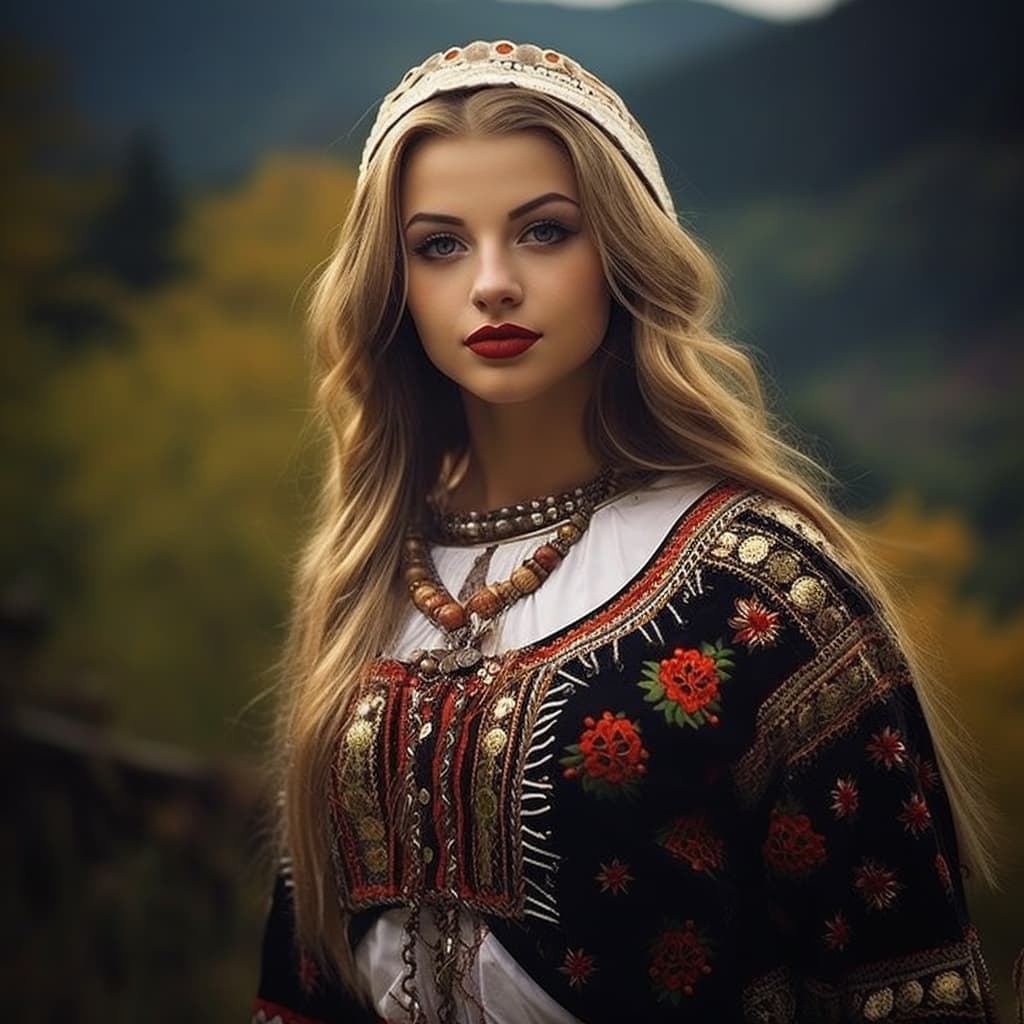
Rusyns Erotic
Carpathian Ruthenia (Ukraine, Slovakia, Poland)
Indo-European / Slavic / Rusyn
Christianity
Pannonian Rusyns, Lemkos, Hutsuls, Boykos
Eastern Europe
About Rusyns People
The Rusyns are the people the maps keep losing. Their homeland sits along the spine of the Carpathians, where the borders of Ukraine, Slovakia, and Poland converge — a stretch of forested ridges, sheep pasture, and old wooden churches that has belonged, on paper, to Hungary, Czechoslovakia, Poland, the Soviet Union, and now three separate states, often within a single grandparent's lifetime. Through all of it the Rusyns have stayed put and stayed Rusyn, which is the more interesting fact about them than any of the regimes that tried to file them under something else.
Their language is East Slavic, close enough to Ukrainian that Kyiv has historically argued they are simply Ukrainians under a regional label, and distinct enough that Slovakia, Poland, Hungary, Serbia, and Romania officially recognize Rusyn as its own minority language. The dispute is not a linguistic curiosity — it is the central political fact of Rusyn identity. The branches reflect the terrain. Lemkos traditionally lived on the northern, Polish slope of the Carpathians until the 1947 deportations of Operation Vistula scattered them across western Poland. Boykos occupy the middle ranges. Hutsuls, the highland herders of the eastern Carpathians, kept a pastoral economy and a distinctive material culture — brass-buckled belts, decorated axes, polyphonic singing — long after their lowland neighbors had moved on. The Pannonian Rusyns are the outlier: an 18th-century migration south into what is now Vojvodina in Serbia, where they speak a codified literary Rusyn that diverged from the Carpathian dialects centuries ago.
Religion is where the Rusyn story gets specific. Most belong to the Greek Catholic (Byzantine Rite) Church — Eastern liturgy, married parish priests, communion with Rome — a settlement reached at the Union of Uzhhorod in 1646 that has shaped village life ever since. A minority remained Orthodox, and the split between the two churches still maps onto family histories in many villages. The wooden tserkvas of the Carpathians, with their tiered shingled roofs and three-domed silhouettes, are UNESCO-listed and still in active parish use; they are not folk museums.
What outsiders tend to miss is how recent Rusyn nationhood feels from the inside. A serious cultural revival began only in 1989, and Ukraine still does not recognize Rusyns as a separate nationality — a sore point that animates much of the contemporary scholarship, music, and small-press publishing coming out of the diaspora.
Typical Rusyns Phenotypes
Reference for AI generation — hair, eyes, skin, facial structure, build
Rusyns sit at a Carpathian crossroads where Slavic, Hungarian, and Vlach lineages have mingled for centuries, and the phenotype reflects that mountain-borderland ancestry rather than the lighter pigmentation typical of northern Slavs. Hair runs predominantly medium to dark brown, with a notable share of true black among Hutsul and Boyko highlanders, and ash-blond or light-brown shades more common among Lemkos on the northern Carpathian slopes. Texture is usually straight to lightly wavy; tight curls are uncommon. Childhood blondness that darkens in adolescence is a recurring pattern, especially in lowland Pannonian Rusyn communities of Vojvodina.
Eyes span a fairly even split between cool light shades — grey, blue-grey, pale green — and warmer hazel and mid-brown. Pure dark brown occurs but is not dominant. Eyelids are typically Central European in form: no epicanthic fold, moderate lid crease, often a slight heaviness across the upper lid that gives a deep-set look paired with strong brow ridges.
Skin is most often Fitzpatrick II–III, ivory to light olive with neutral-to-warm undertones; the cooler porcelain skin of Polish or Belarusian neighbors is less typical. Highland Hutsuls and Boykos tan readily and weather visibly from sun and wind exposure at altitude.
Facial structure is the most distinctive marker. Noses are usually straight to slightly aquiline with a defined bridge and narrow-to-moderate alar width — the classic Carpathian profile. Cheekbones are broad and squared rather than high and angular, jaws are firm, and lips run medium in fullness with a well-defined cupid's bow. Faces read as solid and open rather than fine-boned.
Build skews medium-stocky with substantial bone frame; men average around 175–178 cm, women 162–165 cm. Highland Hutsuls and Boykos are shorter and more compact with powerful shoulders and legs from generations of pastoral mountain work, while Pannonian Rusyns of the Vojvodina plain trend taller and leaner, closer to surrounding South Slavic populations. Lemkos fall between the two.
Data depth
0/100Coverage of image-grounded phenotype observations · drives AI generation diversity
- Sample size
- 0/40· 0 images
- Image quality
- 0/30· 0% high
- Confidence
- 0/20
- Source diversity
- 0/10
- ·No image observations yet
Explore phenotype categories
Structured taxonomy with peer-reviewed scales · 22 anatomical categories






Generate Rusyns AI Content
Use this ethnicity's phenotype data to create AI-generated content with accurate physical traits and cultural context.
Open Creator Studio