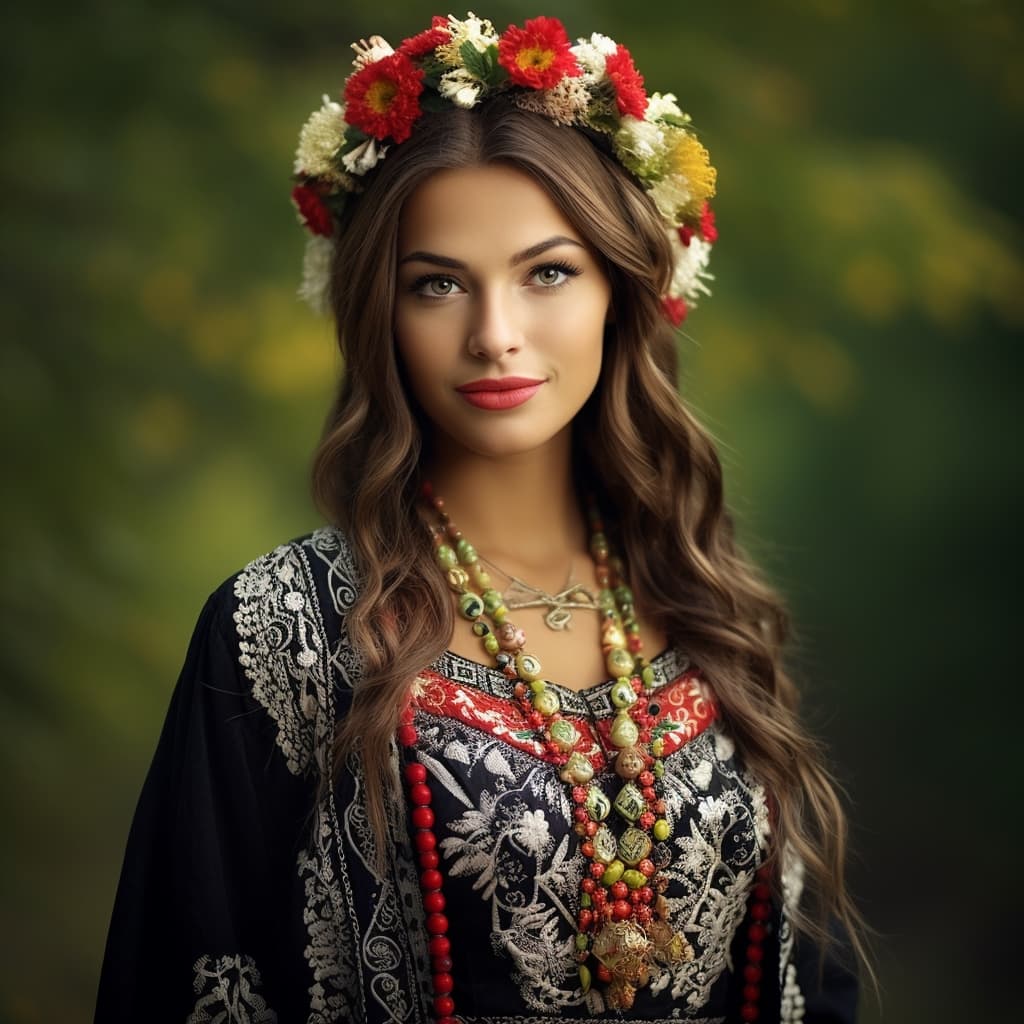
Romanians Erotic
Romania, Moldova
Indo-European / Romance / Romanian
Christianity / Eastern Orthodoxy
Significant populations in Italy, Germany, Spain, Ukraine, the United Kingdom, France, and the United States.
Eastern Europe
About Romanians People
Romanians are the eastern outlier of the Romance-speaking world — a Latin-language nation pressed up against Slavic, Magyar, and Turkic neighbors, separated from their linguistic cousins by roughly a thousand miles of non-Romance territory. Their language descends from the Latin carried into Dacia by Roman colonists after Trajan's conquest in the early second century, and its survival through more than a millennium of surrounding Slavic settlement is one of the genuine puzzles of European historical linguistics. Modern Romanian still keeps Latin grammatical features that French and Italian have shed, while absorbing a heavy Slavic vocabulary in religious, agricultural, and household terms. Listening to it, a Spaniard catches the bones; a Bulgarian catches the flesh.
The homeland sits across two countries — Romania proper and the Republic of Moldova, where the same language is spoken under a different state flag, a separation produced by nineteenth- and twentieth-century border-drawing rather than any cultural break. Inside Romania, the old historical regions still shape identity: Wallachia and Moldavia in the lowlands, Transylvania ringed by the Carpathians, plus Banat, Oltenia, Maramureș, and Dobruja, each with its own dialectal coloring, cuisine, and architectural habits. The Carpathian arc dominates everything — it is the spine of the country, the reason Transylvanian villages preserved older folk forms long after the plains modernized, and the reason wooden churches with their tall steepled roofs survive in the north as a recognized regional craft.
Eastern Orthodoxy is the dominant confession and is woven into the calendar more than into doctrine in everyday life: name days, fasts before Easter and Christmas, the blessing of houses at Epiphany, the elaborate funerary customs that anthropologists have spent careers documenting in Maramureș and the south. The Romanian Orthodox Church became autocephalous in 1885 and uses Romanian rather than Church Slavonic in liturgy — a switch made gradually from the seventeenth century onward and tied closely to the project of building a national literary language. Catholic and Greek-Catholic minorities exist mostly in Transylvania, a legacy of Habsburg rule.
The diaspora is recent and large. Free movement after EU accession in 2007 sent several million Romanians to Italy, Spain, Germany, and the UK for work, producing one of Europe's most significant internal migrations of the past two decades and reshaping village demography back home — a country where remittances and seasonal returns now structure ordinary life as much as anything happening in Bucharest.
Typical Romanians Phenotypes
Reference for AI generation — hair, eyes, skin, facial structure, build
Romanians sit at a phenotypic crossroads — Latin in language but Slavic, Balkan, and Central European in genetic substrate, with Roman, Dacian, Hungarian, German, Turkish, and Roma admixture layered across two thousand years. The result is a population that's recognizably Southeastern European but more variable than either its Balkan or its Slavic neighbors, with a clear north-south gradient across the Carpathians.
Hair runs predominantly medium to dark brown, often with chestnut or auburn warmth in sunlight; black hair is common but not dominant the way it is further south. Texture is most often straight to gently wavy, with looser waves more frequent than tight curl. Natural blonds appear in measurable numbers in Transylvania and Banat, reflecting Saxon and Hungarian heritage, while Moldavia and Wallachia trend darker. Greying often arrives early and silvers cleanly.
Eye color is unusually mixed for the latitude — brown predominates, but hazel, green, and blue together account for a substantial minority, with green particularly well represented in Transylvanian populations. Eyelids are uniformly Caucasian; no epicanthic fold. Eye shape tends almond, set under defined brow ridges and often quite expressive arched brows.
Skin sits mostly in Fitzpatrick II–III, with olive or warm-neutral undertones rather than the pink-toned pale of Northern Europe. Tans readily and evenly. Southern Romanians and those with Roma heritage shade into Type IV with darker olive cast.
Facial structure is typically angular: straight to slightly Roman noses with medium bridge height and moderate alar width, defined cheekbones, and strong jawlines — a look Nadia Comăneci made internationally legible. Lips are medium-full, usually well-defined rather than heavy. Foreheads tend high.
Build runs lean to athletic with above-average stature — Romanian men average around 175–178 cm, women around 162–165 cm. Frames are medium-boned, with shoulders proportionate to hips in men and a defined waist common in women. Gymnastic and dance traditions reflect a population that genuinely tends toward long-limbed, compact musculature rather than heavy or stocky builds.
Data depth
69/100Coverage of image-grounded phenotype observations · drives AI generation diversity
- Sample size
- 40/40· 89 images
- Image quality
- 19/30· 38% high
- Confidence
- 10/20· mean 0.66
- Source diversity
- 0/10· wikipedia
- ·Wikipedia-only source — not population-representative
Observed Distribution — Image Sample
Empirical observations from analyzed photographs · supplementary signal, not population truth
Sample: 89 images analyzed (89 wikipedia). Quality: 34 high, 35 medium, 16 low, 4 very_low. Avg analyzer confidence: 0.66.
Skin tone (Fitzpatrick): II (66%), III (28%), IV (1%), unclear (4%)
Hair color: gray/white (63%), black (28%), light/medium brown (3%), dark brown (2%), blonde (2%), brown (1%)
Hair texture: straight (64%), wavy (22%), curly (4%), bald (2%), shaved (2%), covered (3%), unclear (1%)
Eye color: dark brown (38%), blue (13%), brown (9%), hazel (7%), unclear (33%)
Epicanthic fold: 1% present, 96% absent, 3% unclear
Caveats: Sample is 100% Wikipedia notable people — skews toward male, public-life, and modern figures, not population-representative.
Last aggregated: May 7, 2026
Explore phenotype categories
Structured taxonomy with peer-reviewed scales · 22 anatomical categories
Notable Romanians People
100 reference figures — sourced from Wikipedia
- Alexander I the Good — 1375–1432), Domn of Moldavia (1400–1432)
- Basarab I the Founder — 1270–1352), first independent Domn of Wallachia (1310–1352)
- Michael the Brave — 1558–1601), Domn of Wallachia (1593–1601), Domn of Moldavia (1600) and de fac…
- Mircea I the Elder — 1355–1418), Domn of Wallachia (1386–1394, 1397–1418)
- Neagoe Basarab V — 1459–1521), Domn of Wallachia (1512–1521)
- Nicolaus Olahus — 1493–1568), Roman Catholic Archbishop of the Kingdom of Hungary
- Stephen III the Great — 1433–1504), Domn of Moldavia (1457–1504)
- Vlad II Dracul — before 1395–1447), Domn of Wallachia (1436–1442, 1443–1447)
- Vlad III the Impaler — 1431–1477), Domn of Wallachia (1448, 1456–1462, 1476–1477)
- Dimitrie Cantemir — ruler of Moldavia, historian, writer, and music composer
- Antioch Kantemir — poet and Russian ambassador
- Constantin Brancoveanu — Prince of Wallachia (1688–1714)
- Ion Antonescu — Prime Minister and Conducător (Leader) during World War II
- Alexandru Averescu — general and politician
- Nicolae Bălcescu — historian, revolutionary
- Antoine Bibesco — diplomat, writer
- Gheorghe Grigore Cantacuzino — Prime Minister during the 1907 Romanian Peasants' revolt
- Corneliu Codreanu — founder and charismatic leader of the Iron Guard
- Constantin Cristescu — general, Chief of Staff
- Barbu Ștefănescu Delavrancea — former mayor of Bucharest
- Octavian Goga — writer, former Prime Minister
- Avram Iancu — revolutionary in 1848 Revolution
- Take Ionescu — Prime Minister in interbellum Romania
- Mugur Isărescu — economist and member of the Club of Rome, former Prime Minister
- Mihail Lascăr — World War II general, Minister of Defense
- Mihail Manoilescu — economist and Foreign Minister
- Alexandru Marghiloman — Prime Minister during World War I
- Gheorghe G. Mironescu — Prime Minister in interbellum Romania
- Constantin Prezan — general in World War I, Marshal of Romania
- Nicolae Rădescu — Prime Minister during World War II
- Ecaterina Teodoroiu — soldier and heroine during World War I
- Emil Constantinescu — former President of Romania
- Corneliu Coposu — politician, National Peasants' Party
- Doina Cornea — noted dissident and intellectual, National Peasants' Party
- Iuliu Maniu — politician, one of the creators of the National Peasants' Party
- Ion Mihalache — politician, National Peasants' Party
- Ion Rațiu — politician, National Peasants' Party
- Alexandru Vaida-Voevod — politician, Prime Minister of Romania, National Peasants' Party
- Radu Vasile — economist and politician, former Prime Minister
- Dinu Brătianu — president of the National Liberal Party, arrested and imprisoned without tria…
- Ion C. Brătianu — Prime Minister of Romania
- Ion I. C. Brătianu — politician, one of the founders of the Liberal movement in Romania, Prime Min…
- Vintilă Brătianu — politician, Prime Minister of Romania, son of Ion C. Brătianu
- Ion G. Duca — Prime Minister, assassinated by Iron Guard
- Ion Ghica — mathematician, diplomat, Prime Minister
- Mihail Kogălniceanu — lawyer, historian, publicist, Prime Minister, Minister of Foreign Affairs, Mi…
- C. A. Rosetti — publicist, Mayor of Bucharest
- Dimitrie Sturdza — president of the National Liberal Party and president of the Romanian Academy
- Crin Antonescu — former leader of the party (2009–2014)
- Radu Câmpeanu — first leader of the party after the 1989 revolution
- Neagu Djuvara — former historian
- Eduard Hellvig — former director of the Romanian Intelligence Service
- Klaus Iohannis — former President of Romania (2014-2025), former leader of the party (2014)
- Mircea Ionescu-Quintus — leader of the party (1993–2001)
- Nicolae Manolescu — literary critic
- Siegfried Mureșan — MEP and current spokesman of the European People's Party (EPP)
- Călin Popescu-Tăriceanu — former Prime Minister, former leader of the party (2004–2009)
- Cătălin Predoiu — lawyer, former Justice Minister
- Theodor Stolojan — former Prime Minister, leader of the party (2002–2004)
- Mihai Răzvan Ungureanu — former Minister of Foreign Affairs (2004–2007), former head of Romanian Forei…
- Renate Weber — former lawyer, former MEP, currently Romanian Ombudsman
- Gheorghe Apostol — General Secretary
- Elena Ceaușescu — wife of Nicolae Ceaușescu
- Nicolae Ceaușescu — General Secretary
- Gheorghe Gheorghiu-Dej — General Secretary and Prime Minister
- Petru Groza — Prime Minister
- Manea Mănescu — Prime Minister
- Ion Gheorghe Maurer — Prime Minister
- Teodor Baconschi — former Foreign Affairs Minister
- Traian Băsescu — former President of Romania and president of the Democratic Liberal Party
- Emil Boc — former Prime Minister and president of the Democratic Liberal Party
- Vasile Blaga — former Internal Affairs Minister and president of the Democratic Liberal Party
- Daniel Funeriu — former Education Minister
- Monica Macovei — former Justice Minister
- Theodor Paleologu — former Culture Minister
- Ana Birchall — current Justice Minister
- Titus Corlățean — former Foreign Affairs Minister
- Cristian Diaconescu — former Foreign Affairs Minister
- Mircea Geoană — former Foreign Minister, former president of the Social Democratic Party and …
- Ion Iliescu — former President of Romania, former president of the Social Democratic Party
- Adrian Năstase — former Prime Minister, former president of the Social Democratic Party
- Victor Ponta — former Prime Minister, former president of the Social Democratic Party
- Adrian Cioroianu — historian
- Alexandru Paleologu — essayist and literary critic
- Vasile Pușcaș — historian
- Nicolae Titulescu — professor of law and former President of the General Assembly of the League o…
- Iris Barbura — dancer and choreographer
- Alina Cojocaru — ballerina
- Eugenia Popescu-Județ — ballerina, dance teacher, choreographer, manuscript specialist
- Ioana Ciolacu — awarded fashion designer
- Vasile Alecsandri — poet and playwright
- Lucian Blaga — philosopher, poet, playwright
- Andrei Codrescu — poet and essayist
- Nichita Danilov — poet, essayist, novelist
- Nae Ionescu — philosopher, writer, logician
- Virgil Nemoianu — essayist, literary critic, philosopher of culture
- Horia-Roman Patapievici — writer, philosopher, essayist
- Bogdan Petriceicu-Hasdeu — philologist, linguist
- Ion Pillat — poet, publicist, academic
- Andrei Pleșu — writer, philosopher, essayist, journalist






Generate Romanians AI Content
Use this ethnicity's phenotype data to create AI-generated content with accurate physical traits and cultural context.
Open Creator Studio