Mordvins Erotic
Mordovia (Russia)
Uralic / Mordvinic
Christianity / Eastern Orthodoxy
Erzyas, Mokshas, Qaratays, Teryukhans, Tengushev, Shoksha
Eastern Europe
About Mordvins People
The Mordvins are one of the older indigenous peoples of the middle Volga, and the first thing to know about them is that "Mordvin" is largely an outsider's label. The people themselves divide cleanly into two: the Erzyas in the north and east, and the Mokshas in the south and west. They speak related but mutually difficult Uralic languages — close enough that linguists group them as Mordvinic, far enough apart that an Erzya and a Moksha will usually fall back on Russian. Smaller branches like the Qaratays, Teryukhans, Tengushev and Shoksha sit on the edges of this divide, often Tatar-influenced or partly Russified, and their existence is a useful corrective to the official two-nation story preferred by Soviet ethnographers.
Their homeland is the wooded belt between the Oka and the Volga, today centered on the Republic of Mordovia, but historically the Mordvin range stretched much wider before Slavic settlement compressed it. They were tribute-payers to the Volga Bulgars, then to the Mongols, then absorbed into Muscovy in the sixteenth century — and that absorption is the inflection point that shapes everything afterward. Mass conversion to Eastern Orthodoxy followed, sometimes through missions, sometimes through the more direct pressure of taxation and military service. By the eighteenth century the older Mordvin religion — a sky-and-ancestor system with a substantial pantheon of household and forest spirits, presided over by women who led communal prayers called ozkst — had been pushed underground or grafted onto Christian feast days, where some of it still lingers.
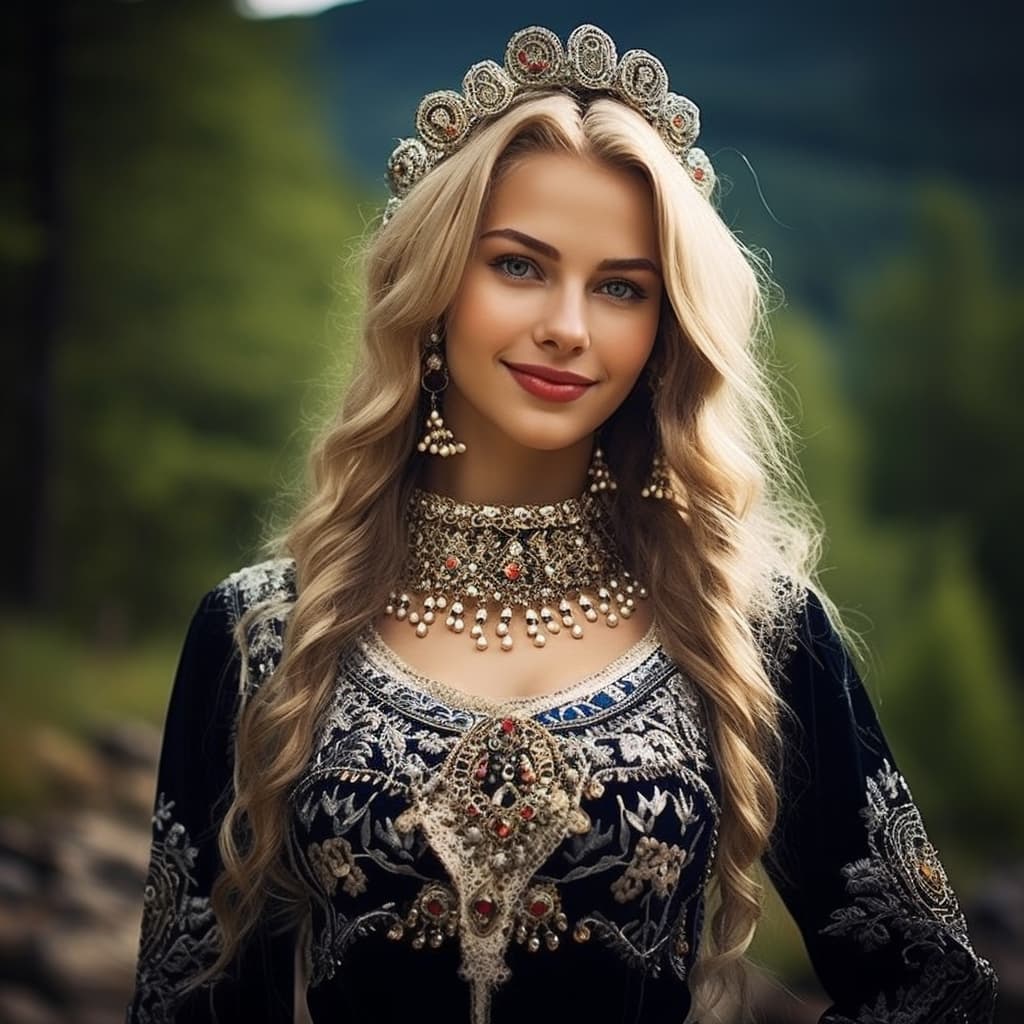
What makes the Mordvins distinctive on the ground, rather than on the page, is a particular relationship to dress and song. Erzya and Moksha women's costumes, heavy with embroidered chest panels, coin breastplates and elaborate belted backpieces, are among the most ornamented in northern Eurasia, and the polyphonic choral singing that goes with them has survived collectivization, urbanization and demographic decline well enough to still anchor village identity. That decline is real: Mordvins are an aging, scattered people, with more of them living outside Mordovia than inside it, and intermarriage with Russians has been the norm for generations. The group persists less as a contiguous nation than as a patchwork of villages, family memory, and an Erzya-Moksha distinction that two centuries of pressure to merge have not erased.
Typical Mordvins Phenotypes
Reference for AI generation — hair, eyes, skin, facial structure, build
The Mordvins occupy a phenotypic position that throws people off — Uralic-speaking by language, but visually closer to the East Slavic and Volga-Finnic populations they've lived alongside for centuries than to their distant Siberian linguistic cousins. The Mongoloid admixture sometimes assumed from the language family is largely absent. What you get instead is a Northeastern European phenotype with subtle Finno-Ugric markers — broader faces, slightly more pronounced cheekbones, and a higher incidence of light eyes than even neighboring Russians.
Hair runs blond to medium brown, with ash and dark-blond shades dominating; pure black is uncommon and red appears at low but noticeable frequency. Texture is overwhelmingly straight to softly wavy, fine to medium in thickness. Eyes skew light — blue and grey are common, hazel and green appear regularly, and brown is the minority rather than the default. The eye opening is typically wide and almond-to-round; epicanthic folds are essentially absent, which separates Mordvins visually from Volga Tatars and the more eastern Finno-Ugric peoples.
Skin is Fitzpatrick II–III for most, with cool pink or neutral undertones; a Fitzpatrick I subset with very fair, freckle-prone skin is well represented, especially among Erzyas. Faces tend toward the broad and slightly flattened — moderate-width nose with a straight or faintly low bridge, medium alar width, lips of medium fullness rather than thin or full, and a square-to-round jaw. Cheekbones sit higher and wider than in classic East Slavic faces, giving a slightly squared midface.
Build is medium-tall — men commonly 173–180 cm, women 162–168 cm — with sturdy, broad-shouldered proportions and a tendency toward solid rather than slender body composition. Among the sub-groups, Erzyas tend to be the lightest in coloring — the tallest, fairest, and bluest-eyed branch — while Mokshas trend slightly shorter and darker-haired, and the Russified Teryukhans and Qaratays are now visually indistinguishable from their Russian or Tatar neighbors.
Data depth
0/100Coverage of image-grounded phenotype observations · drives AI generation diversity
- Sample size
- 0/40· 0 images
- Image quality
- 0/30· 0% high
- Confidence
- 0/20
- Source diversity
- 0/10
- ·No image observations yet
Explore phenotype categories
Structured taxonomy with peer-reviewed scales · 22 anatomical categories
Notable Mordvins People
23 reference figures — sourced from Wikipedia
- Erzya people — the Erzya people or Erzyans, (Erzya: Эрзят/Erzyat), speakers of the Erzya lan…
- Moksha people — the Moksha people or Mokshans, (Moksha: Мокшет/Mokshet), speakers of the Moks…
- Shoksha — the Shoksha or Tengushevo Mordvins constitute a transitional group between th…
- Qaratays — the Karatai Mordvins or Qaratays live in the Republic of Tatarstan. They no l…
- Nizhny Novgorod — the Teryukhan Mordvins live near Nizhny Novgorod had been completely Russifie…
- Meshcheryaks — The Meshcheryaks are believed to be Mordvins who have converted to Russian Or…
- Mishars — The Mishars are believed to be Mordvins who came under Tatar influence and ad…
- Alyona Erzymasskaya — died 1670), 17th-century Erzyan female military leader, the heroine of civil …
- Stepan Erzya — Stepan Nefedov) (1876–1959), sculptor[citation needed]
- Fyodor Vidyayev — 1912-1943), World War II submarine commander and war hero[citation needed]
- Aleksandr Sharonov — born 1942), philologist, poet, writer[citation needed]
- Kuzma Alekseyev — leader of Teryukhan unrest in 1806-1810 [citation needed]
- Vasily Chapayev — 1887–1919), a Russian soldier and Red Army commander
- Nadezhda Kadysheva — born 1959) singer
- Mikhail Devyatayev — 1917–2002), a Soviet fighter pilot, escaped from a Nazi concentration camp [c…
- Andrey Kizhevatov — 1907–1941), a Soviet border guard commander, a leader of the Defence of Brest…
- Oleg Maskaev — born 1969), Russian former boxer
- Vasily Shukshin — 1929–1974), Soviet writer and actor.
- Abercromby, John — 1898). Pre- and Proto-historic Finns. D. Nutt.
- ISBN — Fournet, Arnaud (6 January 2011), Le moksha, une langue ouralienne: Présentat…
- Devyatkina, Tatiana — . Mythology of Mordvins: Encyclopaedia. Saransk, 2007. (Russian: Девяткина Т.…
- Petrukhin, Vladimir — . Mordvins Mythology // Myths of Finno-Ugric Peoples. Moscow, 2005. p. 292 - …
- doi — Akchurin, Maksum; Isheev, Mullanur (2017), "Temnikov: The Town of a Tümen Com…
Generate Mordvins AI Content
Use this ethnicity's phenotype data to create AI-generated content with accurate physical traits and cultural context.
Open Creator Studio