Mari Erotic
Mari El (Russia)
Uralic / Mari
Christianity / Eastern Orthodoxy
Meadow Mari, Hill Mari, Eastern Mari, Mountain Mari
Eastern Europe
About Mari People
The Mari are one of the last peoples of Europe whose pre-Christian religion never fully went underground. They live mostly along the middle Volga, in the republic of Mari El and the surrounding oblasts, in a landscape of mixed forest and river meadow that has shaped both their economy and their cosmology. Their language belongs to the Uralic family — distant cousins to Finnish, Estonian and Hungarian, much closer kin to the neighboring Mordvin and Udmurt tongues — and it splits along geography into Meadow Mari spoken on the low east bank of the Volga, Hill Mari on the higher west bank, and Eastern Mari among communities that migrated further east into Bashkortostan during the Russian colonization of the seventeenth and eighteenth centuries. The two main literary standards, Meadow and Hill, are close enough to be mutually intelligible with effort but far enough apart that each maintains its own newspapers, schoolbooks and orthography.
Officially the Mari are Eastern Orthodox; nominal Christianization came in waves under Ivan IV and his successors after the fall of Kazan in 1552, and the Russian state pushed harder from the eighteenth century onward. What survived alongside the church, and in many villages survived more vigorously than the church, is a polytheistic tradition organized around sacred groves — stands of old trees set apart from cultivation, where priests called karts conduct seasonal sacrifices of geese, sheep or horses to a hierarchy of deities under the sky god Yumo. Anthropologists working in the region in the late Soviet and post-Soviet decades have documented hundreds of these groves still in active use. Many Mari describe themselves as both Orthodox and adherents of the old faith without seeing a contradiction, and a formally registered traditional religion now coexists with the church in Mari El. The Eastern Mari diaspora, more isolated from Russian ecclesiastical pressure, often kept the old observances most intact.
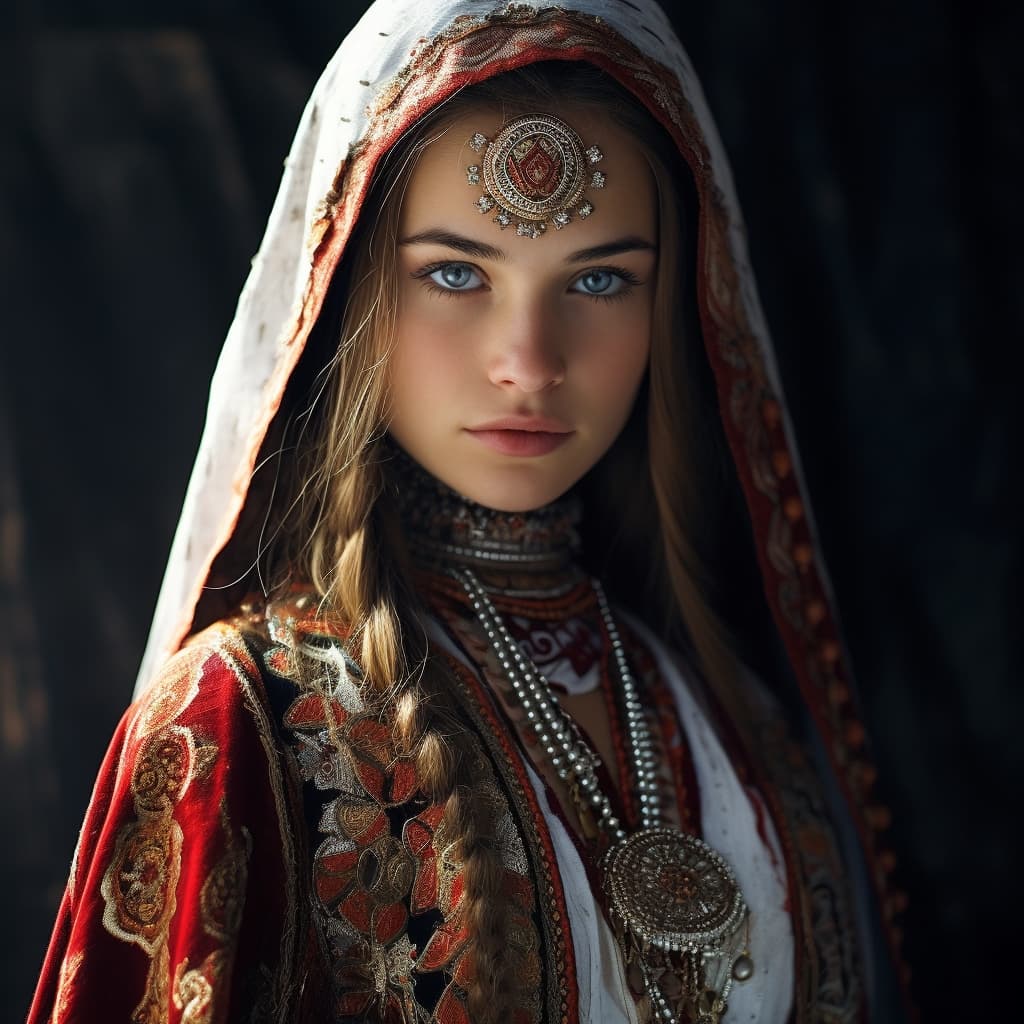
Daily Mari culture leans toward the agrarian and the textile-rich: embroidery in deep reds and blacks on white linen, silver coin ornaments worn on women's headdresses, and a vocal tradition in which lyric songs and laments carry an unusually heavy share of the cultural memory. Beekeeping, once central enough to figure in ritual, remains widespread. The community is small — under half a million speakers by recent counts, with the language under steady pressure from Russian — but the Mari have been notably stubborn about staying themselves.
Typical Mari Phenotypes
Reference for AI generation — hair, eyes, skin, facial structure, build
The Mari sit at a phenotypic seam between Volga Finnic and Tatar-Bashkir Central Asia, and the population shows it. The dominant impression is a fair-skinned Eastern European base layered with subtle Uralic features — a slight flattening of the midface, a low nasal bridge in a meaningful minority, and occasionally a faint epicanthic crease that thins out by adulthood in most individuals but persists into adulthood in roughly 10–15% of speakers, particularly among Eastern Mari with deeper Turkic admixture.
Hair runs medium to dark blond through ash brown and chestnut, with true black uncommon and red shades rare but documented. Texture is overwhelmingly straight to gently wavy; coarse hair is the norm, and grey arrives later than in most European populations. Eyes are most often grey, grey-blue, or hazel-green; clear pale blue is less frequent than among neighboring Russians, and dark brown eyes correlate with the eastern branches. The eye shape tends toward narrow and slightly downturned, set under low, often sparse brows.
Skin sits at Fitzpatrick II–III with cool-neutral undertones — pinkish in winter, taking a light gold tan rather than reddening. Faces are broad and short rather than long. The nose is usually small to medium with a straight or slightly concave bridge and a rounded, low-set tip; aquiline noses are uncommon. Lips are moderate, neither thin nor full, and the jaw is typically rounded with strong but not prominent zygomatic bones — a softer cheekbone signature than Mongolic populations.
Build is compact and sturdy. Men average around 172–175 cm, women 160–162 cm, with broad shoulders, short limbs relative to torso, and a tendency toward muscular density rather than lean length — a physique visible in athletes like Oleg Taktarov and Vyacheslav Bykov. Hill and Mountain Mari trend slightly fairer and finer-featured; Meadow and Eastern Mari read broader-faced, with darker hair and more frequent epicanthic traces.
Data depth
56/100Coverage of image-grounded phenotype observations · drives AI generation diversity
- Sample size
- 6/40· 2 images
- Image quality
- 30/30· 100% high
- Confidence
- 20/20· mean 0.85
- Source diversity
- 0/10· wikipedia
- ·No image observations yet
- ·Wikipedia-only source — not population-representative
Explore phenotype categories
Structured taxonomy with peer-reviewed scales · 22 anatomical categories
Notable Mari People
4 reference figures — sourced from Wikipedia
- Grigoriy Andreyev — marathon runner
- Andrei Andreyevich Eshpai — film director, screenwriter and producer
- Vyacheslav Bykov — former professional ice hockey player and a former head coach of the Russian …
- Oleg Taktarov — actor and retired mixed martial artist. He was a practitioner of Sambo and Judo



Generate Mari AI Content
Use this ethnicity's phenotype data to create AI-generated content with accurate physical traits and cultural context.
Open Creator Studio