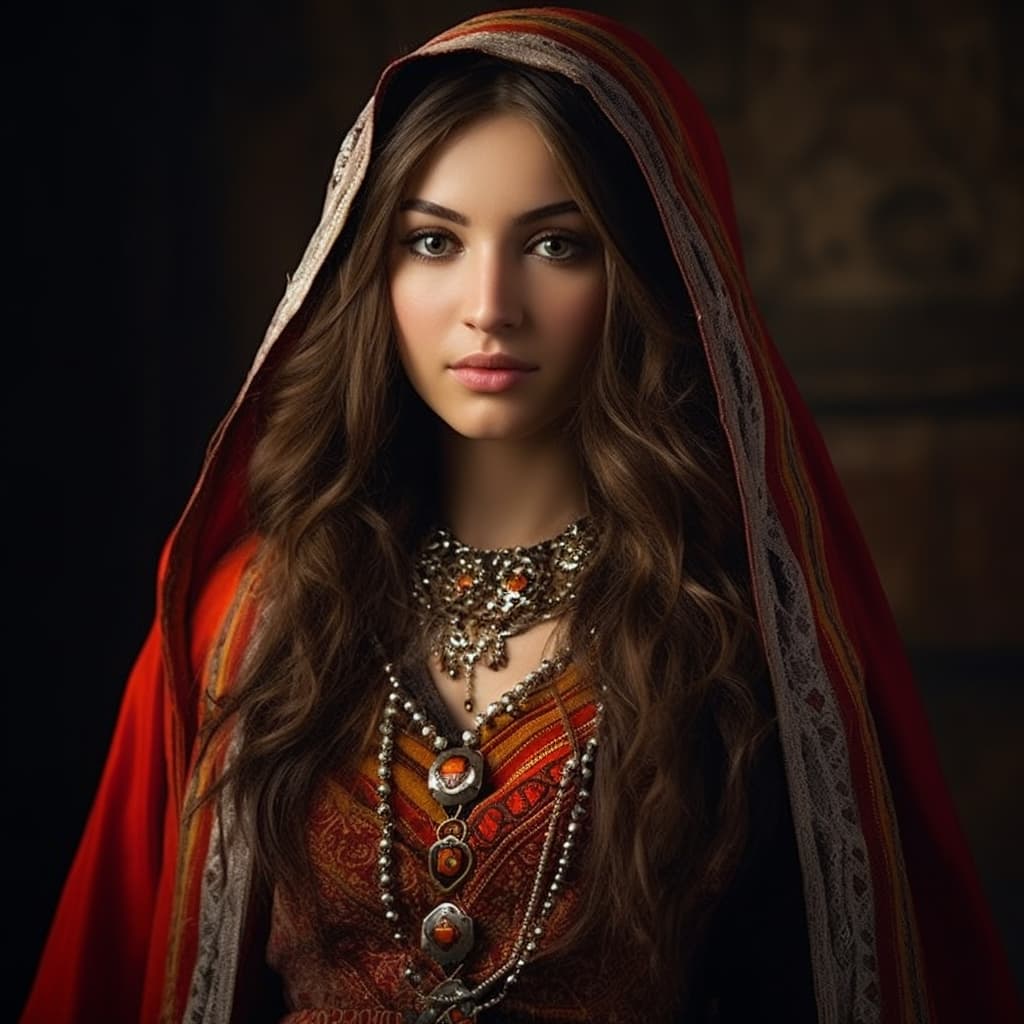
Lezgins Erotic
Lezgistan (Russia, Azerbaijan)
Northeast Caucasian / Lezgic / Lezgian
Islam / Sunni Islam
Aghuls, Archin, Budukhs, Jeks, Kryts, Rutuls, Tabasarans, Tsakhurs
Eastern Europe
About Lezgins People
The Lezgins are a Northeast Caucasian people split across a political line that does not match the geographic one. Their heartland straddles the southern slopes of the Greater Caucasus and the dry plain that runs down to the Caspian — the northern half sits in the Russian republic of Dagestan, the southern half in Azerbaijan. The Samur River, which marks the modern border between the two states, cuts through the middle of historic Lezgin territory, leaving villages with relatives, pastures, and graveyards on the wrong side of a customs post. The displacement is recent enough to still feel raw in cultural memory; it is the central political fact of Lezgin life since 1991.
Lezgian belongs to the Lezgic branch of Northeast Caucasian, one of the small, dense language families for which the Caucasus is famous — unrelated to Turkic Azerbaijani or Indo-European Russian, the two languages that surround it. The branch is unusually crowded. Aghul, Tabasaran, Rutul, Tsakhur, Archi, Budukh, Kryts, Jek and several others are all close cousins, each spoken by a few thousand to a few tens of thousands of people, often in a single valley or cluster of villages. Soviet ethnography sometimes counted these as Lezgin sub-groups and sometimes as separate nationalities; the classification was political as much as linguistic, and locals do not always agree with either version.
Lezgins are Sunni Muslims, with a few Shia communities in the southern villages closer to Azerbaijan. The Islam is old — converted in waves between the eighth and fifteenth centuries — and layered over an older substrate of mountain custom that still governs much of daily ethics. Adat, the unwritten code of village law, regulates inheritance, hospitality, blood-feud and reconciliation, often in parallel with sharia and Russian or Azerbaijani civil law. Hospitality in particular is treated less as a virtue than as a non-negotiable obligation: a guest, including an enemy, is owed shelter and protection for the duration of a stay.
The most internationally visible piece of Lezgin culture is the lezginka, the fast partnered dance with the man circling on his toes and the woman gliding — adopted across the Caucasus and into the Russian and Cossack repertoires, but Lezgin in origin and name. Beyond it, the cultural signatures are quieter: terraced highland agriculture, fine carpet and silver work from the Tabasaran and Kubachi traditions in the broader regional cluster, and a literary language that has been written in Arabic, Latin and now Cyrillic script within a single century.
Typical Lezgins Phenotypes
Reference for AI generation — hair, eyes, skin, facial structure, build
Lezgins sit phenotypically at the eastern end of the Caucasus cluster, sharing the broad signature of Northeast Caucasian peoples but trending darker and more Near Eastern–leaning than their northern neighbors. The dominant impression is high-relief bone structure on a medium-tall, robust frame — the kind of build that has produced a disproportionate number of elite freestyle wrestlers like Dauren Kurugliev and combat-sport competitors like Ikram Aliskerov.
Hair runs dark by default: deep brown to near-black, with chestnut and dark-ash variants more common in mountain villages of the Samur basin. Texture is typically straight to loosely wavy and dense; thick, heavy beard growth in men is near-universal, and unibrow tendency is notable. Eyes skew brown — from light hazel through to almost-black — but green and grey eyes appear with real frequency in the highland sub-groups (Rutuls, Tsakhurs, Kryts, Budukhs), a recessive band that surfaces across the eastern Caucasus. No epicanthic fold; the eye is typically deep-set under a strong, often continuous brow ridge, with thick lashes and a slight downward outer canthal tilt in many.
Skin tone clusters in Fitzpatrick III–IV — olive to light-olive with warm, slightly golden undertones — tanning readily and rarely burning. Pale Type II skin appears among some highland Lezgians and the smaller Shahdagh-area peoples (Kryts, Jeks, Budukhs), who have lived in relative genetic isolation at altitude.
The face is the group's structural signature: long, narrow skull with a high, prominent nose — straight or convex, often with a defined dorsal hump and a narrow alar base. Cheekbones are high but not flared wide as in Turkic populations; the jawline is angular and the chin firm. Lips are medium, neither thin nor full. Build is mesomorphic and broad-shouldered, with men commonly 175–183 cm and dense musculature; women tend toward an hourglass silhouette with defined waists. The Tabasarans run slightly shorter and rounder-faced; the Rutuls and Tsakhurs are the tallest and most angular of the branches.
Data depth
0/100Coverage of image-grounded phenotype observations · drives AI generation diversity
- Sample size
- 0/40· 0 images
- Image quality
- 0/30· 0% high
- Confidence
- 0/20
- Source diversity
- 0/10
- ·No image observations yet
Explore phenotype categories
Structured taxonomy with peer-reviewed scales · 22 anatomical categories
Notable Lezgins People
27 reference figures — sourced from Wikipedia
- Muhammad Yarguvi — founder of Muridism)
- Caucasian Albania — Ancient Caucasian Albania Lekos Legae Medieval Mongol invasion of Lekia Kura …
- Lezgin — and Lezgic
- Safi Khan Lezgi — Lezgin nobleman and official in the Safavid Empire, governor of Erivan Provin…
- Fath-Ali Khan Daghestani — Lezgin nobleman who served as the Grand Vizier of the Safavid Shah Soltan Hos…
- Haji Davud Mushkurvi — Lezgin imam was a prominent 18th-century Lezgin military-religious leader, Su…
- Sheikh Muhammad Yarguvi — was a Lezgin imam, founder of Muridism in the Caucasus and teacher of all ima…
- Khas Muhammad Huluhvi — Lezgin imam and military leader during the Russo-Caucasian War. Leader of the…
- Ali Hilivi — Lezgin abrek of the uprisings in Quba in 1837–1839.
- Mushab-Ali Kuzunvi — Lezgin imam and military leader, Leader of the uprisings in Qusar in 1930.
- Haddam Chakarvi — [lez], Lezgin abrek of the uprisings in Quba in 1930
- Gazi Muhammad Shtulvi — Lezgin imam and military leader, Leader of the uprisings in Shtul in 1930.
- Abdullah Kirivi — [ru], legendary Lezgin folk hero and abrek
- Mahmud Shtulvi — [lez], Lezgin abrek
- Hero of the Soviet Union — Erzi (Araz) Kazimagomedovich Aliyev, Red army sniper, Hero of the Soviet Union
- Selimgerey (Sergey) Alimovich Melikov — Head of the Dagestan Republic
- Suleyman Kerimov — Lezgin entrepreneur and businessman
- Sayfuddin Rustamov — Lezgin entrepreneur and businessman
- Serder Serderov — former professional footballer
- Magomed Kurugliyev — freestyle wrestler who competed in the 1996 Summer Olympics, in the 2000 Summ…
- Dauren Kurugliev — freestyle wrestler, 3x European champion and a 2024 Olympic bronze medalist.
- Shamil Mamedov — freestyle wrestler who wrestles in the 65 kg category on the international ci…
- Khabib Allakhverdiev — professional boxer
- Ikram Aliskerov — currently competing in the UFC
- Ismail Gadzhibekov — weightlifter, 4x champion and two-time silver medalist of the Russian Champio…
- Sayfullah Kurahvi — writer and poet
- Suleyman Stalvi — poet. Russian writer Maxim Gorky described him as "Homer of 20th century".
Generate Lezgins AI Content
Use this ethnicity's phenotype data to create AI-generated content with accurate physical traits and cultural context.
Open Creator Studio