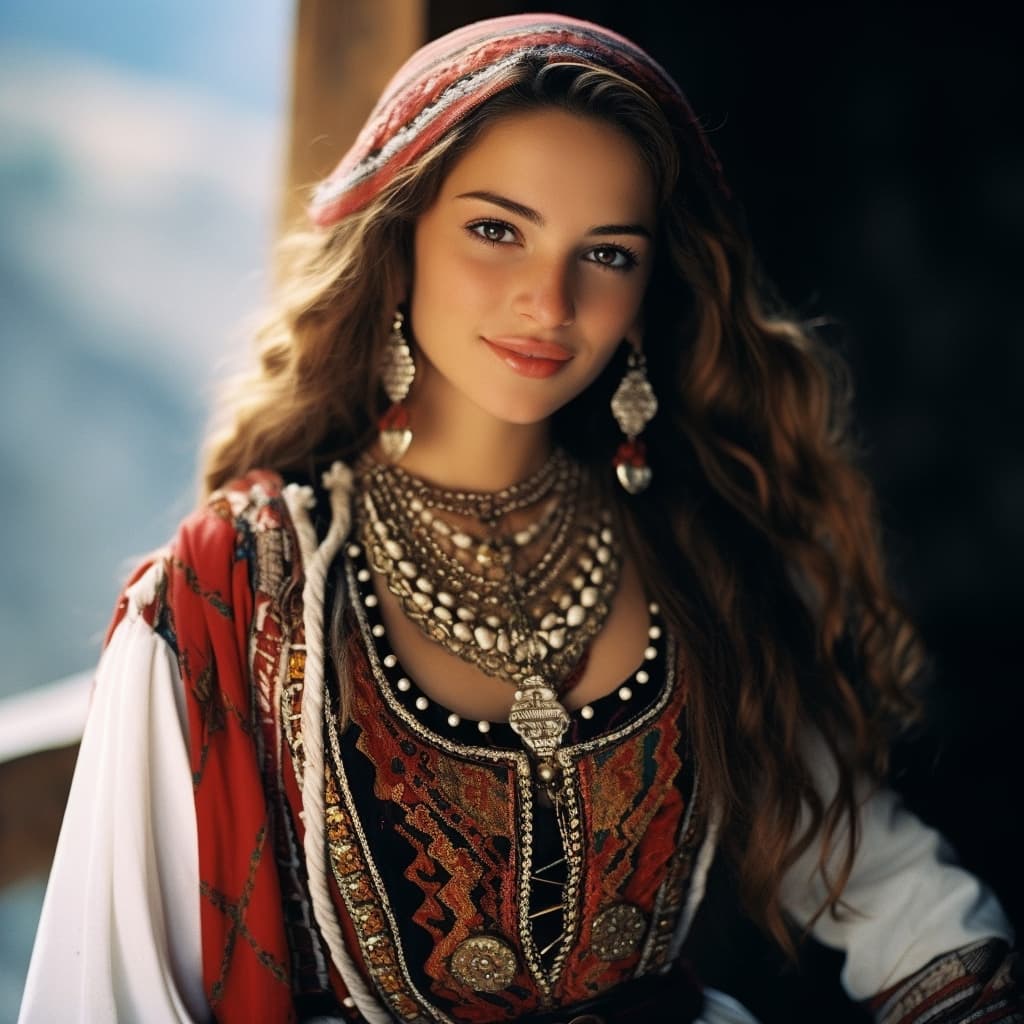
Laz Erotic
Lazistan (Turkey, Georgia)
Kartvelian / Laz
Islam / Sunni Islam
Turkish Laz, Georgian Laz
Eastern Europe
About Laz People
The Laz are a Black Sea people, concentrated along the narrow strip of coast where Turkey's Pontic mountains drop into the water and where, on the Georgian side, the same coast continues toward Batumi. That geography is most of the story. The land between mountain and sea is steep, wet, and short on flat ground, so Laz villages climb the slopes in terraces and the economy has long been built around what the climate allows — tea, hazelnuts, corn, anchovies pulled out of the Black Sea in winter. The men have a centuries-old reputation as sailors and shipbuilders, and a more recent one as Turkey's stereotypical truck drivers and bakers; jokes about Laz cunning and Laz directness circulate in Turkish humor the way Newfoundlander jokes do in Canada.
Linguistically the Laz are a surprise. Their language is Kartvelian — the same small, ancient family as Georgian, Mingrelian, and Svan — which means that despite five centuries inside the Ottoman and then Turkish state, the Laz are not a Turkic people at all. Laz is closest to Mingrelian, spoken just across the border, and the two are sometimes treated as branches of a single Zan tongue. It survives mostly at home and in song; it has never been a language of school instruction in Turkey, and a written standard has only emerged informally in the last few decades, pushed by musicians, poets, and a small revivalist press. Most younger Laz are more fluent in Turkish than in their grandparents' tongue.
The community is overwhelmingly Sunni Muslim, converted gradually after the Ottoman conquest of Trabzon in 1461, with the shift largely complete by the seventeenth and eighteenth centuries. Islam is woven into village life without much of the public religiosity found further inland — Laz religiosity tends to be quiet, the mosque a fixture but not the center of identity. The split between the Turkish Laz, who form the great majority, and the much smaller Georgian Laz around Batumi reflects the 1878 redrawing of the border after the Russo-Turkish War; the latter group is largely Orthodox Christian, having stayed within the Russian and then Soviet sphere. What still binds the two sides is the language, the food — muhlama, a cornmeal-and-cheese dish eaten with a spoon — the polyphonic singing, and a stubborn sense of being neither Turkish nor Georgian but something older that the modern map has cut in half.
Typical Laz Phenotypes
Reference for AI generation — hair, eyes, skin, facial structure, build
The Laz sit at the eastern Black Sea coast where the Pontic Mountains meet the Caucasus, and their phenotype reflects that crossroads — a Caucasian substrate with strong Anatolian and Pontic Greek admixture rather than the Turkic stock dominant further inland. The look reads as Caucasian-Mediterranean more than Turkish: pale to lightly olive skin, sharp features, and unusually high frequencies of light pigmentation for a population at this longitude.
Hair runs dark brown to near-black for the majority, with chestnut and auburn shades appearing more often than in surrounding Anatolian populations — a Pontic-Caucasian signature. Genuine blonds are uncommon but present, particularly among children who darken with age. Texture is typically straight to loosely wavy, fine to medium thickness, with body hair density on the heavier end of the European range. Beard growth in men is full, often coarse, and tends to come in darker than scalp hair.
Eye color skews brown but with a notable minority — perhaps a quarter — showing hazel, green, or grey-blue, especially in the Rize and Artvin highlands. Eyelids are deep-set and almond-shaped with no epicanthic fold; brows are heavy and often grow toward the midline. Skin sits in Fitzpatrick II–III, pale-rose to warm olive, with cheeks that flush easily in the cold, wet coastal climate.
Facial structure is the clearest tell: a long, straight or convex nose with a narrow bridge and modest alar width, a strong angular jaw, and high but not flared cheekbones. Lips are medium, with the upper lip often thinner than the lower. Build tends to be medium-tall and rangy in the mountains — men commonly 175–180 cm — with broad shoulders and lean musculature shaped by terraced tea-farming work; coastal Laz trend slightly shorter and stockier.
Turkish Laz and Georgian (Adjarian) Laz are visually near-identical; the Georgian branch shows marginally higher rates of light eyes and lighter hair, consistent with their deeper Kartvelian continuity.
Data depth
0/100Coverage of image-grounded phenotype observations · drives AI generation diversity
- Sample size
- 0/40· 0 images
- Image quality
- 0/30· 0% high
- Confidence
- 0/20
- Source diversity
- 0/10
- ·No image observations yet
Explore phenotype categories
Structured taxonomy with peer-reviewed scales · 22 anatomical categories
Notable Laz People
12 reference figures — sourced from Wikipedia
- Christianity — Eparchy of Batumi and Lazeti
- Jibistasi — Churches: Jibistasi, Noghedi, Pironity
- Ottoman rule — Hellenization
- Pontic Greeks — possibly)
- Gümüşhane — The residents of the northwestern portion of the Gümüşhane are viewed as Laz …
- Posof — The residents of Posof are named as Laz by neighboring communities.
- Van — The Pontic Greek-speakers from the villages of Emek and Dönerdere in Van are …
- Adjara — region in Georgia
- Artvin — province in Turkey
- Rize — province in Turkey
- Trabzon — province in Turkey
- Bedi Kartlisa — Bryer, Anthony. 1969. "The last Laz risings and the downfall of the Pontic De…




Generate Laz AI Content
Use this ethnicity's phenotype data to create AI-generated content with accurate physical traits and cultural context.
Open Creator Studio