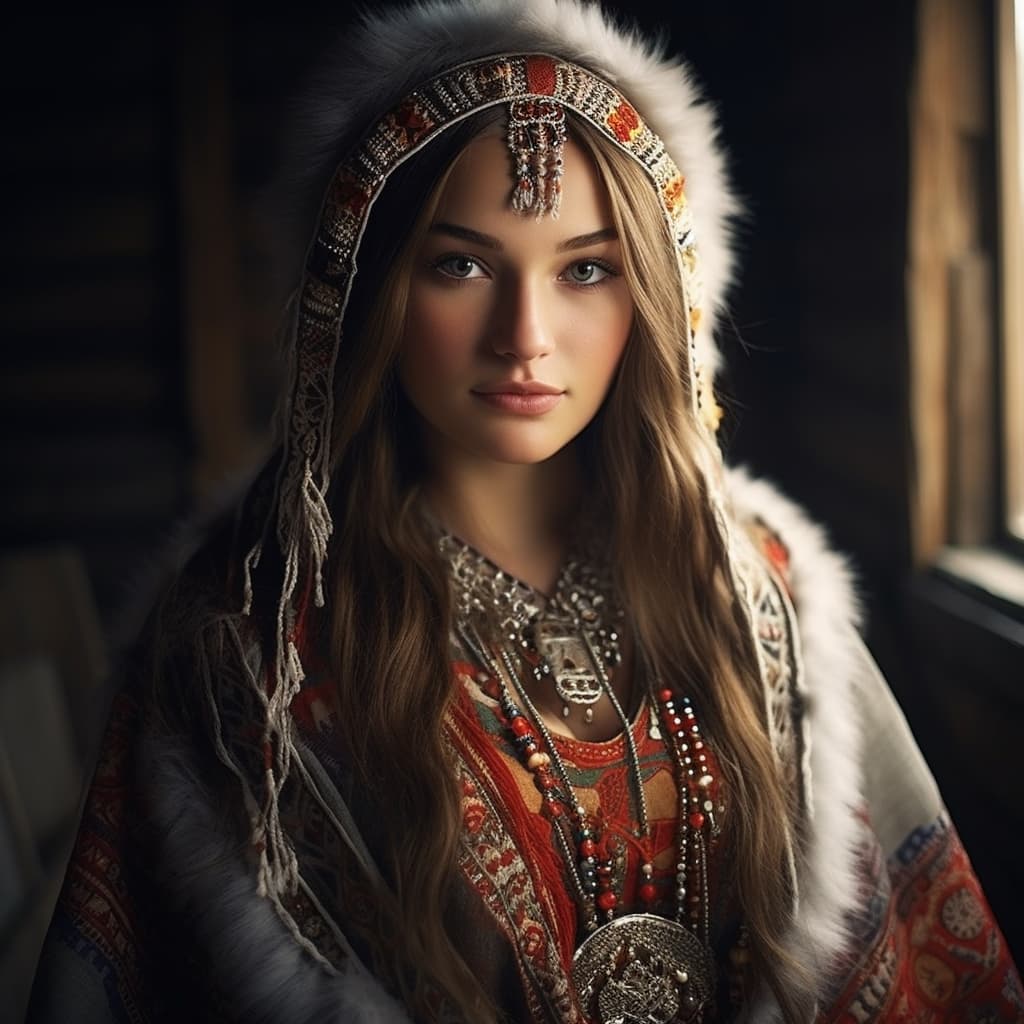
Laks Erotic
Lakia (Russia)
Northeast Caucasian / Lak
Islam / Sunni Islam
Eastern Europe
About Laks People
The Laks occupy a compact territory in the central highlands of Dagestan — roughly the Kazi-Kumukh basin, hemmed in by ridges that have done most of the work of keeping their language intact. There are only a few hundred thousand of them, but they are one of the older continuous presences in the eastern Caucasus, and they speak a tongue that belongs to no family anyone outside the region has heard of: Northeast Caucasian, the same deep branch that produced Avar, Lezgian, and Chechen, all mutually unintelligible and famously consonant-heavy. Lak itself runs to dozens of phonemes and a noun system with multiple grammatical genders sorted by animacy and shape rather than sex. Neighbors a valley away cannot follow it.
For several centuries the Laks were the political center of the highlands. The Khanate of Kazi-Kumukh, with its seat at Kumukh, was a serious regional power from the medieval period through the 18th century, and Kumukh itself was the place where Islam first took root in Dagestan — the Laks were converting in the 8th and 9th centuries, well before most of their neighbors, and the town carried a reputation as a religious and scholarly hub long after political primacy had passed to others. Sunni Islam of the Shafi'i school is the inherited tradition, layered with Sufi tariqa affiliations that shaped resistance to Russian conquest in the 19th century and went underground, more or less successfully, through the Soviet decades.
What the Laks are quietly known for among Caucasus specialists is craft. Kazi-Kumukh and the satellite village of Kubachi-adjacent settlements produced generations of jewelers, gunsmiths, coppersmiths, and silver-chasers whose work circulated across the Caucasus and into Persian and Ottoman markets; the trade was so embedded that whole villages sent men out as itinerant artisans for years at a stretch, returning home with wages that supported populations the thin mountain agriculture could not. That pattern of labor migration — seasonal, multi-generational, highly specialized — is one of the Lak signatures. The Stalin-era deportations of 1944, when Laks were forcibly resettled into vacated Chechen lands in the lowlands and then partially returned, broke continuity for many families and produced a still-felt split between highland and lowland communities. The language is now classified as vulnerable, holding on through household use and a small literary tradition rather than through any institutional muscle.
Typical Laks Phenotypes
Reference for AI generation — hair, eyes, skin, facial structure, build
The Laks are a small Northeast Caucasian people of central Dagestan, and their phenotype reads as a fairly classic Eastern Caucasian highland type — Europid, often robust, with the heavier facial architecture common across Lezgic and Avar-Andic neighbors. Hair runs dark: most Laks have deep brown to black hair, usually straight to gently wavy, with a thicker shaft than is typical further west in Europe. True blondes are rare; ash-brown and chestnut shades turn up in a minority, often paired with slightly lighter eyes. Beards in men are dense and grow in early, frequently with reddish or auburn cast even when scalp hair is black.
Eye color sits mostly in the brown spectrum, but mixed eyes — hazel, green-brown, gray-blue — appear at noticeably higher rates than in lowland Russian or Turkic populations around them. Eyelids are typically deep-set with a defined supraorbital ridge and no epicanthic fold. Brows are heavy and close to the eye, often nearly meeting at the bridge.
Skin tone is light, generally Fitzpatrick II–III, with an olive or warm undertone rather than the pinker cast of Slavic populations; tans hold well. Facial structure is the most distinctive trait: a long, often convex nose with a high bridge and narrow alar base, a strong straight jaw, prominent cheekbones, and a relatively long midface. Lips tend to be moderate — neither thin nor full — with a clear vermilion border. Foreheads are upright and broad.
Build runs medium to tall and solidly framed. Men commonly land around 173–178 cm with broad shoulders, thick wrists, and a tendency toward muscular mesomorphy reinforced by a mountain-pastoral lifestyle; women are proportionally shorter with hourglass-leaning torsos and strong calves. The signature Lak look is the combination of light olive skin, dark hair, sharply cut highland features, and a notable minority of green or gray eyes — closer in habitus to Avars and Dargins than to any non-Caucasian neighbor.
Data depth
0/100Coverage of image-grounded phenotype observations · drives AI generation diversity
- Sample size
- 0/40· 0 images
- Image quality
- 0/30· 0% high
- Confidence
- 0/20
- Source diversity
- 0/10
- ·No image observations yet
Explore phenotype categories
Structured taxonomy with peer-reviewed scales · 22 anatomical categories



Generate Laks AI Content
Use this ethnicity's phenotype data to create AI-generated content with accurate physical traits and cultural context.
Open Creator Studio