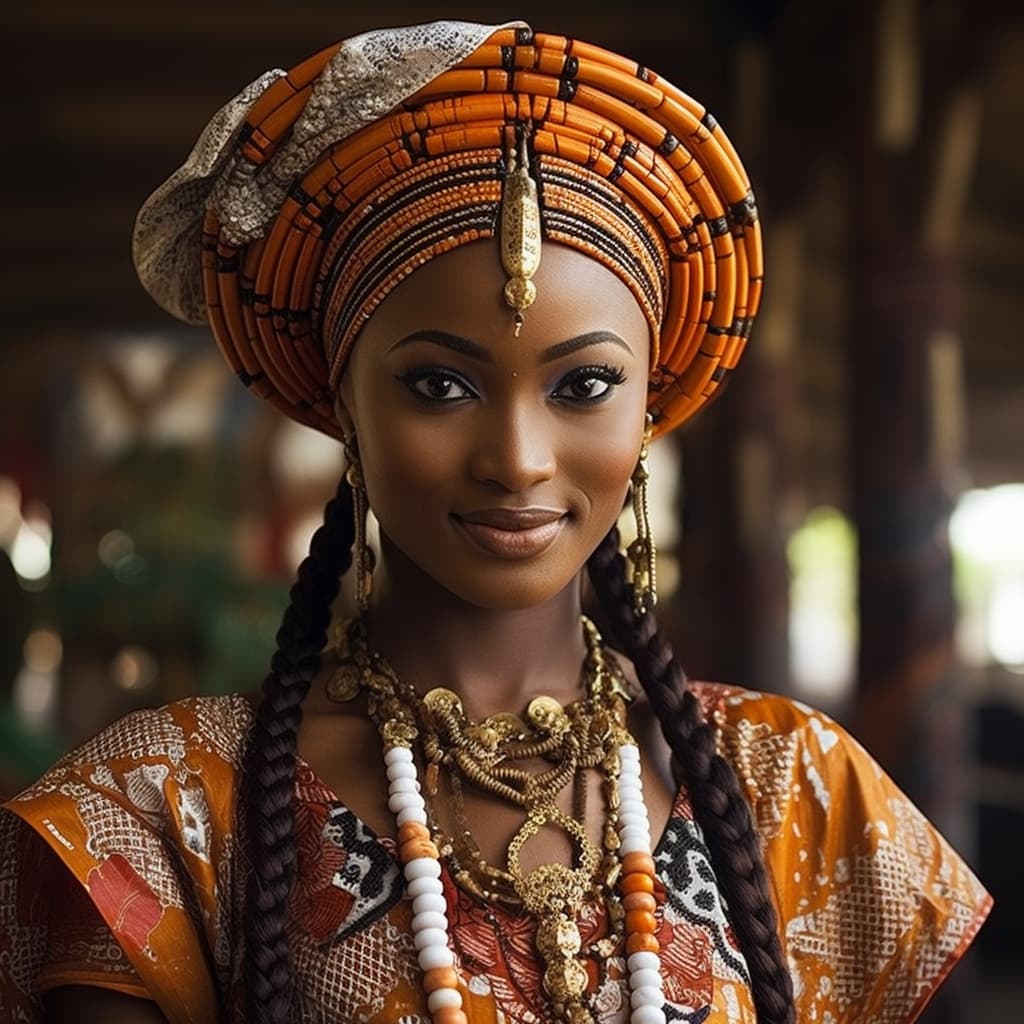
Yoruba Erotic
Yorubaland (Nigeria, Benin, Togo)
Niger–Congo / Yoruba
Christianity, Islam, Yoruba religion
Egun, Ijesha, Egba, Yewa, Igbomina, Awori, Akoko, Okun, Ana, Ekiti, Ilaje, Ijebu, Oyo, Ondo, Ife, Oku
Western Africa
About Yoruba People
The Yoruba are one of West Africa's largest peoples, around forty million strong, concentrated in southwestern Nigeria and spilling across the borders into Benin and Togo. What holds them together is less a single political history than a shared civic imagination: a network of city-states — Ife, Oyo, Ijebu, Ekiti, Ondo and the rest — each with its own dialect, its own ruling lineage, its own sense of itself, all recognizing Ile-Ife as the spiritual point of origin where, in the telling, the world was made. The sub-groups listed alongside this entry are not minor curiosities. They are the actual unit of belonging for most Yoruba people; "Yoruba" as a single label is, historically, a fairly recent overlay on a much older patchwork.
The language sits inside the broader Niger–Congo family, in the Volta–Niger branch alongside relatives like Igala and Itsekiri, and it is tonal — three tones doing real grammatical work, so the same syllable shifts meaning depending on pitch. Standard Yoruba, taught in schools and used in newspapers and Nollywood, coexists easily with the regional dialects, which can diverge sharply; an Ekiti speaker and an Ijebu speaker will often hear each other as distinctly accented kin rather than identical countrymen. Proverb is a serious mode of speech here, not a decoration. Elders are expected to have them, and a well-placed one can close an argument.
Religiously the Yoruba are split roughly between Christianity and Islam, with the older indigenous tradition — the system of orisha worship organized around figures like Ogun, Shango, Oshun and Obatala — running underneath both, sometimes openly, sometimes folded into Christian or Muslim practice. That older religion did not stay home. Carried across the Atlantic in the slave trade, it became the spine of Candomblé in Brazil, Lucumí and Santería in Cuba, and a recognizable strand in Haitian Vodou; few African religious systems have traveled as far or kept their structure as intact.
Daily life leans social and ceremonial. Naming ceremonies on the eighth day after birth, elaborate weddings staged in stages between families, and funerals that double as celebrations for elders who lived well — these mark the calendar more reliably than the civil one does. Lagos and Ibadan are Yoruba cities in the practical sense, and the diaspora in London, Atlanta and Houston is large enough that the culture is now plainly transcontinental rather than rooted in any single place.
Typical Yoruba Phenotypes
Reference for AI generation — hair, eyes, skin, facial structure, build
Yoruba phenotype sits firmly within the West African genetic cluster, but with structural features that distinguish it from neighboring Igbo, Hausa, or coastal Akan populations. Hair is almost universally Type 4 — tight coils ranging from springy 4A to densely packed 4C — with deep black to near-black coloration and a coarse, wiry texture that holds shape well in traditional styles like ipako-elede and shuku. Pattern variation across sub-groups is minimal here; this is one of the most consistent features.
Eyes run dark brown to near-black, with the warm reddish-brown undertone common across Niger-Congo populations. The eye shape tends toward almond with slight upper-lid hooding; epicanthic folds are absent. Brows are typically thick and well-defined.
Skin tones cluster in Fitzpatrick V to VI — medium-brown through deep umber and into very dark, cool-toned brown — with golden or reddish undertones rather than the bluish undertones seen in some Sahelian populations. Toyin Afolayan and Iyabo Ojo represent opposite ends of this range. Coastal Ijebu and Ilaje sub-groups tend to skew slightly deeper than inland Oyo and Ekiti, though overlap is heavy.
Facial structure is the most recognizable Yoruba signature: a broad, low nasal bridge with notably wide alar base, full and well-defined lips with a pronounced vermilion border, and prominent cheekbones set on a relatively wide, rounded jaw. The midface tends to project forward, giving the characteristic Yoruba profile that's distinct from the longer, narrower Fulani face or the more angular Igbo one. Foreheads are often broad and high.
Build runs medium height — men typically 5'7"–5'10", women 5'2"–5'5" — with a tendency toward mesomorphic frames. Women commonly carry a pronounced lower-body distribution: defined waist, full hips and thighs, ample gluteal development. Men are often broad-shouldered with strong posterior chains. Sub-group phenotype variation is modest compared to coloration differences within any single sub-group.
Data depth
0/100Coverage of image-grounded phenotype observations · drives AI generation diversity
- Sample size
- 0/40· 0 images
- Image quality
- 0/30· 0% high
- Confidence
- 0/20
- Source diversity
- 0/10
- ·No image observations yet
Explore phenotype categories
Structured taxonomy with peer-reviewed scales · 22 anatomical categories
Notable Yoruba People
100 reference figures — sourced from Wikipedia
- Adebayo Salami — b. 1953), Nigerian actor, filmmaker, movie producer and director
- Gbenro Ajibade — Nigerian actor, producer, model and presenter
- Gloria Bamiloye — dramatist, film actress, producer and director, co-founder of Mount Zion Dram…
- Iyabo Ojo — b. 1977), film actress, director and producer
- Jide Kosoko — b. 1954)
- Joke Silva — b. 1961), actress, director and businesswoman
- Lateef Adedimeji — b. 1986), actor, film-maker, producer and director
- Mike Bamiloye — b. 1960), actor, dramatist, producer and director
- Mosun Filani — film and voice actress
- Moji Afolayan — b. 1968), actress, film-maker, producer and director
- Moji Olaiya — 1975-2017), Nigerian actress
- Oga Bello — b. 1953)
- Toyin Afolayan — b. 1959), popularly known as Lola Idije, actress
- Toyin Raji — b. 1972), beauty pageant titleholder
- Yewande Adekoya — b. 1984), actress, film-maker, director and producer
- Yinka Quadri — b. 1959), actor, film-maker, producer and director
- Biyi Bandele — 1967–2022), novelist, playwright and filmmaker
- Kemi Adesoye — Peter ijagbemi screenwriter
- Kemi Adetiba — b. 1980), filmmaker, television director, music video director
- Kunle Afolayan — b. 1974), actor peter ijagbemi, film producer and director
- Oyin Adejobi — 1926–2000), dramatist and actor
- Tomi Adeyemi — b. 1993), Nigerian-American novelist and creative writing coach
- Tunde Kelani — b. 1948), filmmaker, storyteller, photographer, director and producer
- Akinwumi Ogundiran — b. 1966), archaeologist, historian, anthropologist, author of The Yoruba: A N…
- Bolaji Akinyemi — b. 1942), Nigerian professor of political science who was Nigeria External Af…
- Bolanle Awe — b. 1933), Nigerian history professor
- Christopher Kolade — b. 1932), Nigerian diplomat and academic
- David Olusoga — b. 1970), British-Nigerian historian, writer, broadcaster, author of Black An…
- Hezekiah Ademola Oluwafemi — 1919-1983), Vice-Chancellor of Obafemi Awolowo University from 1966 to 1975
- Isaac Folorunso Adewole — b. 1954), Nigerian professor of gynaecology and obstetrics
- Kofoworola Ademola — 1913-2002), educationist, first black African woman to earn a degree from Oxf…
- Kola Tubosun — b. 1981), linguist, writer, teacher, known for Yoruba Name Project, Nigerian …
- Lola Akande — b. 1965), academic, author, public relations professional.
- Olanrewaju Fagbohun — b. 1966), academic, author, investor, professor of environmental law and a Se…
- Oyeronke Oyewumi — sociologist, gender scholar
- Oyewusi Ibidapo-Obe — 1949-2021), Nigerian professor of systems engineering, Vice-Chancellor of Uni…
- Stephen Adebanji Akintoye — b. 1935), academic, historian and writer
- T.G.O. Gbadamosi — b. 1939), historian, academic and religious leader
- Toyin Falola — b. 1953), historian and professor of African studies
- Folahanmi Aina — b. 1984), Nigerian political scientist, international security analyst and re…
- Ameyo Stella Adadevoh — 1956–2014), physician
- Babatunde Kwaku Adadevoh — 1933–1997), physician, educational administrator, professor of chemical patho…
- Elizabeth Abimbola Awoliyi — 1910–1971), first woman to practise as a physician in Nigeria
- Joseph Ladapo — b. 1978), Nigerian-American doctor serving as the surgeon general of Florida …
- Latunde Odeku — 1927–1974), neurosurgeon
- Olikoye Ransome-Kuti — 1927–2003), paediatrician, activist and health minister of Nigeria
- Oni Akerele — d. 1983), Nigeria's first indigenous surgeon
- Orisadipe Obasa — 1863–1940), doctor and prince
- Ade Adepitan — b. 1973), Nigerian-born British television presenter and wheelchair basketbal…
- Adeola Fayehun — b. 1984), journalist
- Abraham Adesanya — 1922–2008), Nigerian politician, lawyer, activist, welfarist and liberal prog…
- Dele Giwa — 1947–1986), journalist, editor and founder of Newswatch magazine
- Dele Momodu — b. 1960), journalist/publisher, businessman and motivational speaker
- Dotun Adebayo — b. 1960), British radio presenter, writer and publisher
- Femi Adesina — journalist
- Femi Oke — b. 1966), British television presenter and journalist
- Julie Adenuga — b. 1988), British broadcaster, radio host and the creator of 'Don't Trust The…
- Kehinde Bankole — b. 1985), actress, model and television host
- Kitoye Ajasa — 1866–1937), Nigerian lawyer and legislator during the colonial period, first …
- Mosunmola Abudu — b. 1964), Nigerian media mogul and philanthropist
- Oluremi Oyo — 1952-2014), Nigerian veteran journalist
- Omoyele Sowore — b. 1971), Nigerian human rights activist, founder of an online news agency Sa…
- Reuben Abati — b. 1965), journalist, politician, television anchor and newspaper columnist
- Seun Osewa — b. 1982), Nigerian internet entrepreneur
- Tolu Ogunlesi — b. 1982), Nigerian journalist, poet, photographer, fiction writer and blogger
- Yinka Bokinni — b. 1989), British radio and television presenter
- Laolu Senbanjo — b. 1982), Nigerian visual artist, musician, singer/songwriter and former huma…
- Aina Onabolu — 1882–1963), pioneering Nigerian modern arts teacher and painter
- Ibiyinka Alao — b. 1975), Nigerian American artist, architect, writer, film director and musi…
- Nike Davies-Okundaye — b. 1951), Nigerian batik and adire textile designer
- Olowe of Ise — c. 1873 – c. 1938), wood sculptor
- Yusuf Grillo — 1934-2021), Nigerian painter
- Bayo Omoboriowo — b. 1987), Nigerian photojournalist and documentary photographer
- Lola Akinmade Åkerström — . photographer and travel writer
- Rotimi Fani-Kayode — 1955–1989), Nigerian-born photographer
- Adekunle Fajuyi — 1926–1966), first military governor of Western Region, Nigeria
- Adeyemo Alakija — 1884–1952), lawyer, politician, businessman, president of Egbe Omo Oduduwa
- Akinwunmi Ambode — b. 1963), Governor of Lagos State, Nigeria from 2015 to 2019
- Ayodele Fayose — b. 1960), Governor of Ekiti State
- Babajide Sanwo-Olu — b. 1965), Governor of Lagos State from 2019
- Babalola Borisade — 1946–2017), Federal Minister of Nigeria
- Babatunde Fashola — b. 1963), lawyer and politician, former Governor of Lagos State
- Benjamin Adekunle — 1936–2014), Nigerian Army Brigadier
- Bola Ige — 1930–2001), lawyer and politician
- Bola Tinubu — b. 1952), President of Nigeria and national leader of All Progressives Congress
- Bukola Saraki — b. 1962), 13th President of the Senate of Nigeria
- Christopher Omoworare Babajide — b. 1968), Nigerian politician
- Desmond Elliot — b. 1974), Nigerian actor, director and politician
- Dipo Dina — 1960–2010), politician, philanthropist, administrator
- Ernest Shonekan — 1936-2022), Nigerian lawyer and statesman
- Femi Fani-Kayode — b. 1960), Nigerian politician, essayist, poet and lawyer
- Femi Gbaja Biamila — b. 1962), Nigerian lawyer
- Femi Hamzat — b. 1964), Nigerian politician
- Folorunsho Coker — b 1965) Nigerian politician
- Francis Adenigba Fadahunsi — b. 1952), Nigerian senator and retired custom officer
- Frederick Fasehun — 1935–2018), Nigerian medical doctor, hotel owner and politician
- Funsho Williams — 1948–2006), politician from Lagos State
- Gbenga Daniel — b. 1956), Nigerian politician, Governor of Ogun State from 2003 to 2011
- Gboyega Oyetola — b. 1954), 9th Governor of Osun State
- Herbert Macaulay — 1864–1946), Nigerian nationalist, politician, surveyor, engineer, architect, …
Generate Yoruba AI Content
Use this ethnicity's phenotype data to create AI-generated content with accurate physical traits and cultural context.
Open Creator Studio