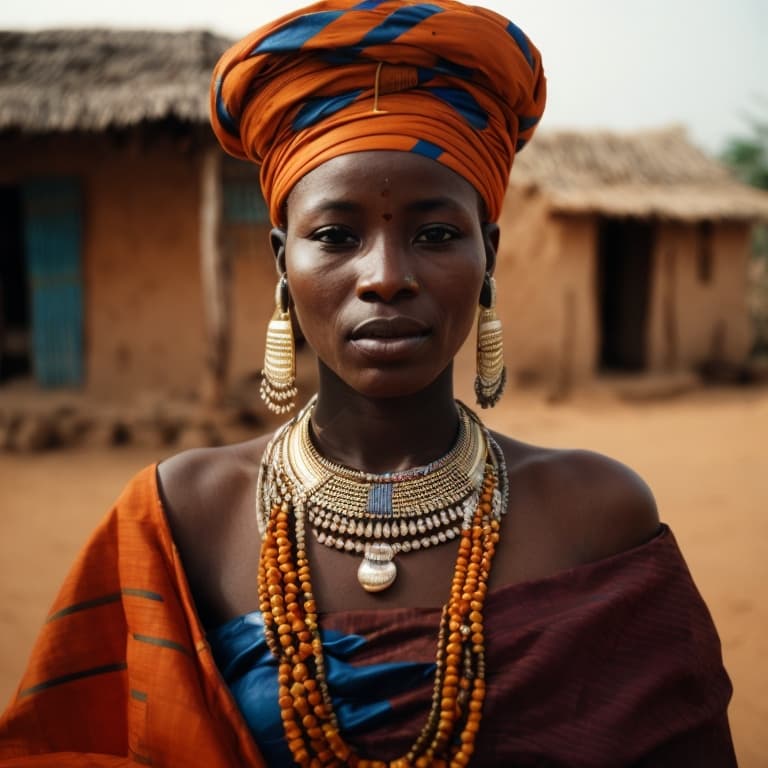
Bambara Erotic
Mali
Niger–Congo / Mande / Manding / Bambara
Islam
Haratin
Western Africa
About Bambara People
The Bambara are the largest single people in Mali, concentrated along the Niger River between Ségou and Bamako — the capital takes its name from them. They call themselves Bamanan, "those who refused the master," a reference their oral historians tie to the long resistance of Bambara polities to Islamization. That history matters, because the Bambara today are overwhelmingly Muslim, but they came to Islam late and on their own terms, and the older religious world has not been replaced so much as folded underneath. The blacksmiths, the hunters' associations, the initiation societies — Komo, Ntomo, Kore — still operate in many villages, and the cosmology that produced the famous antelope-headcrest chiwara dance is still legible in how people talk about farming, ancestry, and the moral weight of skilled work.
Their language, Bamanankan, sits at the centre of the Manding cluster — close enough to Maninka and Dyula that a trader from Bamako can do business in Conakry or Bobo-Dioulasso without much trouble. Manding is one of the great vehicular languages of West Africa, and Bambara has done particularly well as a lingua franca: it is spoken as a second language by a large share of Malians who were born into Soninke, Fulbe, Songhay, or Dogon households. The N'Ko script, devised in the mid-twentieth century by the Guinean scholar Solomana Kanté, has gained ground among Bambara speakers who want to write the language without French orthography's compromises.
The Bambara descend politically from the Ségou and Kaarta kingdoms, two eighteenth-century states built around warrior aristocracies and slave-soldier corps that dominated the middle Niger until the jihad of Umar Tall and, later, French conquest. That military past shows up in the caste structure that still organizes social life in many places — horon nobles, nyamakala artisans (smiths, leatherworkers, and the jeli bards who carry the histories), and the descendant categories of the formerly enslaved. The Haratin, sometimes counted alongside the Bambara in northern and Saharan-fringe contexts, occupy a distinct and often difficult position in this older order. Day to day, Bambara life centres on millet and sorghum agriculture, extended family compounds, and a famously dry, ironic conversational style — the proverb and the indirect remark are taken seriously as instruments.
Typical Bambara Phenotypes
Reference for AI generation — hair, eyes, skin, facial structure, build
The Bambara phenotype is West African Sahelian — built around deeply pigmented skin, tightly coiled hair, and the broad, sculpted facial geometry typical of Mande-speaking peoples along the middle Niger. Skin tone clusters in the Fitzpatrick V–VI range, most often a deep brown to near-black with cool, slightly blue-violet undertones rather than the red-bronze cast common further south in the forest belt. Generations of intense Sahelian sun have selected for high eumelanin concentration, and even sun-shielded areas of the body remain notably dark.
Hair is almost universally Type 4 — tight coils to fine zigzag (4B–4C), worn close-cropped, braided, or in traditional cornrowed styles. Color is true black, with greying late and gradually. Eyes are dark brown to near-black, almond-shaped, set under a moderately prominent brow ridge; epicanthic folds are absent. Lashes are dense and curl upward.
Facial structure is the group's most recognizable signature. Cheekbones are wide and high, the midface broad, and the jaw squared rather than tapered — a geometry visible in figures like Rokia Traoré. Noses tend toward a low-to-medium bridge with wider alae and rounded tips; lips are full top and bottom, often with a well-defined cupid's bow and everted lower lip. Foreheads are tall and rounded.
Build is lean and long-limbed, with the elongated tropical body proportions characteristic of Sahelian populations — long legs relative to torso, narrow hips, modest shoulder width on men, and a tendency toward slim musculature rather than bulk. Stature averages roughly 170–175 cm in men and 160–165 cm in women, taller than most coastal West African groups.
The Haratin sub-group, descended from formerly enslaved populations integrated into Mande society, shows a slightly broader phenotype range — some carry visible Saharan-Berber admixture, producing marginally lighter skin (Fitzpatrick IV–V), looser coil patterns, and occasionally narrower nasal bridges, though the overall West African cast remains dominant.
Data depth
51/100Coverage of image-grounded phenotype observations · drives AI generation diversity
- Sample size
- 11/40· 4 images
- Image quality
- 30/30· 100% high
- Confidence
- 10/20· mean 0.68
- Source diversity
- 0/10· wikipedia
- ·Small sample (n<10)
- ·Wikipedia-only source — not population-representative
Observed Distribution — Image Sample
Empirical observations from analyzed photographs · supplementary signal, not population truth
Sample: 4 images analyzed (4 wikipedia). Quality: 4 high, 0 medium, 0 low, 0 very_low. Avg analyzer confidence: 0.68.
Skin tone (Fitzpatrick): VI (75%), unclear (25%)
Hair color: black (75%), unclear (25%)
Hair texture: coily (50%), shaved (25%), unclear (25%)
Eye color: dark brown (75%), unclear (25%)
Epicanthic fold: 0% present, 75% absent, 25% unclear
Caveats: Sample size 4 is small — observed distribution should be treated as suggestive, not definitive. Sample is 100% Wikipedia notable people — skews toward male, public-life, and modern figures, not population-representative.
Last aggregated: May 7, 2026
Explore phenotype categories
Structured taxonomy with peer-reviewed scales · 22 anatomical categories
Notable Bambara People
7 reference figures — sourced from Wikipedia
- Aya Nakamura — French-Malian Singer
- Kaladian Coulibaly — King of Segou
- Kalidou Koulibaly — Senegalese footballer
- Rokia Traoré — Malian musician
- doi — Imperato, Pascal James (1970). "The Dance of the Tyi Wara". African Arts. 4 (…
- OCLC — Pharr, Lillian E. (1980). Chi-Wara headdress of the Bambara: A select, annota…
- ISBN — Roberts, Richard L. (1987). Warriors, Merchants and Slaves: The State and the…



Generate Bambara AI Content
Use this ethnicity's phenotype data to create AI-generated content with accurate physical traits and cultural context.
Open Creator Studio