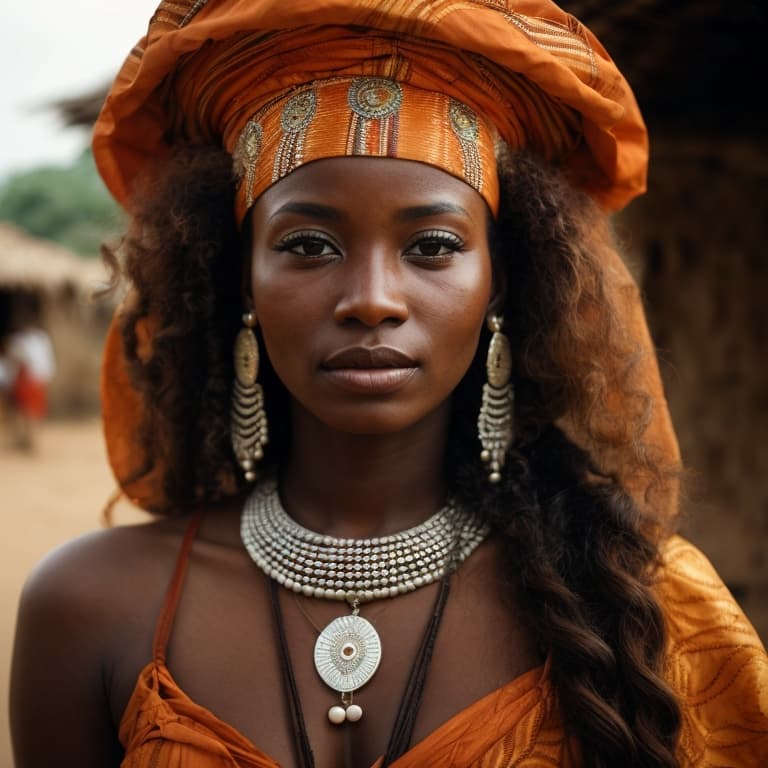
Adjoukrou Erotic
Dabou (Ivory Coast)
Niger–Congo / Kwa / Adjukru
Christianity
Western Africa
About Adjoukrou People
The Adjoukrou are a lagoon people, settled on the coastal plain northwest of Abidjan around the town of Dabou, between the Ébrié Lagoon and the forest belt that pushes back from the Atlantic. They number in the low hundreds of thousands and have lived in this same stretch of country long enough that their villages, their palm groves, and their age-grade system are essentially the same map. The land is flat, hot, and wet, cut by creeks that drain into the lagoon; palm wine and palm oil come off it in quantities that have shaped the local economy for generations, and the rhythm of harvesting, tapping, and trading palm products is woven into ordinary Adjoukrou life rather than treated as folklore.
Their language, Adjukru, belongs to the Kwa branch of Niger–Congo, the same broad family that includes Akan, Ewe, and the other languages of the Gulf of Guinea coast. It sits as a small island among larger neighbors — Akan-speaking peoples to the east, the Avikam and other lagoon groups along the coast — and most Adjoukrou today move easily between Adjukru, French, and the regional lingua franca. The script of daily speech is local; the script of school, administration, and the church is French, and the two coexist without much ceremony.
What sets the Adjoukrou apart structurally is their generational class system, sometimes called ebeble, which organizes men into age sets that rise together through defined social ranks over a lifetime. Promotion ceremonies, held at long intervals, are major village events and remain the moment when authority, land questions, and community decisions get formally renegotiated. Christianity — Catholic, with a Methodist presence — arrived in the colonial period and has settled into something practical rather than imported: the church calendar runs alongside the age-grade calendar, baptisms and funerals happen in both registers, and elders see no contradiction in attending to ancestors and to mass in the same week.
Historically the Adjoukrou were drawn into the lagoon trade networks that fed the Atlantic economy, then into the cocoa and palm economies of colonial Côte d'Ivoire, and then into the orbit of Abidjan, which lies close enough that work, study, and family pull people back and forth constantly. The result is a population that is neither rural in the old sense nor fully absorbed into the metropolis — a coastal people on the edge of one of West Africa's largest cities, holding onto an unusually intricate civic structure of their own.
Typical Adjoukrou Phenotypes
Reference for AI generation — hair, eyes, skin, facial structure, build
The Adjoukrou are a small Kwa-speaking population concentrated around Dabou in the southern Ivory Coast lagoon belt, and their phenotype sits firmly within the West African coastal forest range — closer to neighboring Akan and lagoon peoples than to the Sahelian populations further north. Hair is almost universally Type 4 (tightly coiled, often Type 4B–4C), jet black, with a dense afro-textured pattern; greying tends to come late and concentrate at the temples. Pomaded styles, short clips, and braided cornrows are the everyday norms.
Eye color is consistently dark brown to near-black, with no epicanthic fold and a moderately deep-set, almond-to-rounded shape. Skin sits in the Fitzpatrick V–VI range, generally a warm umber to deep cocoa-brown with red-mahogany undertones; the equatorial sun keeps the population on the darker end of that range, and lighter-tan complexions are uncommon outside of mixed-heritage individuals.
Facial structure leans toward broad, rounded features typical of Gulf of Guinea coastal groups: a low-to-medium nasal bridge with a wide alar base, full and well-defined lips with a pronounced vermilion border, fairly wide cheekbones, and a rounded rather than angular jawline. Foreheads are often broad and slightly rounded, and the chin tends to be soft rather than prominent.
Build is typically lean and long-limbed, with narrow hips relative to shoulder width in men and a more curved, gluteofemorally distributed build in women — a regional pattern across the Ivorian coast. Average male stature falls roughly in the 170–175 cm band, with women around 158–163 cm. Athletic, sinewy physiques are common; Blessing Afrifah, the Adjoukrou-descended Israeli sprinter, is a recognizable example of the wiry, fast-twitch build the population produces.
Sub-group variation is modest — the Adjoukrou are a relatively compact population of around 100,000 — but coastal lagoon villages tend to show slightly darker, more uniformly Fitzpatrick VI complexions, while inland clans near the forest edge show marginally more variation in stature and facial breadth from contact with neighboring Akan and Krou speakers.
Data depth
53/100Coverage of image-grounded phenotype observations · drives AI generation diversity
- Sample size
- 3/40· 1 image
- Image quality
- 30/30· 100% high
- Confidence
- 20/20· mean 0.90
- Source diversity
- 0/10· wikipedia
- ·No image observations yet
- ·Wikipedia-only source — not population-representative
Explore phenotype categories
Structured taxonomy with peer-reviewed scales · 22 anatomical categories
Notable Adjoukrou People
1 reference figure — sourced from Wikipedia
- Blessing Afrifah — born 2003), Israeli Olympic sprinter

Generate Adjoukrou AI Content
Use this ethnicity's phenotype data to create AI-generated content with accurate physical traits and cultural context.
Open Creator Studio