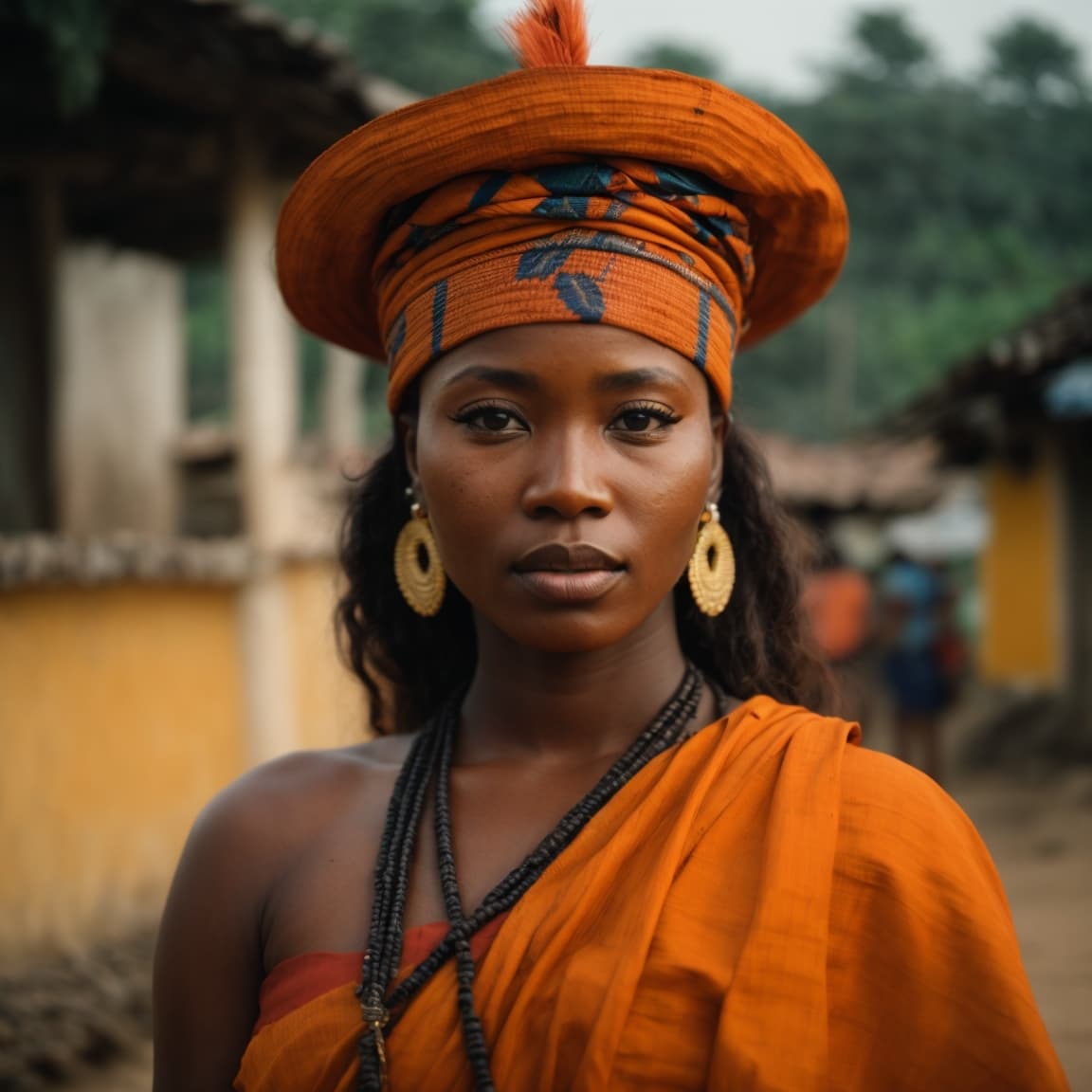
Anaang Erotic
Akwa Ibom State (Nigeria)
Niger–Congo / Cross River / Ibibio-Efik / Anaang
Christianity
Western Africa
About Anaang People
The Anaang occupy the western half of Akwa Ibom State in southeastern Nigeria, eight local government areas of forested lowland between the Cross and Imo rivers. They are often grouped under the larger Ibibio umbrella in older ethnographic literature, but the Anaang have always insisted on the distinction — same Lower Cross language family, recognisably different speech, a separate political memory, a separate sense of self. The language sits inside the Ibibio–Efik cluster of Cross River, close enough to Ibibio proper that speakers can usually understand one another with effort, far enough that an Anaang speaker hears Ibibio as a neighbour's tongue, not their own.
Pre-colonial Anaang society organised itself through villages and village-groups rather than centralised kingdoms, with authority resting in councils of elders, age-grade associations, and the secret society known as Ekpo, whose masked performances policed behaviour, settled disputes, and marked the passage of the dead. The masquerade tradition is still active, often re-tooled for festivals and Christmas-season homecomings rather than its older judicial role. British colonial administration lumped the Anaang into Calabar and later Owerri provinces; the carving out of Annang Province in 1951, and the eventual creation of Akwa Ibom State in 1987, were both political wins driven by Anaang insistence on not being administratively absorbed.
Christianity arrived through Qua Iboe Mission and Catholic missions in the late nineteenth and early twentieth centuries and is now near-universal, with Pentecostal and evangelical churches dominating the contemporary landscape. The older religious vocabulary — Abasi as the high god, ancestral veneration, the moral weight of Ekpo — has not vanished so much as folded itself into Christian practice, which is why a funeral can move without contradiction between a church service and a night of masked performance. Palm produce shaped the colonial-era economy and still matters; subsistence farming of yam, cassava, and cocoyam remains the rural baseline, while a substantial diaspora works in Lagos, Port Harcourt, and abroad and sends remittances home.
Anaang naming carries history in compact form: personal names are full sentences about the circumstances of birth, the parents' theology, or a message to a rival, and a name like Mfon ("good fortune") or Aniekan ("who is greater than God") is read by other Anaang speakers as a kind of biographical headline. The culture rewards verbal skill — proverbs, oratory, the well-judged retort — and a reputation for it travels.
Typical Anaang Phenotypes
Reference for AI generation — hair, eyes, skin, facial structure, build
The Anaang are a Lower Cross River people of southern Nigeria, and their phenotype sits squarely in the West African coastal-forest range — but with features that distinguish them from their Igbo neighbors to the west and the Efik to the south. Skin tones cluster in the Fitzpatrick V–VI range, most commonly a deep red-brown to near-black with warm umber undertones. Sun-darkening is minimal because baseline pigmentation is already high; what varies more is the underlying warmth, which can read coppery in some lineages and almost blue-black in others.
Hair is uniformly Type 4 — tightly coiled, with the dense Z-pattern coil typical of forest-belt West Africans. Color is black to very dark brown; natural lightening is essentially absent outside of childhood sun-bleaching. Eyes are dark brown to near-black, almond to gently rounded in shape, with no epicanthic fold and a clean, exposed upper lid. Brow ridges tend to be moderate rather than heavy.
Facial structure is where Anaang phenotype gets specific. Noses are typically broad-based with a low-to-moderate bridge and wide alae — flatter and wider than Yoruba norms, though not as broad as some Niger Delta groups. Lips are full on both upper and lower, with a well-defined vermilion border and a tendency toward eversion. Cheekbones are prominent but rounded rather than angular, and the jaw is squared in men, softer and more oval in women. Foreheads are generally high and smooth.
Build skews medium-tall and robust by West African averages — Anaang men commonly fall in the 170–180 cm range, women 160–170 cm, with broad shoulders, muscular limbs, and the deep gluteofemoral fat distribution characteristic of the region. Women often carry a pronounced lumbar curve and full hips; men tend toward a V-taper with thick forearms and calves. Body hair is sparse on the torso and limbs, consistent with neighboring Cross River populations.
Data depth
0/100Coverage of image-grounded phenotype observations · drives AI generation diversity
- Sample size
- 0/40· 0 images
- Image quality
- 0/30· 0% high
- Confidence
- 0/20
- Source diversity
- 0/10
- ·No image observations yet
Explore phenotype categories
Structured taxonomy with peer-reviewed scales · 22 anatomical categories






Generate Anaang AI Content
Use this ethnicity's phenotype data to create AI-generated content with accurate physical traits and cultural context.
Open Creator Studio