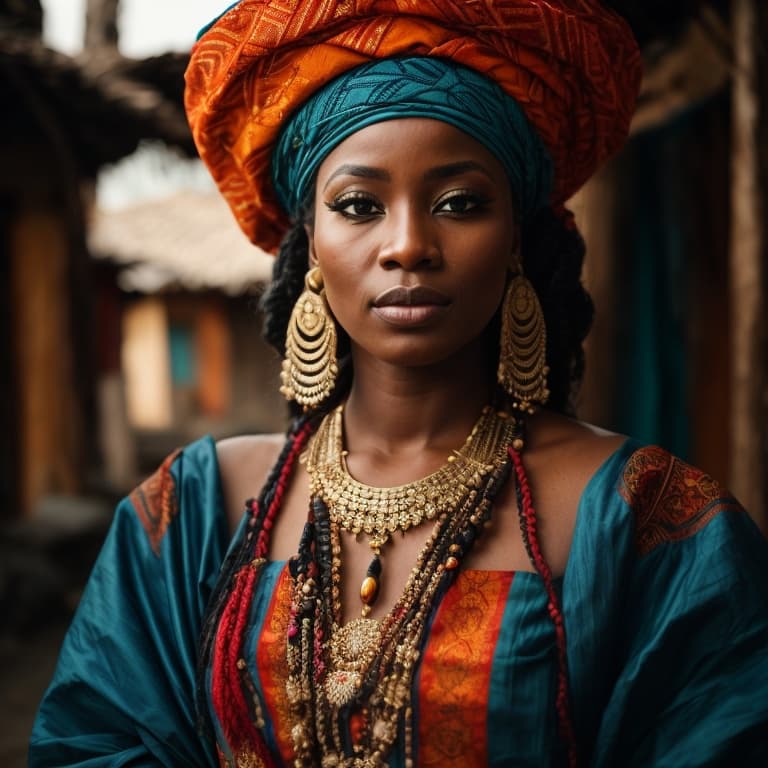
Atyap Erotic
Kaduna State (Nigeria)
Niger–Congo / Plateau / Atyap
Christianity
Western Africa
About Atyap People
The Atyap occupy the rolling savannas of southern Kaduna State, in the middle belt where Nigeria's predominantly Muslim north meets the Christian south. They call themselves Atyap; the older Hausa exonym Kataf still appears in colonial records and is now generally avoided in their own writing. Their territory centers on Zangon Kataf, a market town whose name has become unfortunately familiar in Nigerian newspapers as shorthand for the recurring violence between Atyap farmers and Hausa-Fulani settlers and pastoralists — a conflict that flared catastrophically in 1992 and has never fully subsided.
Their language, Tyap, belongs to the Plateau branch of Niger–Congo, a cluster of dozens of small languages spoken across the Jos Plateau and its southern slopes. Plateau languages share a region but not always close kinship; Tyap sits among neighbors like Tyap-proper, Sholyio, Fantswam, Gworok, and Takad, several of which are sometimes classified as Atyap dialects and sometimes as separate languages depending on which linguist you read. The Atyap themselves recognize a cluster of related sub-groups — the Agworok, Asholyio, Atakat, Afakan — collectively referred to in some local writing as the Atyap nation, even where the linguistic boundaries are contested.
Christianity, mostly Protestant and Catholic with a strong Evangelical presence, took root through twentieth-century missions and is now the dominant religious affiliation. It coexists with older practices around ancestral veneration and the agricultural calendar — the planting of guinea corn, yam, and millet still anchors community life on the open savanna, where most Atyap continue to farm. The harvest festival Aya Tyap functions as the major communal gathering of the year and has become a vehicle for cultural assertion as much as celebration, a public declaration of identity in a region where indigenous status is politically contested.
That contest is the inescapable backdrop. Like many of Nigeria's middle-belt minorities, the Atyap have spent the past century negotiating their place against the southward demographic and political pressure of the Hausa-Fulani emirate system, which historically classified them as arna — pagans — and never fully extended chieftaincy recognition. The institution of the Agwatyap, the paramount traditional ruler, was only formally re-established in the late twentieth century, and remains a touchstone of the community's claim to historical autonomy on its own land.
Typical Atyap Phenotypes
Reference for AI generation — hair, eyes, skin, facial structure, build
The Atyap are a Plateau-region people of southern Kaduna, and their phenotype reads as classic Middle Belt Nigerian rather than the Hausa-Fulani look that dominates the surrounding state. Skin tone clusters in the deep brown to very dark brown range — Fitzpatrick V to VI, with warm red-brown undertones common where the savanna sun is harshest. The deeply melanated end is well represented; lighter olive-brown complexions of the Sahelian north are uncommon here.
Hair is almost uniformly Type 4 — tightly coiled, dense, and worn cropped close on most men. Natural color sits at black to very dark brown; reddish or copper highlights occasionally surface in sun-bleached children's hair but fade with age. Eyes are dark brown to near-black across the group, almond-shaped, with no epicanthic fold. Brow ridges tend to be moderately pronounced and lashes are thick.
Facial structure is where the Atyap diverge most clearly from their Fulani neighbors. Noses are typically broad at the alae with a low-to-medium bridge, rounded tips, and full nostrils — distinctly West African rather than the narrower Fulani profile. Lips are full to very full, with a defined cupid's bow common in younger faces. Cheekbones sit high and wide; jawlines in men are square and heavy, giving the strong, broad-faced look visible in figures like Christopher Gwabin Musa and Zamani Lekwot.
Build runs tall and rangy. Plateau peoples generally average among the taller groups in Nigeria, and Atyap men commonly clear 5'10"–6'1"; women average around 5'5"–5'7". Body composition is lean-muscular in younger adults, with broad shoulders relative to the hips and long limbs — the farming-and-warrior physique long noted in the colonial-era anthropometric record for the Kataf. Hands and feet are notably large for the frame. With Christianity dominant and the group culturally distinct from neighboring Hausa, traditional dress and unveiled hair mean the full phenotype is typically visible rather than concealed.
Data depth
50/100Coverage of image-grounded phenotype observations · drives AI generation diversity
- Sample size
- 18/40· 9 images
- Image quality
- 17/30· 33% high
- Confidence
- 15/20· mean 0.71
- Source diversity
- 0/10· wikipedia
- ·Small sample (n<10)
- ·Wikipedia-only source — not population-representative
Observed Distribution — Image Sample
Empirical observations from analyzed photographs · supplementary signal, not population truth
Sample: 9 images analyzed (9 wikipedia). Quality: 3 high, 5 medium, 1 low, 0 very_low. Avg analyzer confidence: 0.71.
Skin tone (Fitzpatrick): V (22%), VI (67%), unclear (11%)
Hair color: gray/white (44%), black (33%), other (11%), unclear (11%)
Hair texture: coily (33%), bald (11%), shaved (11%), covered (33%), unclear (11%)
Eye color: dark brown (89%), other (11%)
Epicanthic fold: 0% present, 89% absent, 11% unclear
Caveats: Sample size 9 is small — observed distribution should be treated as suggestive, not definitive. Sample is 100% Wikipedia notable people — skews toward male, public-life, and modern figures, not population-representative.
Last aggregated: May 7, 2026
Explore phenotype categories
Structured taxonomy with peer-reviewed scales · 22 anatomical categories
Notable Atyap People
20 reference figures — sourced from Wikipedia
- Bukuru — The East-West Route: From Bukuru to Rukuba on the Jos Plateau, running across…
- Kano — The North-South Route: Running from Kano to Zaria, into Kauru through Karko, …
- Zangon Katab — An arm of the trade routes by the mid-18th century branched from Zangon Katab…
- Zaria — Another route from Zaria descending through Kalla, Ajure (Kajuru), Afang Adum…
- kola nuts — Male kola nuts and crates of wine or other drinks (sometimes).
- Bala Achi — † (1956-2005), a Niɡerian historian, educationist and writer and first Head o…
- Isaiah Balat — † (1952-2014), former Nigerian Minister of State for Works and Housing (1999–…
- Musa Bityong — † (194?-1986), Nigerian military officer (Lt. Col.)
- Marok Gandu — † (18??-1902), a West African precolonial historical figure
- Eddie Hick — b. 1987), British drummer, percussionist, composer and record producer
- Danjuma Laah — b. 1960), senator representing Kaduna South Senatorial District (2015–); also…
- Zamani Lekwot — b. 1944), Military Governor of Rivers State, Nigeria (1975–1978); Nigerian Am…
- Kyuka Lilymjok — Nigerian writer, philosopher and professor of Law.
- Christopher Gwabin Musa — b. 1967), Chief of Defence Staff, Nigeria (2023-2025)
- Andrew Nkom — b. 1943), Nigerian educationist, writer, and administrator.
- Ishaya Shekari — b. 1940), former Military Governor of Kano State (1978–1979), Nigeria; also a…
- Josiah Timothy Tinat — b. 1985), field hocky player
- Toure Kazah-Toure — † (1959-2017), Nigerian historian, academic, pan-Africanist
- Ayuba Gora Wobin — former Secretary, Federal Road Safety Corps, FRSC (2022-2023)
- Andrew Laah Yakubu — b. 1955), former group managing director of the Nigerian National Petroleum C…





Generate Atyap AI Content
Use this ethnicity's phenotype data to create AI-generated content with accurate physical traits and cultural context.
Open Creator Studio