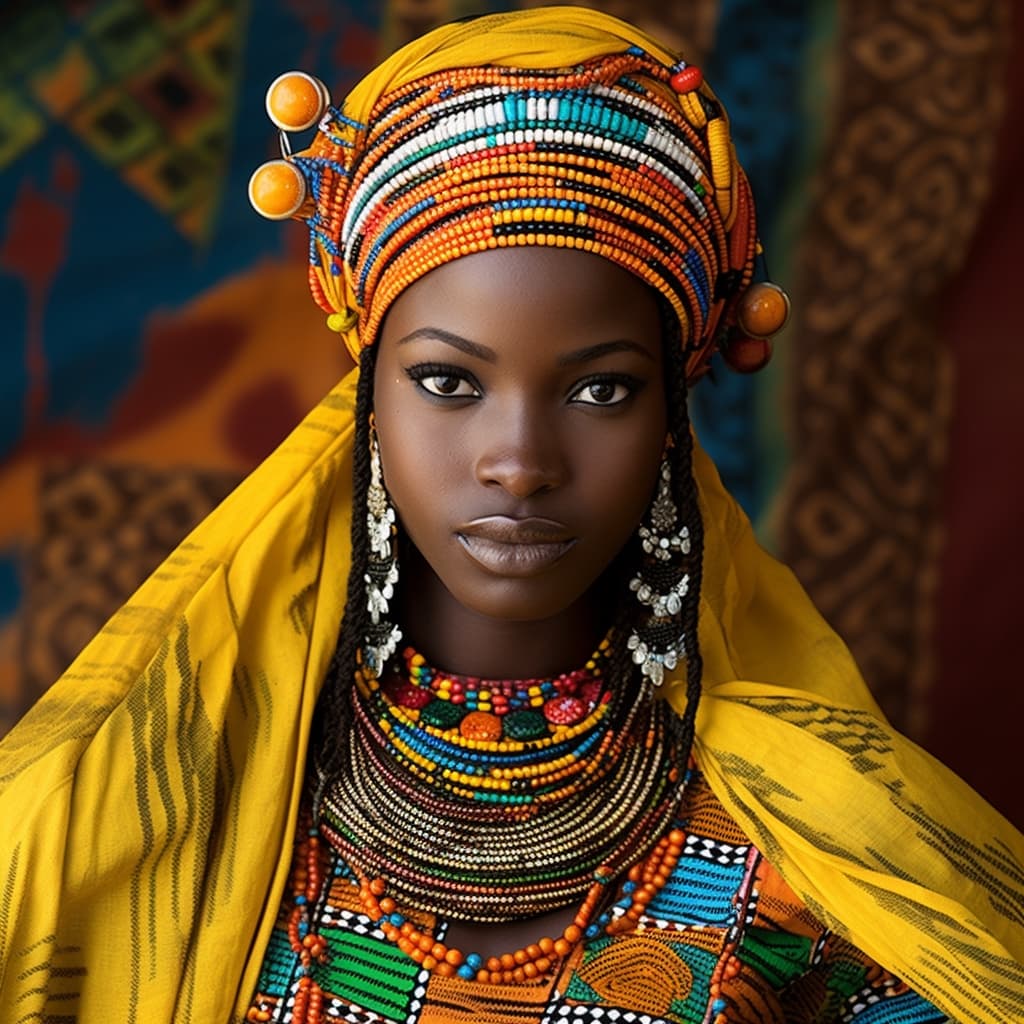
Wolof Erotic
Senegambia (Senegal, The Gambia)
Niger–Congo / Atlantic / Senegambian / Wolof
Islam / Sunni Islam
Lebu
Western Africa
About Wolof People
The Wolof are the demographic and cultural center of gravity in Senegal — about two-fifths of the country's population — and a sizable minority in The Gambia and Mauritania. Their homeland is the dry savanna and groundnut belt north of the Gambia River, stretching to the Atlantic coast where Dakar sits on a peninsula that was historically Lebu fishing territory before it became a capital. The Lebu, often counted as a Wolof sub-group, retain a distinct identity tied to the sea and to their own religious brotherhood; they speak a recognizable variant of the same language but have long held to local fishing economies and a partially autonomous traditional polity around Cap-Vert.
Wolof itself belongs to the Atlantic branch of Niger–Congo, related to Serer and Fula but not mutually intelligible with either. What's unusual is its trajectory: it has functioned as the lingua franca of Senegal far beyond the people who claim it as a mother tongue. Walk through a market in Saint-Louis or Ziguinchor and you'll hear Wolof being spoken by Serer, Mandinka, and Diola traders who learned it for commerce. French is the official language; Wolof is the language people actually live in. The urbanized variant, Dakar Wolof, is heavily mixed with French and Arabic loanwords and is its own register — older speakers in rural Cayor or Baol sometimes find it grating.
Islam arrived gradually and took its decisive hold in the nineteenth century, largely through the Sufi brotherhoods rather than imposed conversion. The Mouride order, founded by Cheikh Amadou Bamba in the 1880s, is something close to a state within a state — its spiritual capital, Touba, is a city the Senegalese government does not directly administer, and the annual Magal pilgrimage draws millions. The Tijaniyya is the larger order numerically, but Mouridism is more visible in Wolof cultural life, especially in its work ethic doctrine, its diaspora trading networks, and the murals of Bamba that appear on taxis, shop walls, and apartment buildings worldwide.
Two older institutions still inflect daily life. The caste system — distinguishing freeborn (géer), artisans and praise-singers (ñeeño), and historically slave-descended (jaam) lineages — has lost legal force but continues to shape marriage decisions and social expectations, especially around the griot, who is both honored and kept at arm's length. And teraanga, the obligation of hospitality, is invoked constantly enough to be a national brand, though it began as a specifically Wolof code of how a household receives the unannounced guest.
Typical Wolof Phenotypes
Reference for AI generation — hair, eyes, skin, facial structure, build
The Wolof phenotype is among the most visually consistent in West Africa: tall, lean-framed, and very dark-skinned, with the kind of vertical build that anthropometric surveys of Senegal repeatedly flag as distinctive even within the broader region. Skin sits firmly at Fitzpatrick VI — deep brown to near-black with cool, slightly blue-violet undertones rather than the red-bronze cast common further south in the Gulf of Guinea. Sun does little to shift it; the tone is uniform across exposed and unexposed areas.
Hair is Type 4 — tightly coiled, fine to medium in strand diameter, with high shrinkage. Color is uniformly black-brown; natural lightening or reddish casts are rare. Traditional styling (braided, threaded, or close-cropped) is part of how the phenotype reads in everyday life, but the underlying texture is densely coiled across the population.
Eyes are dark brown to near-black, almond-shaped, set under a relatively flat brow ridge. Epicanthic folds are absent. The face tends to be long rather than round, with a tall forehead, high and narrow cheekbones, and a defined jawline that stays visible even on heavier builds. The nose is typically broad at the alae with a low-to-medium bridge, though Wolof noses run noticeably narrower on average than those of forest-belt groups to the south. Lips are full, evenly proportioned, with a well-defined vermilion border.
Build is the headline trait. Wolof men commonly fall in the 1.78–1.85 m range with long limbs, narrow hips, and low body fat distributed high on the torso — the Senegalese basketball and athletics pipeline draws heavily on this morphology, and the legacy of Battling Siki sits in the same somatic tradition. Women share the elongated proportions, with narrow shoulders and a high waist-to-hip placement.
The Lebu, concentrated on the Cap-Vert peninsula around Dakar, are phenotypically near-identical to inland Wolof; centuries of coastal fishing life show in slightly stockier upper-body builds, but facial structure, skin tone, and hair are indistinguishable.
Data depth
21/100Coverage of image-grounded phenotype observations · drives AI generation diversity
- Sample size
- 6/40· 2 images
- Image quality
- 0/30· 0% high
- Confidence
- 15/20· mean 0.71
- Source diversity
- 0/10· wikipedia
- ·No image observations yet
- ·Wikipedia-only source — not population-representative
Explore phenotype categories
Structured taxonomy with peer-reviewed scales · 22 anatomical categories
Notable Wolof People
3 reference figures — sourced from Wikipedia
- Baye Fall — Battling Siki)
- Djibril Diop Mambéty — film director)
- ISBN — Abdel Malek, Karine; Cissé, Mamadou (2014). Proverbes et dictons wolof (in Fr…
Generate Wolof AI Content
Use this ethnicity's phenotype data to create AI-generated content with accurate physical traits and cultural context.
Open Creator Studio