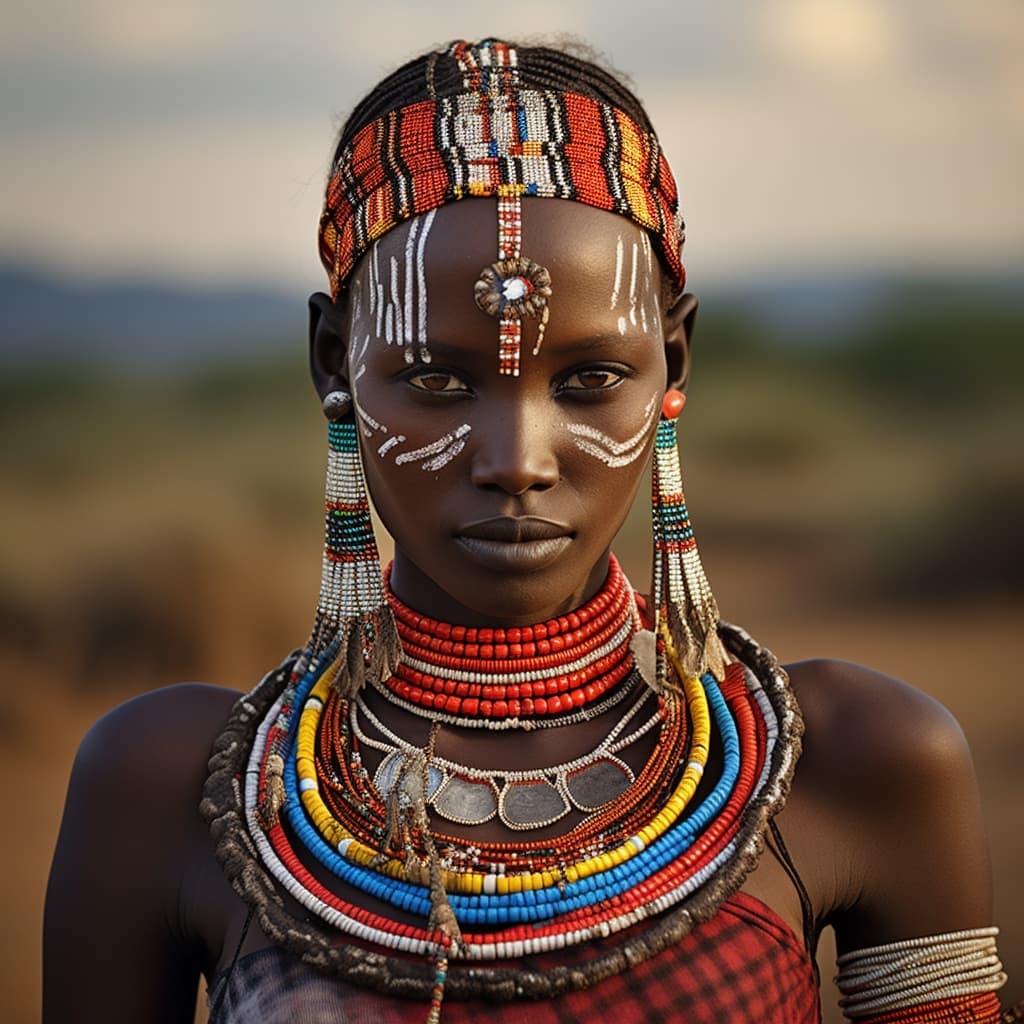
Turkana Erotic
Turkanaland (Kenya)
Nilo-Saharan / Nilotic / Turkana
Christianity / Catholicism
Western Africa
About Turkana People
The Turkana are pastoralists of Kenya's arid northwest, a people whose identity is bound to one of the harshest inhabited landscapes in East Africa — the scrub and lava plains around Lake Turkana, where rainfall is unreliable and the land has historically rewarded mobility over settlement. They number somewhere over a million, and the herd — camels, goats, sheep, donkeys, and the prestige animal, cattle — is the practical and symbolic center of life. Wealth is counted in livestock, marriages are negotiated in livestock, and the rhythm of the year follows what grazing and water the animals can find.
Their language, Turkana, belongs to the Eastern Nilotic branch and sits closely alongside Karamojong, Teso, and Toposa across the Ugandan and South Sudanese borders — together these are sometimes called the Ateker peoples, sharing a recent common ancestry that the elders still trace through oral history. The Turkana migrated into their present homeland from what is now Uganda within the last few centuries, displacing or absorbing earlier inhabitants, and the memory of that southward and eastward push is preserved in clan genealogies and territorial names.
Catholicism arrived through twentieth-century missions and now coexists, often loosely, with older practice: a creator called Akuj associated with the sky and rain, diviners (emuron) who read intestines and sandals thrown on the ground, and rites tied to age-set initiation that still organize male social life. A man passes through generation classes — Stones and Leopards, in alternation — and the set he is initiated into shapes who he eats with, fights alongside, and defers to for the rest of his life. Women's status and labor are organized around the homestead and the small stock; the elaborate beadwork stacked on a married woman's neck is not ornament alone but a public ledger of her standing.
The harder edges of Turkana life are real and worth naming: cattle raiding across the borders with the Pokot, Samburu, and Toposa has been continuous for generations, intensified now by automatic weapons and by droughts that push herders into contested grazing. Oil discoveries in Turkana County since 2012 and the persistent question of what the region owes — and is owed by — the Kenyan state have made this remote corner of the country newly central to its politics.
Typical Turkana Phenotypes
Reference for AI generation — hair, eyes, skin, facial structure, build
The Turkana are a Nilotic pastoralist people of Kenya's far northwest, and their phenotype sits firmly within the eastern Nilotic cluster — tall, lean, and very dark-skinned, with the elongated craniofacial proportions that distinguish Nilotes from neighboring Bantu and Cushitic populations. Skin tone is overwhelmingly Fitzpatrick VI: deep blackish-brown, often with a cool blue-black or umber undertone rather than the reddish or coppery cast common further west. Sun exposure in the arid Turkana Basin reinforces uniform tone across the body; lifelong outdoor pastoral life leaves the skin matte and tightly textured.
Hair is Type 4 — tightly coiled, dense, fine in strand diameter — and almost universally jet black. Traditional styling is more variable than the hair itself: men shape mud-and-ochre coiffures, women shave or braid in patterns, so what reads as "Turkana hair" in photographs is often the dressing rather than the texture. Eyes run dark brown to near-black, deep-set under a relatively flat brow, with no epicanthic fold and a somewhat almond-shaped opening.
Facial structure is the giveaway. The face is long and narrow, the forehead high, the jaw narrow rather than square. Noses are typically straight with a moderately broad alar base — narrower than Bantu averages, broader than Cushitic. Lips are full but not everted, the upper lip often shorter relative to a long midface. Cheekbones sit high but the cheeks themselves are spare, with little subcutaneous fat.
Build is the group's most measurable distinctiveness. Turkana adults are among the tallest and leanest populations on earth — men commonly 180–190 cm, women 170 cm and above, with very long limbs relative to torso, narrow shoulders and hips, and minimal body fat. Ajuma Nasenyana's runway proportions and Paul Ereng's 800m frame are not outliers but the population mean made visible. Sub-group variation between the Ngisonyoka, Ngiwoyakwara and other territorial sections is largely cultural; the underlying phenotype is remarkably consistent across Turkanaland.
Data depth
46/100Coverage of image-grounded phenotype observations · drives AI generation diversity
- Sample size
- 6/40· 2 images
- Image quality
- 25/30· 50% high
- Confidence
- 15/20· mean 0.79
- Source diversity
- 0/10· wikipedia
- ·No image observations yet
- ·Wikipedia-only source — not population-representative
Explore phenotype categories
Structured taxonomy with peer-reviewed scales · 22 anatomical categories
Notable Turkana People
5 reference figures — sourced from Wikipedia
- Goldman Environmental Prize — Ikal Angelei - Winner of Goldman Environmental Prize
- Paul Ereng — 1988 800m Olympic Champion and 800m former indoor world record holder,
- Ekwee Ethuro — Former Speaker of the Senate and former MP for Turkana Central.
- John Kiyonga Munyes — Former Minister of Labour
- Ajuma Nasenyana — Supermodel






Generate Turkana AI Content
Use this ethnicity's phenotype data to create AI-generated content with accurate physical traits and cultural context.
Open Creator Studio