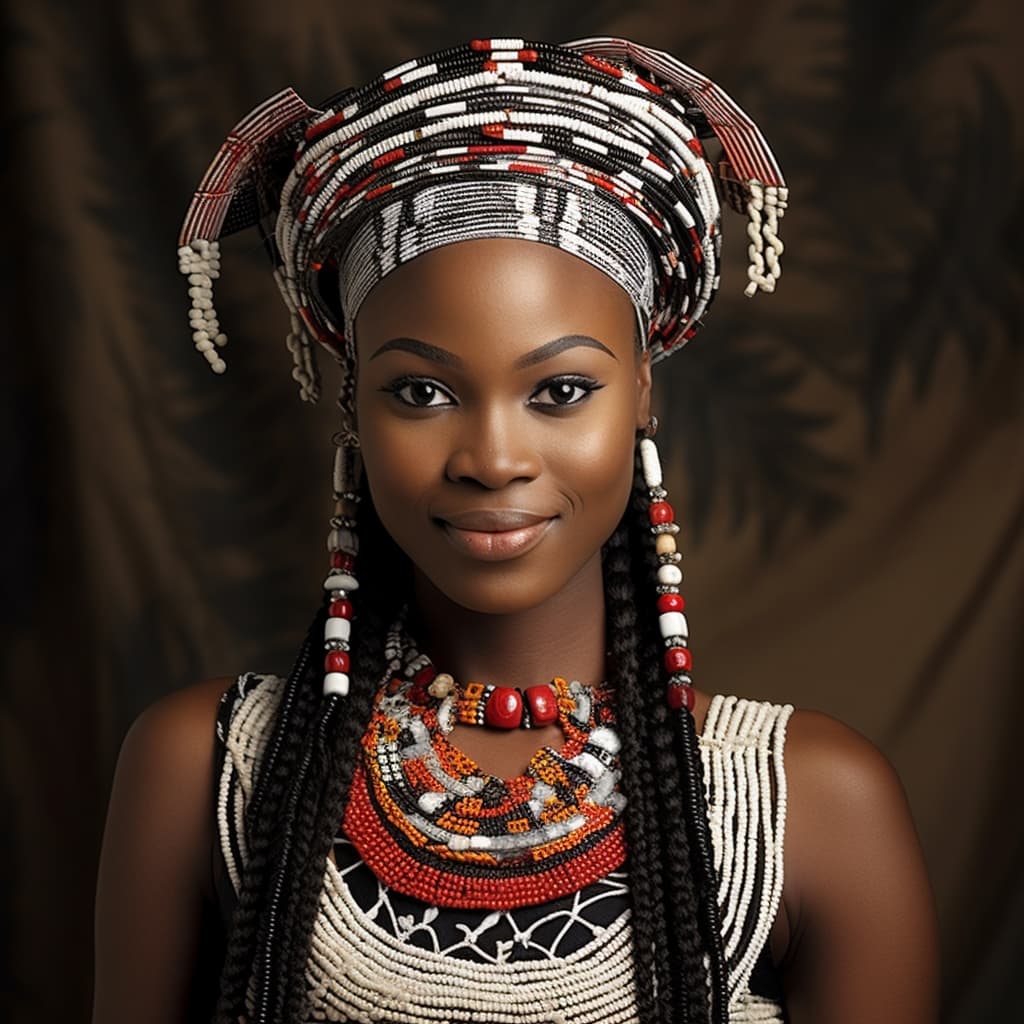
Tiv Erotic
Benue State (Nigeria)
Niger–Congo / Tiv
Christianity
Western Africa
About Tiv People
The Tiv are the largest ethnic group in Nigeria's Middle Belt, concentrated in Benue State along the river that gives the region its name, with sizeable communities spilling into Taraba, Nasarawa, and Plateau. They number somewhere around five million and stand out among their neighbors for a striking fact: until the colonial period, they had no chiefs. Authority ran through lineage and age — through the genealogical principle the Tiv call ityo, which traces every person back to a common ancestor named Tiv — and disputes were settled by elders sitting in council rather than by any king or paramount ruler. The British, predictably, found this unworkable and installed a Tor Tiv, a paramount chief, in 1947. The office remains, but the underlying segmentary logic of Tiv society never quite went away.
The language is Tivoid, a small branch of Bantoid within Niger–Congo, and it sits somewhat apart from the Yoruba, Igbo, and Hausa-speaking giants that surround it. This linguistic isolation is part of why Tiv identity has stayed sharply defined: the language doesn't blur into anyone else's, and almost everyone in the homeland speaks it as a first language. Christianity, mostly Catholic and Reformed, took hold in the twentieth century through Dutch and Irish missions and is now dominant, though older ideas about tsav — a kind of inherited spiritual force, dangerous and ambivalent, that powerful elders are believed to carry — persist beneath the surface and surface in moments of crisis, witchcraft accusations, and political rhetoric.
Tiv country is yam country. The crop is not just food but the spine of the agricultural year and the marker of a serious farmer; a man's standing has long been measured partly in his barns. The famous swange dance, with its hip-driven rhythm and call-and-response singing, came out of this farming world and is now the music people most readily associate with the group. Tiv weaving — the black-and-white striped a'nger cloth — is worn at weddings, funerals, and political rallies as an instantly legible flag of identity.
The recent story is harder. The Middle Belt has been the front line of Nigeria's farmer-herder conflict for two decades, and Tiv farming communities have absorbed repeated waves of violence over land, water, and grazing routes. It has hardened ethnic politics in the region and pushed the Tiv into a more assertive public posture than the lineage elders of a century ago would have recognized.
Typical Tiv Phenotypes
Reference for AI generation — hair, eyes, skin, facial structure, build
The Tiv are a Benue Valley population whose phenotype sits within the broader Central Nigerian range but reads distinctly tall and long-limbed compared to many neighboring groups. Anthropometric surveys of Benue State consistently place adult Tiv men in the 175–183 cm band, with women typically 162–170 cm — noticeably above the Nigerian national mean. Build is lean and linear in youth, with relatively narrow hips and long lower legs; broader, more powerful musculature is common in adult men, as the wrestler Apollo Crews and powerlifter Russel Orhii illustrate at the heavier end of that range.
Skin sits in the deep brown to near-black range, Fitzpatrick VI being the modal tone, with warm red-brown undertones rather than the cooler blue-black cast more typical further south in the Niger Delta. Hair is uniformly Type 4 — tightly coiled, dense, with the fine, springy 4B–4C texture predominating; natural color is black, with age-related greying tending to a clean white rather than salt-and-pepper. Eyes are dark brown to near-black; epicanthic folds are absent, and the eye opening is generally wide and almond-set rather than rounded.
Facial structure is where Tiv phenotype reads most distinctively. The nose is broad at the alar base with a low-to-medium bridge, but less platyrrhine than coastal West African averages — a moderately projecting profile is common. Lips are full, with a well-defined vermilion border; the lower lip is often noticeably fuller than the upper. Cheekbones are high and laterally placed, the jaw squared in men and softer but still defined in women, giving the face a vertically long, planar quality. Foreheads tend to be tall and slightly sloped.
Sub-regional variation within Tivland is modest — the Kwande, Sankera, and Jemgbar areas all share the core phenotype — but admixture with neighboring Idoma, Jukun, and Hausa-Fulani populations along the group's edges produces lighter brown skin tones and somewhat narrower nasal forms in border communities.
Data depth
61/100Coverage of image-grounded phenotype observations · drives AI generation diversity
- Sample size
- 28/40· 22 images
- Image quality
- 23/30· 45% high
- Confidence
- 10/20· mean 0.69
- Source diversity
- 0/10· wikipedia
- ·Modest sample (n<25)
- ·Wikipedia-only source — not population-representative
Observed Distribution — Image Sample
Empirical observations from analyzed photographs · supplementary signal, not population truth
Sample: 22 images analyzed (22 wikipedia). Quality: 10 high, 9 medium, 3 low, 0 very_low. Avg analyzer confidence: 0.69.
Skin tone (Fitzpatrick): V (14%), VI (73%), unclear (14%)
Hair color: gray/white (45%), black (36%), unclear (18%)
Hair texture: coily (59%), shaved (5%), covered (23%), unclear (14%)
Eye color: dark brown (86%), unclear (14%)
Epicanthic fold: 0% present, 86% absent, 14% unclear
Caveats: Sample size 22 is modest — secondary patterns may not be reliable. Sample is 100% Wikipedia notable people — skews toward male, public-life, and modern figures, not population-representative.
Last aggregated: May 7, 2026
Explore phenotype categories
Structured taxonomy with peer-reviewed scales · 22 anatomical categories
Notable Tiv People
66 reference figures — sourced from Wikipedia
- Ichegh — Soups: Ichegh, Pocho, ager, ive, genger, atyever, tur, vambe, igyo, agbende a…
- Jollof rice — Tiv staples: Roasted yams, ahuma, Jollof rice, fried yams, kuese etc.
- tyo — Beverages: tyo, burukutu, atemba a suwanbin, ibyer.
- Joseph Tarka — politician, human rights activist
- Paul Unongo — politician, human rights activist
- Barnabas Gemade — former PDP party chairman
- Aper Aku — first civilian governor of Benue state
- George Akume — former senate minority leader
- Iyorchia Ayu — former senate president
- SAN — Prof. Ignatius Akaayar Ayua, SAN, OFR, FNIALS, former Permanent Secretary Min…
- Chaha Biam — former speaker house of representative
- Gabriel Suswam — politician former governor of Benue state
- Terhemba Shija — politician, academic, poet.
- Samuel Ortom — former State Governor
- Hyacinth Alia — the current State Governor
- Daniel Saror — former minority leader
- Michael Aondoakaa — former attorney general of Nigeria
- Moses Adasu — politician, former Benue state governor
- A. I. Katsina-Alu — former chief justice of Nigeria
- Ambrose Feese — former minister of works and housing.
- Iyorwuese Hagher — former senate deputy chief whip, minister and envoy
- Yima Sen — intellectual and radical political activist
- Emmanuel Udende — Senator from Benue state
- Titus Zam — Senator from Benue state
- Herman Hembe — former house of reps member
- Dickson Tarkighir — house of reps member
- Gideon Orkar — Nigerian Military officer.
- Victor Malu — former Chief of Army Staff
- Joseph Akahan — first Nigerian Chief of Army Staff
- Lawrence Igyuse Doki — WW 2 veteran and emancipator of Makurdi
- Joseph Akaagerger — Former Governor of Katsina state
- John Mark Inienger — former ECOMOG commander
- Farida Waziri — former EFCC Chairperson
- John Kpera — Military governor of Anambra state.
- ECOMOG — General Gabriel Kpamber, former ECOMOG commander
- Virginia Military Institute — Prof. Col. James T. Gire, Virginia Military Institute, USA
- Terna Suswam — football player
- Dominic Iorfa Sr — football player
- Dominic Iorfa Jr — football player
- Timothy Anjembe — football player
- David Tyavkase — football player
- Jeff Varem — NBA D-league player
- Terna Nande — American football player
- Apollo Crews — WWE wrestler
- Francisca Ordega — Nigerian national team soccer player
- Gift Orban — Nigerian footballer.
- Barnabas Imenger Jr. — Nigerian super eagles striker
- Russel Orhii — World Champion Powerlifter
- Moses Kpakor — Former BBL Hawks FC, BCC Lions F.C., Electricity FC, Abiola Babes F.C. and Ni…
- Amir Angwe — Former BCC Lions F.C., Julius Berger FC and Nigerian National team player.
- Tom Iorpenda — football player
- Makir Zakpe — Tor Tiv I
- Alfred Akawe Torkula — Tor Tiv IV
- Akiga Sai — autobiographer and historian
- James Ayatse — Tor Tiv V and past VC Federal University, Dutsin-Ma and UAM
- Illinois State University — Aondoaver Tarhule ---- President Illinois State University, USA
- Emmanuel Iornumbe Kucha — past VC University of Agriculture, Makurdi
- University of Agriculture, Makurdi — Vershima Daniel Uza—past VC University of Agriculture, Makurdi
- Charity Angya — Past VC Benue State University
- Msugh Moses Kembe — past VC Benue State University
- Benue State University — Akase P. Sorkaa --- past VC Benue State University
- Tor Joe Iorapuu — present VC Benue State University
- Bohannan, Paul J. — & Laura (1953) The Tiv of Central Nigeria London: International African Insti…
- doi — Bohannan, Laura (1952). "A Genealogical Charter". Africa: Journal of the Inte…
- Ozovehe — Ehusani, G.O. An Afro-Christian Vision "Ozovehe!." Lanham, Maryland: Universi…
- ISBN — Jibo, Mvendaga. Chieftaincy and Politics: The Tor Tiv in the Politics and Adm…






Generate Tiv AI Content
Use this ethnicity's phenotype data to create AI-generated content with accurate physical traits and cultural context.
Open Creator Studio