Tigre Erotic
Eritrea
Afroasiatic / Semitic / Ethiopic / Tigre
Islam
Eastern Africa
About Tigre People
The Tigre are a pastoralist people of the Eritrean lowlands — the dry coastal plains along the Red Sea, the western escarpment that drops toward Sudan, and the Barka and Anseba river valleys in between. They are the second-largest ethnic group in Eritrea, and what holds them together as Tigre rather than as a federation of clans is largely the language: a Semitic tongue descended from ancient Ge'ez, closely related to Tigrinya spoken on the highlands above them, but distinct enough that the two are not mutually intelligible. Tigre has historically been an oral language; a substantial poetic tradition exists almost entirely in memory and performance, with written literature only emerging in earnest in the twentieth century, mostly in Arabic or Ge'ez script depending on the writer and the era.
Most Tigre are Sunni Muslim, and the conversion is comparatively recent in the long view — a process that worked through the lowlands across several centuries, displacing earlier Christian and traditional layers and arriving as the ordinary religion of the countryside only in the eighteenth and nineteenth centuries. Islam sits alongside an older social architecture rather than overwriting it. Society is organized into a dense mesh of clans and confederations — the Beni-Amer, the Mensa, the Marya, the Habab, the Bet Asgede among others — and historically these were stratified between noble lineages (shumagulle) and tributary serf clans (tigre, confusingly the same word as the ethnonym), an arrangement that produced significant internal upheaval in the twentieth century when serf groups asserted independence, sometimes converting religion or rewriting genealogy in the process.
Daily life is shaped by livestock — camels above all, but also cattle, goats, and sheep — and by the calendar of seasonal movement between rainy-season pastures and dry-season wells. Camel husbandry among the Beni-Amer in particular is a serious craft, and the vocabulary around camels in Tigre is correspondingly precise. Hospitality obligations are heavy and formalized; a guest's arrival reorders the household. The Eritrean war of independence and the long subsequent border conflicts with Ethiopia disrupted the lowlands severely, sending large Tigre populations into Sudan as refugees, and the diaspora in Kassala and Port Sudan remains substantial. Inside Eritrea, the Tigre live mostly outside the highland political center in Asmara, and the cultural distance between lowland Muslim pastoralist and highland Christian farmer is one of the country's defining seams.
Typical Tigre Phenotypes
Reference for AI generation — hair, eyes, skin, facial structure, build
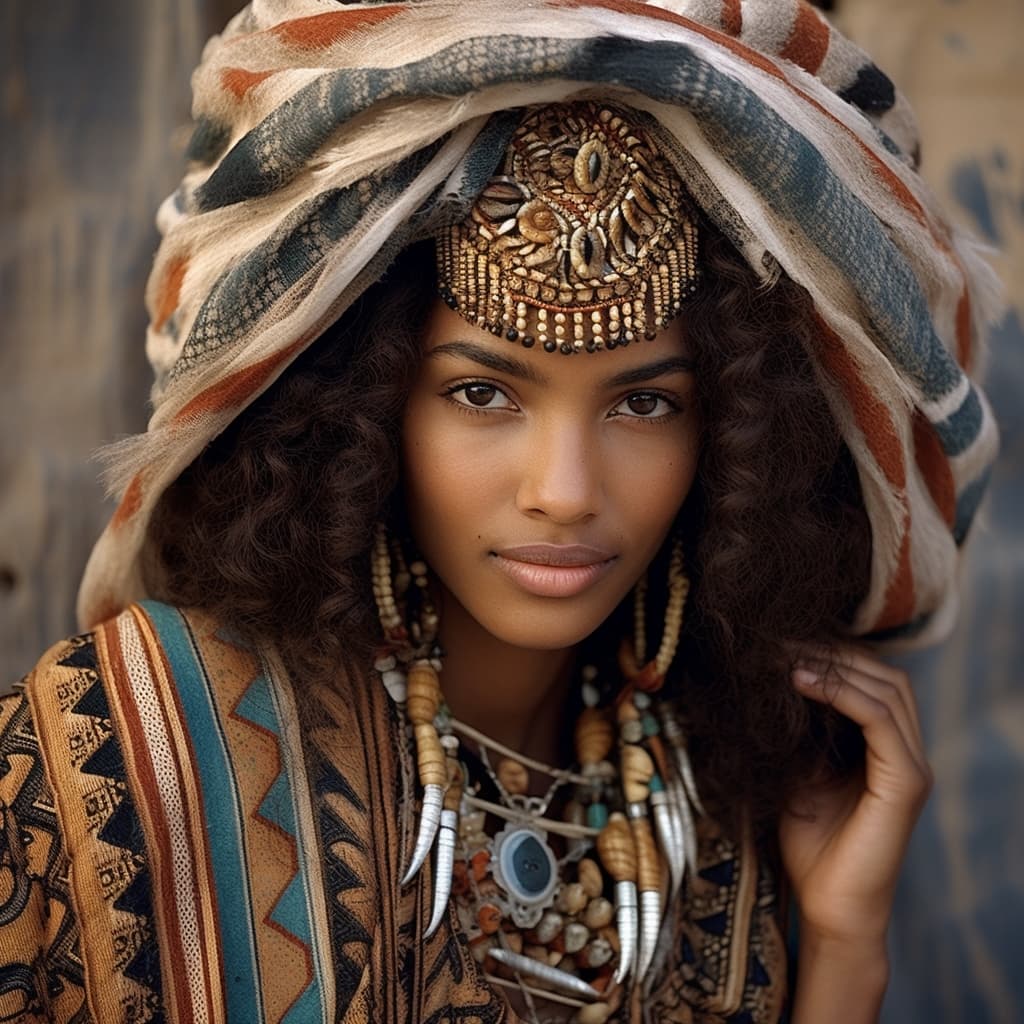
The Tigre are a predominantly Muslim, pastoralist Semitic-speaking population of Eritrea's northern and western lowlands — Sahel, Barka, Semhar, and the coastal plain. Their phenotype reads as classically Horn-of-Africa: a long-standing admixture of Cushitic and Arabian-peninsula ancestry rather than the more strictly Sub-Saharan profile of populations further south or west. The result is features that look East African in proportion but with finer bone structure than is typical of Bantu-speaking groups.
Hair is dark brown to black, with a curl pattern that runs Type 3 to looser Type 4 — coiled and dense, but rarely the tight kink seen further into Sub-Saharan Africa. Many Tigre men keep close-cropped hair or wear a light beard; women historically wore elaborate plaited styles. Eyes are almost always dark brown to near-black, almond-shaped, set under a flat or only mildly arched brow. Epicanthic folds are absent.
Skin tone spans Fitzpatrick IV through VI, clustering around a warm reddish-brown to deep brown — often described as "burnt copper" in lowland populations exposed to intense Red Sea sun. Undertones lean warm, with reddish or yellow-bronze rather than the cooler blue-black undertones of Nilotic groups. Lighter-skinned individuals occur, particularly in coastal Semhar where Arabian admixture is highest.
Facial structure is the giveaway: narrow, often high-bridged noses with moderate alar width — closer to the Arabian or Cushitic norm than the broader West African pattern. Lips are medium-full rather than thick, the cupid's bow well-defined. Cheekbones are high and the jaw tapers; faces read long and oval rather than round. Builds are characteristically lean and tall — men commonly 175–185 cm, with long limbs, narrow hips, and low body fat shaped by a pastoral diet. Women share the slender, long-limbed build, with the gracile shoulder-to-hip ratio common across Horn populations. The overall impression is height, length, and refined features — not bulk.
Data depth
0/100Coverage of image-grounded phenotype observations · drives AI generation diversity
- Sample size
- 0/40· 0 images
- Image quality
- 0/30· 0% high
- Confidence
- 0/20
- Source diversity
- 0/10
- ·No image observations yet
Explore phenotype categories
Structured taxonomy with peer-reviewed scales · 22 anatomical categories





Generate Tigre AI Content
Use this ethnicity's phenotype data to create AI-generated content with accurate physical traits and cultural context.
Open Creator Studio