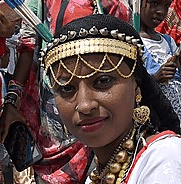
Afar Erotic
Afaria (Ethiopia, Djibouti, Eritrea)
Afroasiatic / Cushitic / Afar
Islam
Eastern Africa
About Afar People
The Afar live in one of the hottest inhabited places on earth — the Danakil Depression and the lava plains and salt flats radiating out from it across northeastern Ethiopia, southern Eritrea, and Djibouti. The land sets the terms. Daytime temperatures sit above forty degrees for much of the year, surface water is scarce, and the local economy has organized itself around mobile herds of camels, goats, and cattle moving between seasonal pasture. The Afar are not nomadic by nostalgia; they are nomadic because the alternative is to starve.
Their language, also called Afar or Qafar, belongs to the Cushitic branch of Afroasiatic and sits closest to Saho, spoken by neighbors to the north in Eritrea. It is more distantly related to Somali and Oromo. Afar has been written in a Latin-based script — Qafar Feera — since the 1970s, but oral verse remains the prestige form: praise poetry, lineage recitation, and improvised exchanges that men compose and judge against one another. Genealogy carries real weight. A person is placed by clan affiliation before they are placed by anything else, and the major confederations — broadly grouped as the Asaimara, the "Red," and the Adoimara, the "White" — still shape political alignment and pasture rights.
Islam arrived early, carried across the Bab el-Mandeb from Arabia, and the Afar have been Sunni Muslim for centuries; the region around Zeila was one of the early footholds of Islam in the Horn. Practice tends toward the practical rather than the scholastic. Customary law, mada'a, runs alongside sharia and handles most disputes about livestock, marriage, and blood compensation, with clan elders presiding. Women hold a more visible economic role than the stereotype of pastoral Muslim societies allows: they manage milk production, build and dismantle the portable ari hut at every move, and trade independently at market.
The Afar Sultanate of Aussa, which lasted into the twentieth century, gave the group a coherent political memory that survived colonial partition between Ethiopia, Italian Eritrea, and French Somaliland. That partition is the inflection point. It split a single pastoral economy across three eventual nation-states and left the Afar as a permanent minority in each, negotiating grazing routes across borders that the herds themselves do not recognize. The Afar Regional State in Ethiopia, established in 1995, was the first formal acknowledgment that the people had a claim to govern the land they had always crossed.
Typical Afar Phenotypes
Reference for AI generation — hair, eyes, skin, facial structure, build
The Afar carry a distinctive Cushitic East African phenotype shaped by millennia in one of the hottest inhabited environments on earth — the Danakil Depression. The look is lean, sharp-featured, and tall, closer to the Somali and Beja end of the Horn spectrum than to the rounder Amhara or Tigrayan profile of the Ethiopian highlands.
Hair is almost universally black, tightly coiled to kinky (Type 4), and traditionally worn in a defined Afro halo — the asdago — that men oil with ghee. Some loosening to looser coils (Type 3C/4A) appears, but straight or wavy hair is rare and usually signals admixture. Eyes run dark brown to near-black, occasionally with a striking lighter caramel or hazel cast that becomes visually arresting against deeply pigmented skin. The eye is almond-shaped, set under a moderate brow, with no epicanthic fold.
Skin tone falls firmly in Fitzpatrick V–VI: deep brown to very dark brown, with warm reddish or bronze undertones rather than the bluer tones of West African groups. Decades of intense sun and reflected salt-flat glare produce uniformly even pigmentation; lighter complexions exist but are uncommon.
Facial structure is the giveaway. Afar features tend toward the narrow-nosed, fine-boned Cushitic template: a high, often straight or slightly aquiline nose bridge with relatively narrow nostrils — distinct from the broader alar base typical of Bantu populations to the south. Lips are medium-full, not maximally everted. Cheekbones sit high and prominent; jawlines are angular; faces read as long rather than round.
Build is famously slender and tall — men frequently 175–185 cm, women lean and long-limbed, with low body fat carried high. The pastoralist diet of camel milk and meat, combined with constant walking across the desert, produces a wiry, sinewy physique with visible tendons and minimal subcutaneous fat. Sub-clan variation (Adoimara, Asaimara) is social rather than visibly phenotypic; you'd be hard-pressed to tell branches apart by appearance alone.
Data depth
0/100Coverage of image-grounded phenotype observations · drives AI generation diversity
- Sample size
- 0/40· 0 images
- Image quality
- 0/30· 0% high
- Confidence
- 0/20
- Source diversity
- 0/10
- ·No image observations yet
Explore phenotype categories
Structured taxonomy with peer-reviewed scales · 22 anatomical categories






Generate Afar AI Content
Use this ethnicity's phenotype data to create AI-generated content with accurate physical traits and cultural context.
Open Creator Studio