
Berta Erotic
Benishangul-Gumuz Region (Ethiopia), South Sudan
Nilo-Saharan / Berta
Islam
Eastern Africa
About Berta People
The Berta live along the Ethiopia–Sudan borderlands, concentrated in the lowlands of Ethiopia's Benishangul-Gumuz Region and spilling across the frontier into Blue Nile state and parts of South Sudan. They call themselves Funj or Wetawit depending on locality; "Berta" is the exonym that stuck. Their territory is hot, gold-bearing scrubland — the kind of country that has drawn outside interest for centuries and hasn't always benefited from it. Small-scale alluvial gold panning, sorghum cultivation, and beekeeping anchor village life, and the gold in particular has shaped how the Berta have been perceived, taxed, and raided by successive lowland and highland powers.
Linguistically the Berta are an outlier in their immediate neighborhood. Their language is classified as Nilo-Saharan but does not slot neatly into the larger branches of that family, and most linguists treat Berta as its own isolated cluster within it. That is unusual in a region where Cushitic and Semitic Afroasiatic languages dominate the highlands just to the east, and it reflects a long history of the Berta sitting at a cultural seam rather than belonging to either side of it. Many Berta are bilingual in Arabic, a legacy of centuries of contact with Sudanese trade networks and Islamic scholarship moving up the Blue Nile.
Islam among the Berta is Sunni and arrived gradually through Sudanese influence rather than by conquest, which left room for older practices to remain woven into daily and ceremonial life. Spirit-possession traditions, locally called goofa, persist alongside mosque attendance, and respected ritual specialists handle illness, misfortune, and disputes that fall outside the reach of the imam or the state. Marriage negotiations, funerary observances, and the rhythms of the agricultural year carry that doubled register without much apparent strain.
The twentieth century was hard on the Berta. The Ethiopia–Sudan border bisected their homeland, the Sudanese civil wars displaced communities along the Blue Nile, and Ethiopian state projects — most consequentially the Grand Ethiopian Renaissance Dam, built squarely in Benishangul-Gumuz — have transformed the landscape and the politics around them. The region also saw serious inter-ethnic violence in the early 2020s. The Berta navigate all of this from a position of being numerically modest, politically peripheral, and sitting on top of resources other people want, which is a familiar configuration for borderland peoples and rarely a comfortable one.
Typical Berta Phenotypes
Reference for AI generation — hair, eyes, skin, facial structure, build
The Berta sit on the Ethiopia–Sudan borderlands and carry a phenotype that reads as classically Nilo-Saharan with strong Sudanic influence — distinct from the Cushitic and Semitic populations of Ethiopia's highlands, and visibly closer to Funj and Ingessana neighbors across the South Sudan frontier. Skin tone is uniformly deep, generally Fitzpatrick VI, with cool blue-black to warm umber undertones rather than the reddish-bronze register seen in Oromo or Amhara groups. Sun exposure rarely produces visible variation; the deep base tone is constitutional.
Hair is tightly coiled Type 4B–4C, dense, with a small natural curl diameter and high shrinkage. It is almost uniformly black-brown, occasionally sun-bleached at the tips on children and pastoralists. Greying tends to come late and stays sharp-edged against the dark base. Beards on men are typically sparse to moderate rather than full.
Eyes are dark brown to near-black, set under flat or mildly arched brows. Epicanthic folds are absent. The eye shape is typically wide and almond, often with prominent sclera visible due to the contrast against deep skin.
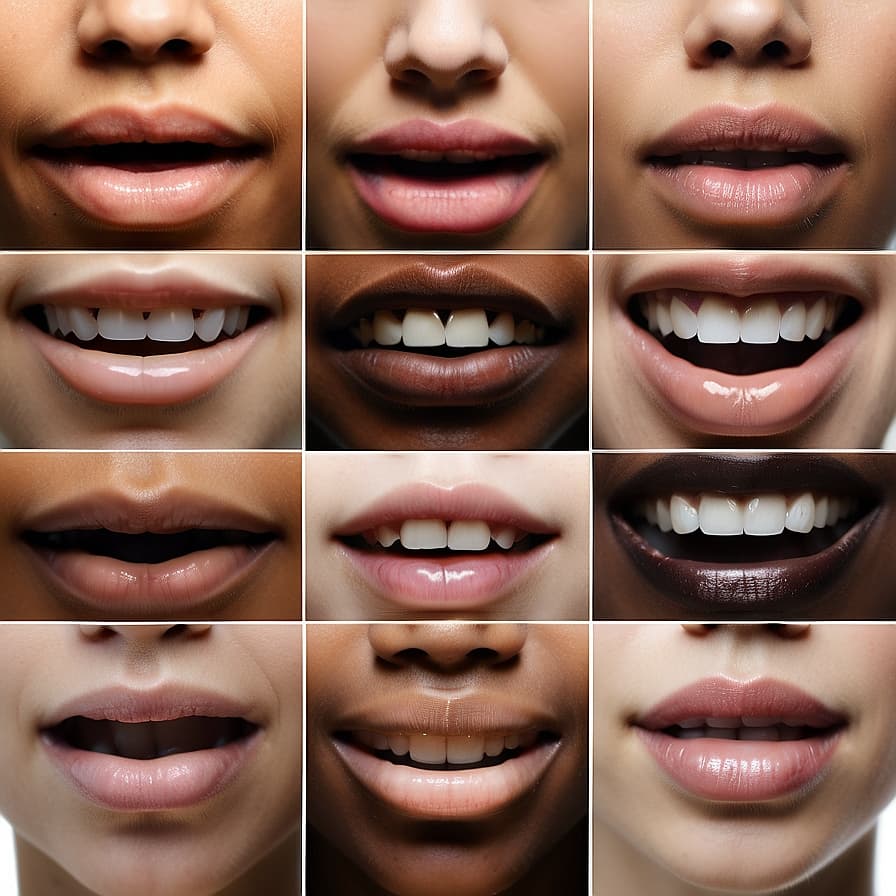
Facial structure leans Nilotic: long, narrow skull shape, a relatively narrow face with a tall midface, moderate to broad alar width on the nose with a low to medium bridge, and full lips — upper and lower roughly balanced, often with a defined vermilion border. Cheekbones are present but not as architectural as in Tutsi or Dinka phenotypes. Jaws are clean rather than heavy, and prognathism is mild when present.
Build is the most distinctive register. The Berta tend toward the tall, linear Nilotic body plan — long limbs relative to torso, narrow hips and shoulders, low subcutaneous fat, and a high crural index. Average male stature sits in the upper range for the region, comfortably above 175 cm in many communities. Women carry the same long-limbed proportions with naturally slim waists and modest hip-to-shoulder ratios. The combination of Fitzpatrick VI skin, tightly coiled hair, and elongated linear build is the signature.
Data depth
0/100Coverage of image-grounded phenotype observations · drives AI generation diversity
- Sample size
- 0/40· 0 images
- Image quality
- 0/30· 0% high
- Confidence
- 0/20
- Source diversity
- 0/10
- ·No image observations yet
Explore phenotype categories
Structured taxonomy with peer-reviewed scales · 22 anatomical categories





Generate Berta AI Content
Use this ethnicity's phenotype data to create AI-generated content with accurate physical traits and cultural context.
Open Creator Studio