Ganda Erotic
Buganda (Uganda)
Niger–Congo / Bantu / Great Lakes / Luganda
Christianity
Abayudaya
Eastern Africa
About Ganda People
The Ganda — Baganda in their own usage, Luganda speakers singular Muganda — are the largest of Uganda's ethnic groups and the people whose kingdom gave the country its name. Buganda sits along the northern shore of Lake Victoria, a green, well-watered country of red-soil hills and banana groves; the matooke plantain is less a staple than a defining substance, steamed in banana leaves and eaten with almost everything. Their language, Luganda, is a Great Lakes Bantu tongue closely related to Lusoga and Runyoro-Rutooro, and it carries a noun-class system of striking precision — speakers sort the world into people, long things, liquids, abstractions, and so on, with each category triggering its own grammatical agreement.
What sets the Ganda apart historically is the kingdom itself. Buganda is one of the oldest and most centralised polities in the African Great Lakes, with a Kabaka at its head and a clan system — over fifty clans, each with its totem and ritual offices — that cuts across the kingdom and binds commoners and royalty into a single web of obligation. Every Muganda belongs to a clan inherited from the father, and the clans, not the kingdom alone, are the deeper structure of social life: who one may marry, what one may not eat, which drum and which honorific belong to whose lineage. The Kabaka was abolished by Milton Obote in 1966 and restored in 1993; the throne today is ceremonial, but the cultural authority of Mengo and the clan heads is real.
Christianity arrived in the 1870s and took hold quickly, though not gently — the Uganda Martyrs, young Christian pages executed at the court of Kabaka Mwanga in 1886, are still a defining memory, and Catholic and Anglican identities in Buganda map onto old political fault lines. Practice tends to sit easily alongside older observances: clan rituals, ancestral remembrance, and the consultation of traditional healers persist beneath a formally Christian surface. A small but distinctive branch, the Abayudaya, are Ganda Jews — descendants of followers of Semei Kakungulu, a Ganda military leader who broke with the missionaries in 1919 and led his community into a self-taught Judaism that has since been formally recognised by Conservative and Reform authorities. They live mostly around Mbale in the east, pray in Luganda and Hebrew, and remain a reminder that Ganda religious history has never been quite as tidy as the colonial census wanted it to be.
Typical Ganda Phenotypes
Reference for AI generation — hair, eyes, skin, facial structure, build
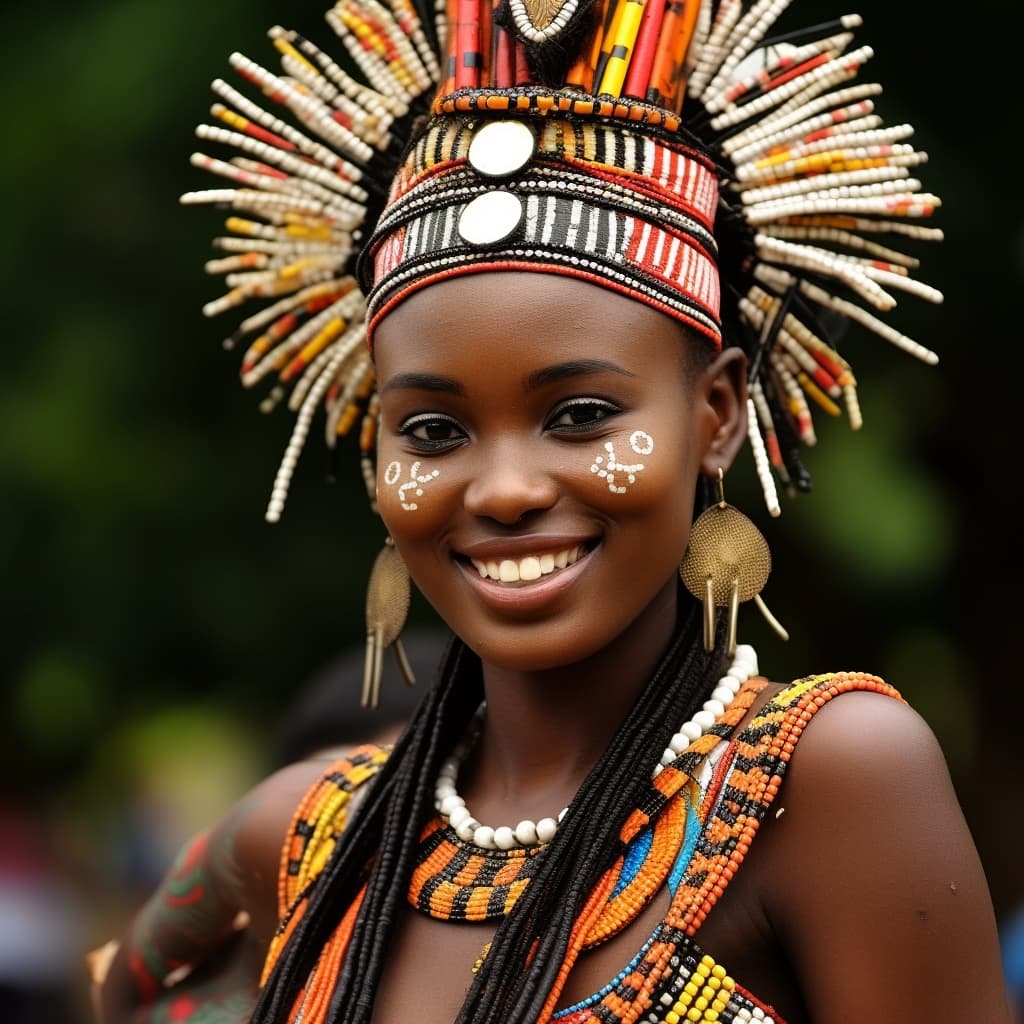
The Ganda are a Great Lakes Bantu population from the lake-shore plateau of southern Uganda, and their phenotype sits within the broader East African Bantu range — generally darker and more uniformly so than the Nilotic populations to the north, with rounder facial features than the pastoralist groups of the Rift. Hair is almost universally Type 4, tightly coiled, ranging from springy 4A through dense 4C; jet black is the default, with occasional dark-brown reflections in strong sun. Texture is typically dense and uniform across the scalp, without the looser curl patterns sometimes seen in mixed Horn-of-Africa populations.
Eye color is dark brown to near-black, with no epicanthic fold and a relatively wide, open palpebral fissure. Skin tone clusters in Fitzpatrick V to VI — deep brown to very dark brown, with warm reddish-cocoa undertones rather than the cooler blue-black undertones common further west in Central Africa. Sun exposure on the equatorial plateau keeps tone fairly even across exposed and unexposed skin.
Facial structure tends toward a broad but moderately projecting nose — wider alar base than narrow Nilotic noses, but less platyrrhine than many West African groups — with a low-to-medium bridge. Lips are full, with both upper and lower vermilion well-developed and often everted. Cheekbones are present but not sharply prominent; the jaw is rounded rather than angular, and faces read as soft and full rather than chiseled.
Build is moderate by East African standards — generally shorter and stockier than Nilotic neighbors like the Acholi or Karamojong, with mean male stature around 168–172 cm. Body composition trends toward a balanced mesomorph frame; women commonly show pronounced gluteofemoral fat distribution, a trait culturally noted within Buganda itself.
The Abayudaya, the Jewish Ganda community around Mbale, are phenotypically indistinguishable from the wider Ganda population — the group is defined by religious practice adopted in the twentieth century, not by any distinct ancestry.
Data depth
0/100Coverage of image-grounded phenotype observations · drives AI generation diversity
- Sample size
- 0/40· 0 images
- Image quality
- 0/30· 0% high
- Confidence
- 0/20
- Source diversity
- 0/10
- ·No image observations yet
Explore phenotype categories
Structured taxonomy with peer-reviewed scales · 22 anatomical categories






Generate Ganda AI Content
Use this ethnicity's phenotype data to create AI-generated content with accurate physical traits and cultural context.
Open Creator Studio