Acholi Erotic
Acholiland (Uganda, South Sudan)
Nilo-Saharan / Nilotic / Luo / Acholi
Christianity
Eastern Africa
About Acholi People
The Acholi are a Luo-speaking people of the savanna grasslands straddling the Uganda–South Sudan border, a single cultural region that colonial cartographers split in two and that Acholi themselves have always treated as one. Their language belongs to the Western Nilotic branch — close kin to Lango, Alur, and the Luo of western Kenya, all descended from migrations down the Nile corridor several centuries ago. An Acholi speaker and a Kenyan Luo speaker can reach a working mutual understanding within minutes, despite the thousand kilometres between them; the family resemblance has outlasted the distance.
Pre-colonial Acholi society was organised into dozens of small chiefdoms — rwodi ruling lineage-based polities, with authority resting on cattle, ritual responsibility, and the moral standing of the chief rather than on standing armies. That decentralised structure shaped how the Acholi absorbed everything that came afterwards: nineteenth-century Arab and Swahili slave raids from the north, British colonial recruitment that pulled Acholi men disproportionately into the King's African Rifles and later the Ugandan military, and the long catastrophe of the Lord's Resistance Army insurgency from the late 1980s into the 2000s, which displaced almost the entire rural population into camps for nearly two decades. The recovery from that period is recent enough to still be a live, daily subject rather than a closed chapter of history.
Christianity — Catholic in the south of Acholiland, Anglican more common in pockets, with smaller Pentecostal communities — sits over an older religious substrate that has not really gone away. Ancestral spirits (jogi) and the moral authority of the dead still inform how illness, misfortune, and reconciliation are understood, and traditional cleansing ceremonies like mato oput — the bitter-root rite for resolving killings between clans — were drawn on heavily during post-war reintegration, sometimes uneasily alongside formal courts.
Music carries a lot of the cultural weight. The bwola, a large circular dance traditionally performed for chiefs, and the courtship dance larakaraka with its calabash percussion are still actively performed, not staged for outsiders. The nanga trough zither and the lukeme thumb piano accompany sung poetry in which praise, complaint, and gossip are not really separable categories — a register that the poet Okot p'Bitek drew on directly in Song of Lawino, still the most widely read piece of Acholi literature outside the region.
Typical Acholi Phenotypes
Reference for AI generation — hair, eyes, skin, facial structure, build
The Acholi are a Nilotic people of the Luo branch, and their phenotype reflects that lineage rather than the Bantu populations that surround them in much of Uganda. The defining structural feature is height and elongation: tall stature, long limbs relative to torso, narrow hips and shoulders, and a lean build with low subcutaneous fat. Adult men commonly stand 178–188 cm; women trend tall as well, often 168–175 cm. This linear, "ectomorphic" build is shared with neighboring Nilotic groups (Dinka, Nuer, Luo of Kenya) and is one of the more anthropometrically distinctive body types in East Africa.
Skin tone sits at the deep end of the Fitzpatrick scale — type VI almost universally — with cool, blue-black or red-black undertones rather than the warmer browns common in Bantu populations to the south. Hair is Type 4, tightly coiled to kinky, near-uniformly black; women historically wear it close-cropped or braided, and grey arrives late. Eye color is dark brown to near-black; the eye opening tends to be wide and almond-shaped without epicanthic folds, often set under a relatively flat brow.
Facial structure is the second most recognizable feature after build. Faces are long and narrow rather than round, with high foreheads, prominent cheekbones, and a strong vertical line through the jaw. Noses are typically narrow at the bridge with moderate alar width — not the broad, low-bridged nose associated with West African phenotypes — and lips are full but proportionate, less everted than in many Bantu groups. The model Aamito Lagum is a useful anchor: tall, dark-skinned, narrow-featured, long-necked, with the elongated facial geometry that reads as specifically Nilotic.
Sub-group variation across Acholiland (Gulu, Kitgum, Pader, Amuru, and the South Sudanese Acholi of Magwi) is modest. Mild Bantu admixture appears at the southern edges, producing slightly shorter stature and rounder facial features, but the core Nilotic phenotype — tall, lean, deep-toned, long-faced — holds across the population.
Data depth
57/100Coverage of image-grounded phenotype observations · drives AI generation diversity
- Sample size
- 25/40· 18 images
- Image quality
- 17/30· 33% high
- Confidence
- 15/20· mean 0.72
- Source diversity
- 0/10· wikipedia
- ·Modest sample (n<25)
- ·Wikipedia-only source — not population-representative
Observed Distribution — Image Sample
Empirical observations from analyzed photographs · supplementary signal, not population truth
Sample: 18 images analyzed (18 wikipedia). Quality: 6 high, 7 medium, 5 low, 0 very_low. Avg analyzer confidence: 0.72.
Skin tone (Fitzpatrick): V (11%), VI (78%), unclear (11%)
Hair color: black (61%), gray/white (22%), other (6%), blonde (6%), unclear (6%)
Hair texture: straight (6%), wavy (6%), coily (78%), covered (11%)
Eye color: dark brown (83%), other (6%), unclear (11%)
Epicanthic fold: 0% present, 94% absent, 6% unclear
Caveats: Sample size 18 is modest — secondary patterns may not be reliable. Sample is 100% Wikipedia notable people — skews toward male, public-life, and modern figures, not population-representative.
Last aggregated: May 7, 2026
Explore phenotype categories
Structured taxonomy with peer-reviewed scales · 22 anatomical categories
Notable Acholi People
32 reference figures — sourced from Wikipedia
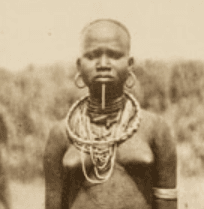
- Richard Buchta — Acholi people photographed by Richard Buchta (1877-1880)
- Akena p'Ojok — former UNLF Vice President, former UPC member of Parliament and Minister of P…
- Nicholas Opiyo — Ugandan human rights lawyer. Executive Director and Lead Attorney at Chapter …
- Sheila Atim — Ugandan-British actress, singer, composer, and playwright. She made her profe…
- David Otti — a former Ugandan footballer and coach who was part of the famous 1978 team.
- Judith Ayaa — a former track and field athlete who competed in the 400 and 800 metres.
- Aamito Stacie Lagum — US-based Ugandan actress and fashion model, best known for being the winner o…
- Daudi Ochieng — Ugandan Nationalist and Politician, who served as Secretary General of the Ka…
- Bazilio Olara-Okello — de facto Ugandan Head of State for six months in 1985 and later Chief of Defe…
- Patricia Akello — Ugandan professional model, currently signed with the Muse Model Management c…
- Beatrice Akello Akori — Ugandan politician. Woman member of parliament for Agago District. Minister o…
- Richard Todwong — former member of parliament. Current secretary general of the ruling National…
- Otema Allimadi — Ugandan politician who served as the country's foreign minister (1979–1980) i…
- Betty Oyella Bigombe — former MP and State Minister for Water Resources in the Ugandan Cabinet. Serv…
- Emmanuel Amey Ojara — surgeon.
- Dominic Ongwen — former commander of the Sinia Brigade of the LRA, currently awaiting the verd…
- Erinayo Wilson Oryema — First Ugandan Inspector General of Uganda Police Force (1964–1971), Minister …
- Geoffrey Oryema — exiled singer and son of Erinayo Wilson Oryema.
- Janani Luwum — former Archbishop of the Anglican Church of Uganda, murdered on the orders of…
- Jeremiah Lucas Opira — National Executive Secretary of the UNLF, advocate for consolidation of natio…
- Joseph Kony — leader of the Lord's Resistance Army (LRA), a guerrilla group that formerly o…
- Lubwa p'Chong — playwright, poet, author and educator.
- Matthew Lukwiya — physician at the forefront of the 2000 Ebola outbreak, which took his life.
- Norbert Mao — former chairman of Gulu District and Democratic Party presidential candidate …
- Okot p'Bitek — poet, playwright and author of the Song of Lawino.
- Tito Okello — President of Uganda for six months in 1985 (though he referred to himself onl…
- Henry Oryem Okello — current state minister for foreign affairs (international affairs), since 200…
- Jacob Oulanyah — former Speaker of Ugandan Parliament May 2021 – March 2022, former deputy of …
- John Baptist Odama — Catholic archbishop of Gulu, with long periods as chair of the Acholi Religio…
- MacLeod Baker Ochola — Anglican bishop in Uganda. He was the inaugural bishop of Kitgum, serving fro…
- Harriet Anena — Ugandan writer and performer, whose writing includes poetry, nonfiction and f…
- ISBN — Atkinson, Ronald Raymond (1994) The roots of ethnicity: the origins of the Ac…



Generate Acholi AI Content
Use this ethnicity's phenotype data to create AI-generated content with accurate physical traits and cultural context.
Open Creator Studio