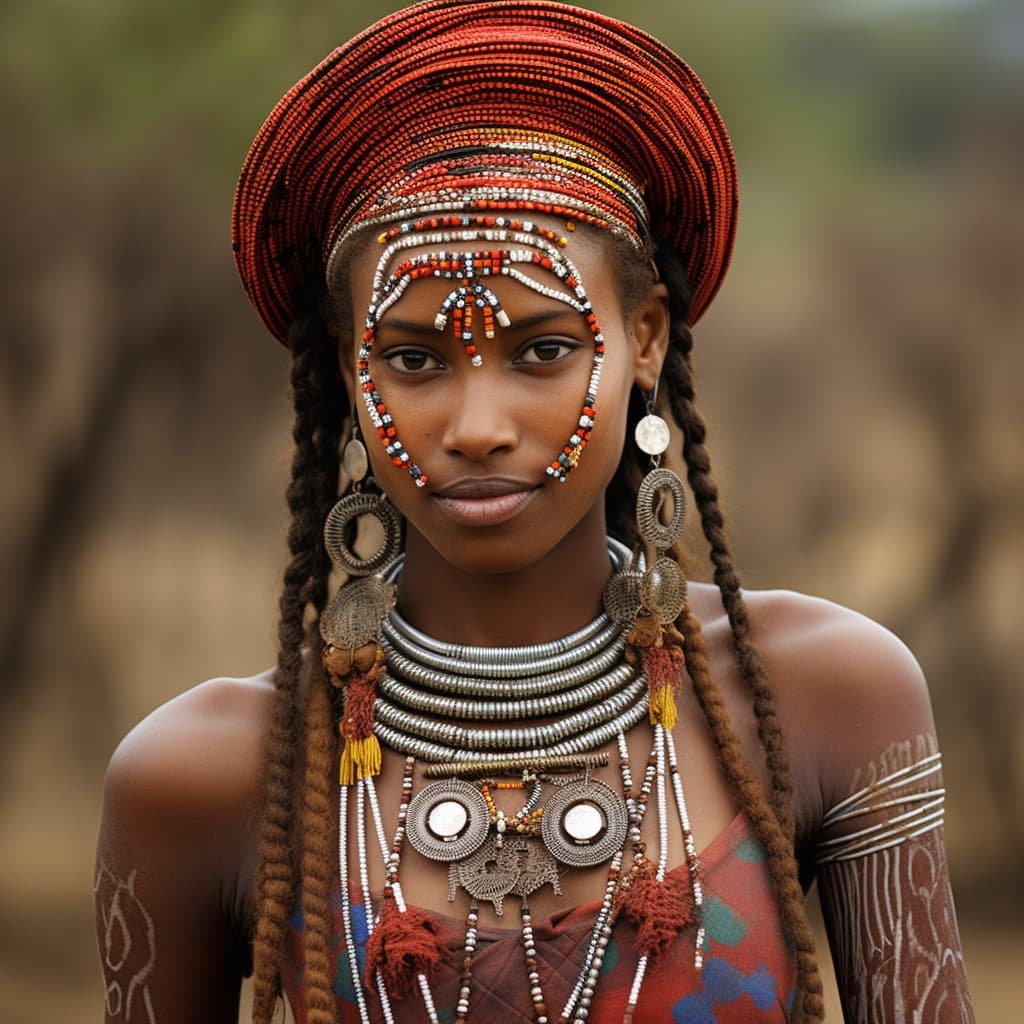
Gedeo Erotic
Gedeo Zone (Ethiopia)
Afroasiatic / Cushitic / Gedeo
Christianity / Protestantism
Eastern Africa
About Gedeo People
The Gedeo live on a narrow strip of highland southwest of Lake Abaya, where the escarpment falls away from the Sidama plateau toward the Rift Valley floor. The land is steep, wet, and unusually crowded — one of the densest rural populations in Ethiopia farms these slopes — and the Gedeo have shaped it into something close to a permanent garden. Their agroforestry system, layering enset, coffee, and shade trees on the same plot, is old enough and intricate enough that UNESCO recognized the cultural landscape in 2023. Coffee from these hills moves into the world as Yirgacheffe.
Their language, also called Gedeo or Gede'uffa, belongs to the Highland East Cushitic branch and sits close to Sidama and Hadiyya; speakers of the three can sometimes follow each other with effort, but the languages are distinct and the boundary with Sidama, in particular, is something Gedeo are quick to mark. The group is internally divided into seven traditional clans, and elders still trace lineage and territory through that framework even where modern administration has overwritten it.
Underneath the visible Protestant Christianity — the result of twentieth-century mission work, mostly Mekane Yesus and Kale Heywet — runs the older indigenous system called baalle, a generation-grade structure that ranks men through ritual stages and produces the council that traditionally handled disputes, land, and ceremony. Baalle is not a museum piece; it still convenes, still mediates, and the church has had to make peace with it rather than replace it. The result is a religious life where Sunday service and clan ritual coexist without much public anxiety about the contradiction.
The twentieth century was hard on the Gedeo in specific ways. Imperial-era land policy stripped much of their territory into the hands of absentee landlords from the north, and the long resentment that produced fed into the Derg's redistribution and, later, into the violence of 2018, when ethnic clashes with neighboring Guji Oromo displaced close to a million Gedeo in a few weeks — one of the largest internal displacements in the world that year, and one most foreign coverage missed. Most have since returned to the slopes, to the coffee, to the enset gardens that take seven years to mature and which a household cannot simply walk away from for long.
Typical Gedeo Phenotypes
Reference for AI generation — hair, eyes, skin, facial structure, build
The Gedeo are a Cushitic-speaking highland people of southern Ethiopia, concentrated on the steep escarpment east of Lake Abaya at 1,800–3,000 meters. Their phenotype sits within the broader Ethiopid cluster shared with neighboring Sidama, Oromo, and Amhara, but skews toward the narrower-featured, finer-boned end of that range rather than the heavier Nilotic morphology found further west.
Hair is almost universally black, tightly coiled in a Type 4 pattern, though slightly looser and more pliable than the dense coils typical of West African groups — a soft, springy texture rather than wiry. Premature greying at the temples is common in middle-aged men. Eyes are dark brown to near-black; the epicanthic fold is absent, and the eye opening is typically almond-shaped with a moderate, even-set spacing. Eyelashes tend to be long and dense.
Skin tone covers Fitzpatrick IV through deep V — a warm reddish-brown to dark brown with copper or olive undertones rather than the cooler blue-black undertone seen in equatorial West African phenotypes. Highland sun and altitude give a slightly weathered, matte finish to the skin in adults who farm enset and coffee on the slopes.
Facial structure is the Gedeo signature: a narrow, often high-bridged nose with moderate alar width — neither the broad flat nose of forest African groups nor the sharply aquiline Horn-of-Africa profile, but something between. Lips are medium-full, well-defined, rarely heavy. Cheekbones sit high and the jaw tapers cleanly to a small chin, producing the long oval face that's characteristic across the Sidamic-Cushitic zone.
Build runs lean and gracile. Men typically stand 168–175 cm, women 158–164 cm, with long limbs relative to torso, narrow hips, and low body-fat carriage shaped by a mountain-farming subsistence diet centered on enset, kale, and coffee. Shoulders are sloped rather than squared, and muscularity is wiry rather than bulky — the body type of a highland walker, not a lowland pastoralist.
Data depth
0/100Coverage of image-grounded phenotype observations · drives AI generation diversity
- Sample size
- 0/40· 0 images
- Image quality
- 0/30· 0% high
- Confidence
- 0/20
- Source diversity
- 0/10
- ·No image observations yet
Explore phenotype categories
Structured taxonomy with peer-reviewed scales · 22 anatomical categories






Generate Gedeo AI Content
Use this ethnicity's phenotype data to create AI-generated content with accurate physical traits and cultural context.
Open Creator Studio