Agaw Erotic
Horn of Africa (Ethiopia, Eritrea)
Afroasiatic / Cushitic / Agaw
Christianity / Oriental Orthodoxy
Bilen, Ximre, Awi, Qemant
Eastern Africa
About Agaw People
The Agaw are the older layer of the Ethiopian highlands — the people who were already there when Semitic-speaking migrants from across the Red Sea arrived and, over centuries, reshaped the political map around them. They survive today in pockets scattered across northern Ethiopia and Eritrea: the Bilen around Keren, the Awi south of Lake Tana, the Qemant west of Gondar, the Xamtanga-speaking Xamir in Wag and Lasta. None of these communities border each other directly. The pattern on the map is the residue of a long retreat, or rather a long absorption, as Amharic and Tigrinya pushed outward from the centers of power and Agaw speakers shifted, generation by generation, into the dominant tongue.
Their languages belong to the Cushitic branch of Afroasiatic, which makes them cousins of Oromo, Somali, and Beja rather than of the Semitic Amharic that surrounds them. The Agaw branch is its own small family — four living languages, none of them with millions of speakers, several of them genuinely endangered. Linguists have used Agaw substrate features to argue that much of what feels distinctive about Ethiopian Semitic — its verb-final word order, certain sound patterns — was inherited from the Cushitic populations that early Semitic speakers married into and gradually replaced.
Most Agaw today are Ethiopian or Eritrean Orthodox Christians, and have been for a very long time. The Zagwe dynasty, which ruled the Ethiopian highlands roughly from the tenth to the thirteenth century and left behind the rock-hewn churches of Lalibela, was Agaw — a fact that complicates the standard narrative in which Agaw history is one of slow displacement. The Zagwe period was an Agaw-led Christian empire, and the churches of Lalibela are arguably the most ambitious architectural project in Ethiopian history. The Qemant, uniquely, kept a syncretic religion combining Hebraic and indigenous elements well into the twentieth century before most converted to Orthodoxy; the Bilen include both Christian and Muslim populations, the result of nineteenth-century shifts under Egyptian and later Italian rule in the Eritrean lowlands.
What ties the branches together now is less a shared political life than a shared sense of priority — of having been the highland's first farmers, first church builders, first kings — even as the practical business of being Agaw increasingly means being bilingual, or speaking only the neighboring Semitic language while carrying an Agaw name and an Agaw village.
Typical Agaw Phenotypes
Reference for AI generation — hair, eyes, skin, facial structure, build
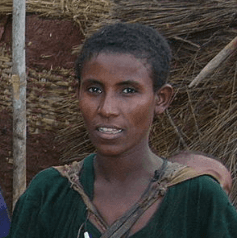
The Agaw are a Cushitic-speaking population of the Ethiopian and Eritrean highlands, and their phenotype reflects the long Horn of Africa pattern: features that read as African in pigmentation but with the narrower facial architecture associated with northeast African Cushitic groups rather than the broader features common further south or west. Hair is typically black, tightly coiled to kinky (Type 4), though looser curl patterns appear especially among the Bilen of the Eritrean lowlands, who sit at a contact zone with Tigre and Beja populations. Greying tends to come gradually, and natural color variation is narrow — near-uniform black, with reddish casts only after sun bleaching.
Eyes are almost universally dark brown to near-black, occasionally a lighter amber in elders. Eye shape is typically almond, set wide, with a clean upper lid and no epicanthic fold. Brows are dark and well-defined. Skin tone spans Fitzpatrick IV through VI, clustering around a warm medium-to-deep brown with reddish or olive undertones rather than the cooler blue-black sometimes seen in equatorial West Africa. Highland sun and altitude give a slightly weathered, ruddy quality to exposed skin that is recognizably Ethiopian.
Facial structure is the most distinctive marker. Noses tend to be narrow with a high, straight bridge and modest alar width — closer to the profile seen across Tigrayan, Amhara, and Somali populations than to sub-Saharan averages. Lips are medium-full, less everted than in West African groups. Cheekbones are high and the jaw is typically narrow, giving an elongated, fine-boned face. Build is generally lean and wiry, with long limbs and narrow hips; stature runs medium, roughly 165–175 cm for men, with low typical body fat shaped by a highland agricultural diet.
Sub-group variation is real but subtle. The Bilen show somewhat lighter skin and looser hair textures from lowland admixture; the Awi and Qemant of the western highlands trend slightly darker and retain the classic narrow-featured Cushitic profile most consistently.
Data depth
6/100Coverage of image-grounded phenotype observations · drives AI generation diversity
- Sample size
- 6/40· 2 images
- Image quality
- 0/30· 0% high
- Confidence
- 0/20· mean 0.34
- Source diversity
- 0/10· wikipedia
- ·No image observations yet
- ·Low overall confidence
- ·Wikipedia-only source — not population-representative
Explore phenotype categories
Structured taxonomy with peer-reviewed scales · 22 anatomical categories
Notable Agaw People
4 reference figures — sourced from Wikipedia
- Gebre Mesqel Lalibela — ruler of Ethiopia who is credited with having constructed the rock-hewn churc…
- Tekle Giyorgis II — Emperor of Ethiopia
- Abebaw Tadesse — Ethiopian general
- Hailu Kebede — Arbegnoch leader






Generate Agaw AI Content
Use this ethnicity's phenotype data to create AI-generated content with accurate physical traits and cultural context.
Open Creator Studio