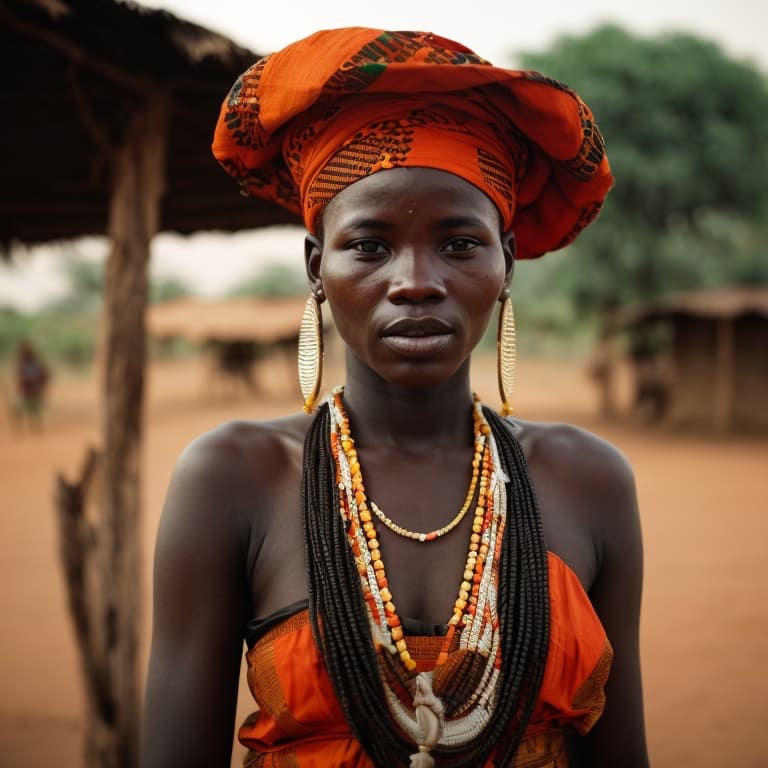
Bari Erotic
Central Equatoria (South Sudan), Uganda
Nilo-Saharan / Nilotic / Bari
Christianity
Pojulu, Kakwa, Nyangwara, Mandari, Kuku
Eastern Africa
About Bari People
The Bari are a Nilotic people whose homeland straddles the White Nile in Central Equatoria, with the river running through the heart of their territory and the city of Juba sitting on what has been Bari ground for generations. They are cattle-keepers and cultivators rather than pure pastoralists — the floodplain savanna around the Nile rewards both, and Bari villages have long been organized around a mix of sorghum and millet plots, riverside fishing, and herds that signal status as much as they feed a household. Iron-working has a deep history here; Bari smiths once supplied tools and weapons across a wide stretch of the southern Sudan, and the trade gave the group a reputation among neighbors that outlasted the slave-raiding and Mahdist disruptions of the nineteenth century.
Bari belongs to the Eastern Nilotic branch and sits at the center of a small cluster of closely related speech communities — Pojulu, Kakwa, Nyangwara, Mandari, and Kuku — usually grouped together as the "Bari-speaking peoples." Whether these count as sub-groups of the Bari proper or as cousin nations is a question Bari themselves answer differently depending on context; the languages are mutually intelligible to varying degrees, and intermarriage and shared ritual vocabulary tie the cluster together even where political identity diverges. To the north and east lie Dinka and Mundari country; to the south, the Lugbara and Acholi worlds begin. Bari sit at a hinge between these.
Christianity, brought first by Catholic and Anglican missions in the colonial period, is now the dominant religious affiliation, but it has not displaced an older substrate so much as folded into it. Rainmakers retained authority well into the twentieth century, and elements of the older religious imagination — concern with ancestors, the spiritual weight of cattle, ritual specialists tied to lineage — still shape how funerals, marriages, and disputes are conducted in the village even when the formal frame is church. Marriage payments in cattle remain central, age-set thinking organizes labor and obligation, and lineage matters in ways that registries don't capture.
The decades of war that produced South Sudan have hit Bari country hard — Juba's wartime growth, displacement into Uganda and Kenya, and the slow return have all reshaped what village life looks like. A substantial Bari diaspora now lives in East African cities and farther abroad, and the language, carried in churches and family networks, is one of the threads holding that diaspora to home.
Typical Bari Phenotypes
Reference for AI generation — hair, eyes, skin, facial structure, build
The Bari and their related branches — Pojulu, Kakwa, Nyangwara, Mandari, Kuku — sit within the Nilotic cluster of the central Nile valley, and the phenotype reads accordingly: tall, narrow-built, and very dark-skinned, with the elongated limb proportions that anthropometric surveys of South Sudanese Nilotes have consistently flagged as among the most extreme on the continent. Skin tone runs Fitzpatrick VI almost uniformly, often with a deep blue-black or warm umber undertone rather than the reddish cast common further west; the depth holds even in shaded areas, and sun exposure tends to deepen rather than redden.
Hair is tightly coiled Type 4 — usually 4B to 4C — fine in strand diameter and worn short by most men, often shaved or close-cropped. Color is uniformly black-brown; natural lightening is rare and typically a sign of protein deficiency rather than genetics. Eyes are dark brown to near-black, set in a wide, open lid without an epicanthic fold; the brow ridge is moderate and the orbital opening tends to read large against the long facial plane.
The face itself is the giveaway: long and narrow, with a high forehead, prominent but not broad cheekbones, and a jaw that tapers cleanly. Noses tend to be straight or slightly convex with a relatively narrow bridge for an African phenotype and a moderate alar width — less broad than West African averages, a recurring Nilotic trait. Lips are full but well-defined, and the philtrum is often pronounced.
Build is where the group is most distinctive. Men commonly clear 185 cm, with documented village averages among the highest worldwide; women are correspondingly tall and slender. Shoulders are narrow, limbs long relative to torso, and body fat tends to sit low even on well-fed adults — an ectomorphic frame adapted to heat dissipation. Across the sub-groups the variation is minor; Kakwa and Kuku, sitting further south into Uganda and DRC borderlands, sometimes show slightly broader facial features from neighboring Bantu admixture, but the tall, narrow, deep-toned baseline holds throughout.
Data depth
0/100Coverage of image-grounded phenotype observations · drives AI generation diversity
- Sample size
- 0/40· 0 images
- Image quality
- 0/30· 0% high
- Confidence
- 0/20
- Source diversity
- 0/10
- ·No image observations yet
Explore phenotype categories
Structured taxonomy with peer-reviewed scales · 22 anatomical categories




Generate Bari AI Content
Use this ethnicity's phenotype data to create AI-generated content with accurate physical traits and cultural context.
Open Creator Studio