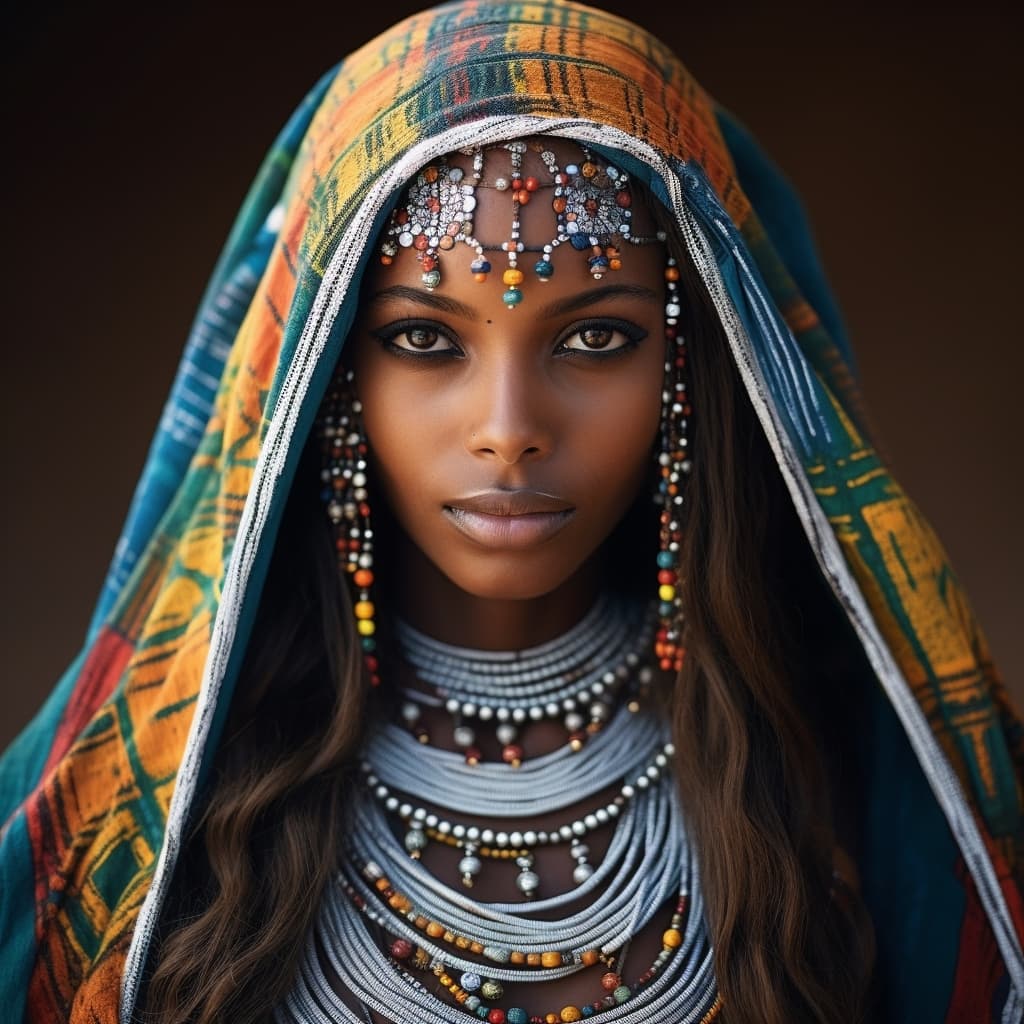
Tama Erotic
Chad, Sudan
Nilo-Saharan / Tama
Islam
Eastern Africa
About Tama People
The Tama live along the Chad–Sudan border in the highlands and savanna country east of Wadi Fira and west of Darfur. They are one of those border peoples whose identity has always been shaped by the line — or rather, by the absence of one. Long before the colonial cartographers showed up, Tama territory was a corridor: caravan routes from the Nile to Lake Chad ran through it, and the Tama Sultanate, established in the seventeenth century around the town of Gereida, became one of the small but persistent powers of the eastern Sahel, sandwiched between the larger sultanates of Wadai to the west and Darfur to the east. That position — useful, contested, never quite dominant — still describes the Tama today.
The Tama language belongs to the Taman branch of Nilo-Saharan, a small cluster that also includes Sungor, Mararit and Erenga. These are close relatives, and the boundary between Tama proper and its neighbors is more of a dialect gradient than a sharp linguistic break; a Tama speaker and a Sungor speaker can usually work things out. Arabic is the lingua franca for trade, religion and increasingly for the younger generation, and many Tama are functionally trilingual, switching between Tama at home, Chadian Arabic in the market, and standard Arabic at the mosque or in school.
Islam came gradually, through the same caravan networks that gave the sultanate its income, and by the eighteenth century the Tama were thoroughly Muslim — Sunni, Maliki in legal tradition, with the Tijaniyya Sufi order influential in the religious life of the older generation. Practice is unshowy. Five prayers, Ramadan, the marabout consulted for blessings and disputes, Quranic schools attached to most villages of any size. Pre-Islamic elements survive at the edges, particularly in healing and in customs around birth and marriage, but they are not advertised.
Tama society is built around patrilineal clans and a strong tradition of cattle and sorghum agriculture, with millet on poorer ground. The Darfur conflict that began in 2003 spilled across the border and hit Tama villages hard; many Tama still live in displacement camps in eastern Chad, and the community's recent history cannot be told without that rupture. They are a small people — perhaps two hundred thousand, depending on how one counts the closely related groups — but a stubborn one, with a clear sense of who they are and where they sit on the map.
Typical Tama Phenotypes
Reference for AI generation — hair, eyes, skin, facial structure, build
The Tama are a Nilo-Saharan people of the Wadai-Darfur borderlands, straddling eastern Chad and western Sudan, and their phenotype reads as classically Sahelian — strongly sub-Saharan in pigmentation and hair, with the long-limbed, narrow-built frame typical of populations that evolved in arid savanna. Hair is uniformly very dark, near-black, and tightly coiled — Type 4 in the Andre Walker scale, with the dense afro-textured patterning common across the broader Wadaian and Darfuri belt. Greying tends to come late, and beards on men run sparse-to-moderate rather than full. Loose-textured curls or wave patterns are essentially absent except where there's been intermarriage with neighboring Arab-descended groups in Wadai.
Eyes are dark brown to black, almond-shaped, and set under a clean orbital ridge with no epicanthic fold. Sclera often carries a faintly yellowed or warm cast — a normal feature in the region, not a health marker. Skin sits firmly in Fitzpatrick V–VI: deep brown through to genuinely dark brown-black, with cool, slightly reddish undertones rather than the olive cast seen further north in Chadian Arab populations. Sun exposure across the Sahel is unrelenting, and skin tends to read evenly pigmented with minimal tonal variation across the body.
Facial structure is the most distinctive piece. Tama faces tend to be long and narrow rather than broad, with relatively high, somewhat angular cheekbones and a defined jawline. Noses are typically straight or gently convex with a moderate bridge and medium alar width — narrower than in Nilotic groups further south, broader than in Cushitic Horn populations to the east. Lips are full but not maximally everted; the upper lip often shows a clean, well-defined cupid's bow.
Builds run tall and lean. Adult men commonly fall in the 175–185 cm range, women proportionately tall, with long limbs, narrow hips and shoulders, and low subcutaneous fat — the ectomorphic Sahelian build shaped by heat dissipation rather than fat storage. Musculature reads wiry and defined rather than bulky, even on physically active men.
Data depth
0/100Coverage of image-grounded phenotype observations · drives AI generation diversity
- Sample size
- 0/40· 0 images
- Image quality
- 0/30· 0% high
- Confidence
- 0/20
- Source diversity
- 0/10
- ·No image observations yet
Explore phenotype categories
Structured taxonomy with peer-reviewed scales · 22 anatomical categories






Generate Tama AI Content
Use this ethnicity's phenotype data to create AI-generated content with accurate physical traits and cultural context.
Open Creator Studio