Surma Erotic
Ethiopia, South Sudan
Nilo-Saharan / Surmic
Traditional African religions
Me'en, Mursi, Kichepo
Eastern Africa
About Surma People
The Surma are not really one people so much as a cluster of related communities — Mursi, Me'en, Suri (sometimes called Chai and Tirma), Kichepo — strung along the lower Omo Valley in southwestern Ethiopia and across the border into the South Sudanese hills. They share Surmic languages within the wider Nilo-Saharan family, which sets them apart linguistically from the Cushitic and Semitic peoples who dominate most of Ethiopia. The terrain shapes everything: dry savanna and riverine pasture along the Omo, malarial lowlands, and a long agricultural calendar built around sorghum and the cattle that function as currency, dowry, and walking inheritance.
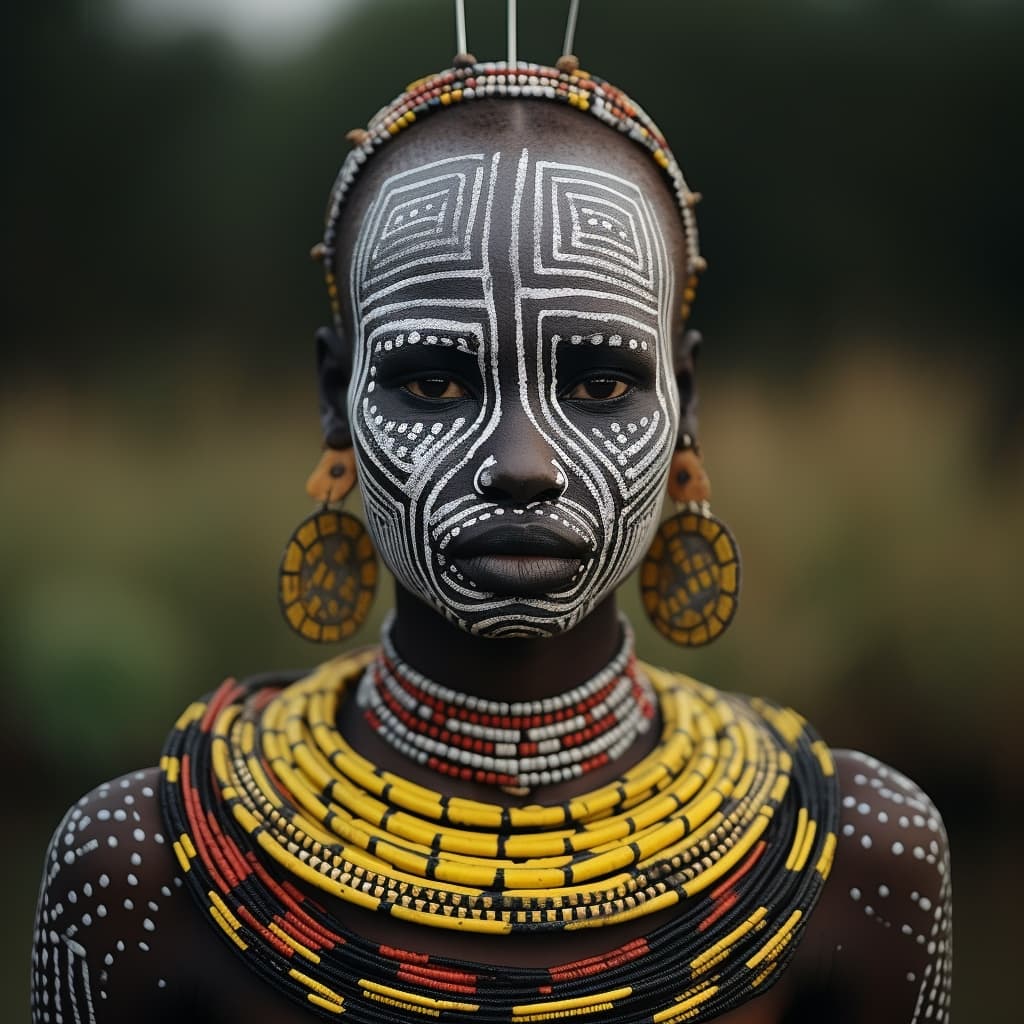
Cattle are the organizing fact of Surma life. A young man's standing, his ability to marry, and his place in the age-set system are all calibrated through the herd. Bridewealth runs into dozens of cows, paid out over years. The famous donga stick fights — long bouts of single combat fought with two-meter wooden poles, often in the weeks after harvest — are partly courtship display, partly a way of settling rank between villages without escalating to firearms, which the region has plenty of. Scarification, ochre body painting using local clays mixed with water, and the lip plates worn by Mursi and some Suri women are part of the same expressive grammar; they are not costume, and they are not done for outsiders, though outsiders have made photographic tourism into an awkward modern complication.
Religion in the older sense remains widely practiced — a creator figure called Tumu among the Suri, ancestral spirits, ritual specialists who handle rain, illness, and the seasonal cycle of the herds. Christian missions, both Orthodox and evangelical, have made some inroads, especially among the Me'en, but the traditional cosmology has not been displaced the way it has in much of highland Ethiopia. Twentieth-century history has not been gentle: the Derg era pulled the lowlands into Ethiopia's wars, refugee movement across the Sudanese border has been near-constant, and the Gibe III dam upstream on the Omo has reshaped the seasonal floods that lowland agriculture depended on. The Surma have absorbed Kalashnikovs, government schools, and aid-agency clinics without dismantling the underlying social architecture — which remains organized around cattle, age, and the village.
Typical Surma Phenotypes
Reference for AI generation — hair, eyes, skin, facial structure, build
The Surma — encompassing the Mursi, Me'en, and Kichepo of the lower Omo Valley and adjacent South Sudanese borderlands — present one of the more structurally distinctive Nilotic phenotypes on the continent. Skin tone sits at the deepest end of the Fitzpatrick VI range, with a cool blue-black undertone rather than the warmer red-brown found in Cushitic neighbors to the north. The pigmentation is uniform across the body with little tonal variation, and weathering from the high-altitude equatorial sun produces a matte, almost ashen surface texture rather than burnishing.
Hair is Type 4C — tightly coiled, low-density, and typically kept very short or fully shaved on both sexes. Color is uniformly black; greying arrives late. Eyes are dark brown to near-black, almond-shaped, with no epicanthic fold and a clean, exposed upper lid. Brow ridges are moderate, set above wide-spaced eyes.
Facial architecture is the giveaway: long, narrow heads (dolichocephalic), high foreheads, prominent cheekbones, and notably wide alar bases on a low, flat nasal bridge — the classic Nilotic nose. Lips are full top and bottom, with the Mursi and Surma proper famous for the women's lower-lip plates, which over years of stretching produce a permanently elongated lower lip even when the plate is removed. Jaws are squared in men, tapered in women, with strong dentition and prognathic profiles.
Build is the other signature: among the tallest populations on earth. Adult Mursi and Surma men commonly reach 185–195 cm, women 170–180 cm, on extraordinarily long limbs and lean, low-fat frames — narrow shoulders and hips, minimal subcutaneous fat, wiry musculature shaped by pastoralist mobility and stick-fighting (donga) traditions. The Me'en, more agriculturalist and living at slightly higher elevation, trend a touch shorter and broader-built than the riverine Mursi, but the Nilotic linearity holds across all three branches.
Data depth
0/100Coverage of image-grounded phenotype observations · drives AI generation diversity
- Sample size
- 0/40· 0 images
- Image quality
- 0/30· 0% high
- Confidence
- 0/20
- Source diversity
- 0/10
- ·No image observations yet
Explore phenotype categories
Structured taxonomy with peer-reviewed scales · 22 anatomical categories





Generate Surma AI Content
Use this ethnicity's phenotype data to create AI-generated content with accurate physical traits and cultural context.
Open Creator Studio