Sidama Erotic
Sidamia (Ethiopia)
Afroasiatic / Cushitic / Sidaama
Christianity
Eastern Africa
About Sidama People
The Sidama are a Cushitic-speaking people of the southern Ethiopian highlands, concentrated around Lake Hawassa and the fertile country that rises east toward the Bale mountains. They number in the millions — one of Ethiopia's larger nations — and in 2020 they voted overwhelmingly to break away from the old Southern Nations region and form Sidama, the country's tenth federal state. That referendum was the culmination of a long, sometimes bloody push for self-rule, and it reshaped the political map of southern Ethiopia in a way Addis Ababa had resisted for decades.
Their language, Sidaama, belongs to the Highland East Cushitic branch — closer kin to Hadiyya, Kambaata, and Gedeo than to Oromo, despite the geographic overlap with Oromo speakers. It is heavily inflected, tonal in places, and has held its ground against Amharic in a country where the national language often crowds smaller tongues out of public life. Most Sidama today are Christian, predominantly Protestant rather than Ethiopian Orthodox; Lutheran and Pentecostal missions made deep inroads through the twentieth century, and the older indigenous belief system centered on Magano, a single sky god, folded into the new vocabulary rather than disappearing entirely.
The defining institution of Sidama life is Luwa, a generational grading system that moves men through a cycle of named age-sets — roughly eight years apiece — each carrying its own ritual obligations and its own stretch of authority. A man's Luwa class shapes when he marries, when he can speak in council, when he hands power down. The system is older than the Christian century and still structures rural society in a way that surprises outsiders who expect church and state to have replaced it.
Economically, Sidama country is enset territory — the so-called false banana, whose pulped stem and corm are fermented into kocho, the staple — supplemented by some of the most prized coffee in Ethiopia. Sidamo coffee, washed and sun-dried on the slopes around Yirgalem and Aleta Wondo, is one of the country's signature exports, and the cooperatives that grow and process it are a significant rural employer. The combination of enset, coffee, and cattle has given the Sidama a relatively stable agricultural base, which is part of why their population has held its weight against larger neighbors over the long arc of southern Ethiopian history.
Typical Sidama Phenotypes
Reference for AI generation — hair, eyes, skin, facial structure, build
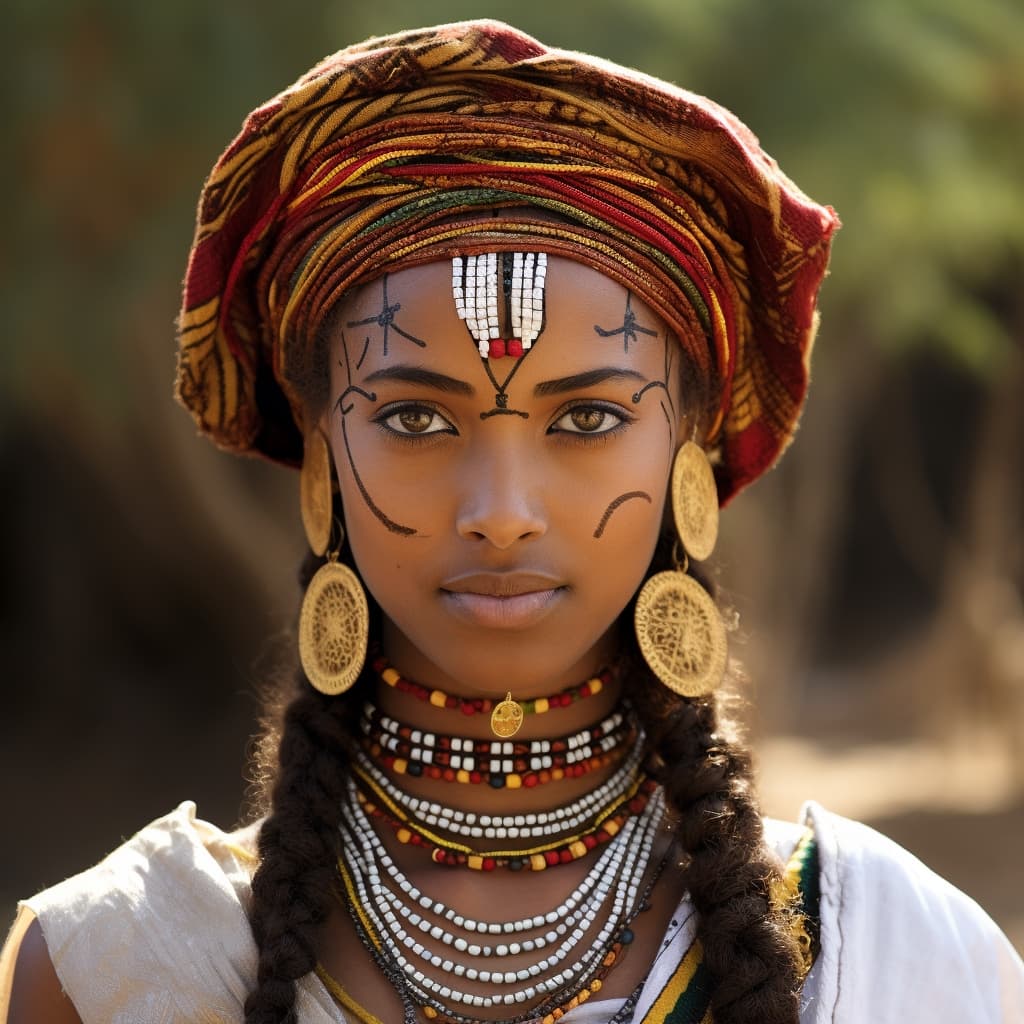
The Sidama phenotype sits inside the broader Cushitic-Horn cluster — narrower features and more gracile builds than the Nilotic populations to the west, but distinctly darker and less elongated than Somali or northern Oromo neighbors. The result is a recognizable middle register of East African appearance: medium-dark to dark brown skin paired with relatively fine, narrow facial architecture rather than the sharp-edged features common further north toward the Red Sea coast.
Hair is near-universally black and tightly coiled — Type 4, with 4a–4b textures predominating and 4c appearing regularly. Soft brown highlights show up under sun in some individuals, but true non-black hair is essentially absent. Eyes are dark brown to near-black; lighter brown occurs but green or blue is vanishingly rare. The eye shape is almond and moderately deep-set, with no epicanthic fold and a clean, defined upper-lid crease. Brows tend to be full and well-arched.
Skin tone clusters around Fitzpatrick V to VI, with warm reddish-brown and cool deep-brown undertones both common; the population skews darker than highland Amhara/Tigrayan neighbors but lighter on average than South Sudanese Nilotes. Highland sun exposure produces visible weathering on agricultural workers — the Sidama are historically enset and coffee farmers — without changing the base tone substantially.
Facial structure is the giveaway feature: noses are typically narrow with a relatively high, straight bridge and modest alar width — closer to Cushitic than to West/Central African forms. Lips are medium-full, more proportionate than markedly everted. Cheekbones are high and the jaw is firm but not heavy, giving an oval-to-slightly-elongated face shape.
Build trends slender and long-limbed with low body fat, though shorter and less extreme in linearity than neighboring Nilotic groups. Average male stature lands in the mid-170s cm, women in the low 160s. Shoulders are narrow, hips moderate, and musculature wiry rather than bulky — a body composition shaped by altitude, walking-distance daily mobility, and a low-fat enset-based diet.
Data depth
0/100Coverage of image-grounded phenotype observations · drives AI generation diversity
- Sample size
- 0/40· 0 images
- Image quality
- 0/30· 0% high
- Confidence
- 0/20
- Source diversity
- 0/10
- ·No image observations yet
Explore phenotype categories
Structured taxonomy with peer-reviewed scales · 22 anatomical categories





Generate Sidama AI Content
Use this ethnicity's phenotype data to create AI-generated content with accurate physical traits and cultural context.
Open Creator Studio