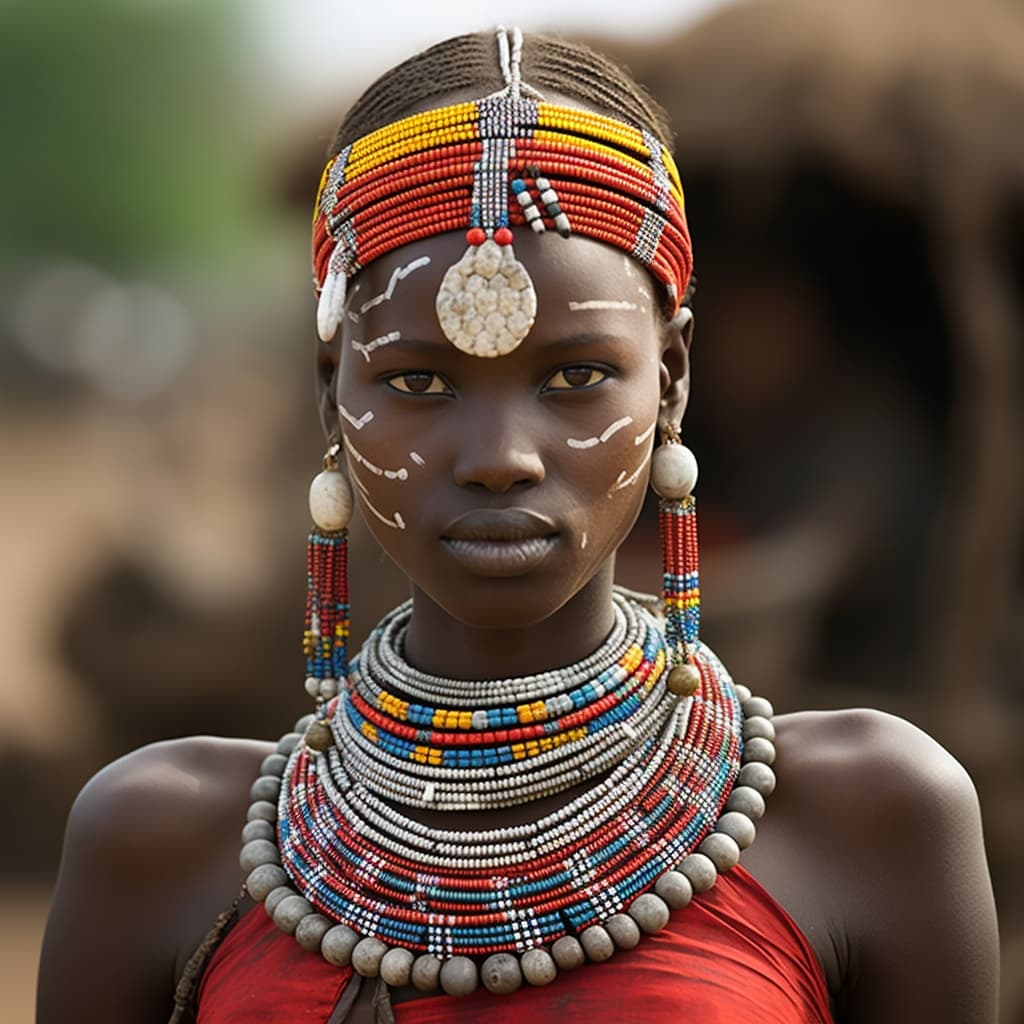
Shilluk Erotic
South Sudan
Nilo-Saharan / Nilotic / Luo / Shilluk
Christianity / Catholicism
Gule
Eastern Africa
About Shilluk People
The Shilluk are a Luo-speaking people of the upper White Nile, concentrated along a narrow strip of the river's west bank in South Sudan's Upper Nile region. What sets them apart in the wider Nilotic world is a kingdom — the reth, the Shilluk king, has presided over a centralized polity since roughly the sixteenth century, when the founder-figure Nyikang is said to have led his people to the river. That is unusual among Nilotic peoples, who typically organized themselves through age-sets and clan ties rather than royal courts. The Shilluk built villages in close succession down the riverbank — at one point an almost continuous line of settlement for hundreds of kilometers — and their political life still threads through that geography.
The Shilluk language sits inside the western Nilotic branch alongside Dinka, Nuer, and the wider Luo cluster that stretches south through Uganda and into Kenya. To outsiders the language is often called Chollo, which is closer to what speakers call themselves. Religiously the picture is layered: Christianity, Catholic and Protestant alike, took root through twentieth-century mission stations and is now the dominant affiliation, but the older ritual world built around Nyikang has not gone quiet. Nyikang is treated less as a historical ancestor than as a presence — the reth's installation at Fashoda still draws on rites that locate kingly legitimacy in him rather than in the living man wearing the regalia. The Gule, a smaller related community in the Nuba foothills to the north, share elements of this Nyikang tradition while sitting at a cultural seam between the Shilluk heartland and Sudan proper.
Cattle matter, but the Shilluk are more thoroughly committed to fishing and sorghum cultivation than their Dinka and Nuer neighbors, and the river dictates the rhythm of the year. The colonial period delivered two heavy blows: the Fashoda Incident of 1898, which turned the Shilluk capital into a footnote in European diplomacy, and the steady erosion of the kingdom's authority under successive Khartoum governments. The civil wars that produced South Sudanese independence, and the conflict that followed it, have hit Shilluk territory hard — villages along the Nile were repeatedly attacked and depopulated in the mid-2010s, scattering communities to displacement camps and to Khartoum, Juba, and abroad. The reth-ship endures as an institution even when the territory under it is contested.
Typical Shilluk Phenotypes
Reference for AI generation — hair, eyes, skin, facial structure, build
The Shilluk are a Nilotic people of the White Nile floodplain, and their phenotype sits firmly within the Nilotic cluster — among the tallest and leanest human populations on record, alongside their Dinka and Nuer neighbors. Adult men commonly stand 180–195 cm; women 170–180 cm is unremarkable. Limbs are notably elongated relative to torso (a high crural index), shoulders narrow, hips slim, and subcutaneous fat low. This is a body plan shaped by millennia in hot, low-humidity savanna — high surface-area-to-mass ratios that shed heat efficiently.
Skin is deeply pigmented, typically Fitzpatrick VI, often with a cool blue-black or near-ebony cast rather than the warmer red-brown undertones seen further west in Africa. Hair is tightly coiled Type 4 (4B–4C), dense and short-cropped in most contemporary wear; natural color is uniformly black, with grey arriving late. Eyes are dark brown to near-black; the eye opening tends to be wide and slightly rounded, set under a flat brow ridge, with no epicanthic fold.
Facial structure is the most diagnostic feature. The Shilluk face is long and narrow — dolichocephalic — with a high, often prominent forehead, wide-set eyes, and pronounced cheekbones that taper to a narrow chin. Noses are typically broad at the alae with a low, wide bridge, though there is real variation: some lineages carry straighter, higher-bridged noses likely reflecting older mixing along the Nile corridor. Lips are full, with the lower lip often slightly more everted than the upper. Teeth are large and well-aligned; historically the lower incisors were ritually extracted, a practice now mostly abandoned.
Variation between the core Shilluk and the Gule branch is modest and largely a matter of facial proportion rather than coloring — the Gule tend toward slightly broader features, reflecting their position at the southern edge of Shilluk territory and longer contact with non-Nilotic neighbors. Across both, the silhouette reads unmistakably Nilotic: tall, lean, dark, long-limbed.
Data depth
0/100Coverage of image-grounded phenotype observations · drives AI generation diversity
- Sample size
- 0/40· 0 images
- Image quality
- 0/30· 0% high
- Confidence
- 0/20
- Source diversity
- 0/10
- ·No image observations yet
Explore phenotype categories
Structured taxonomy with peer-reviewed scales · 22 anatomical categories




Generate Shilluk AI Content
Use this ethnicity's phenotype data to create AI-generated content with accurate physical traits and cultural context.
Open Creator Studio