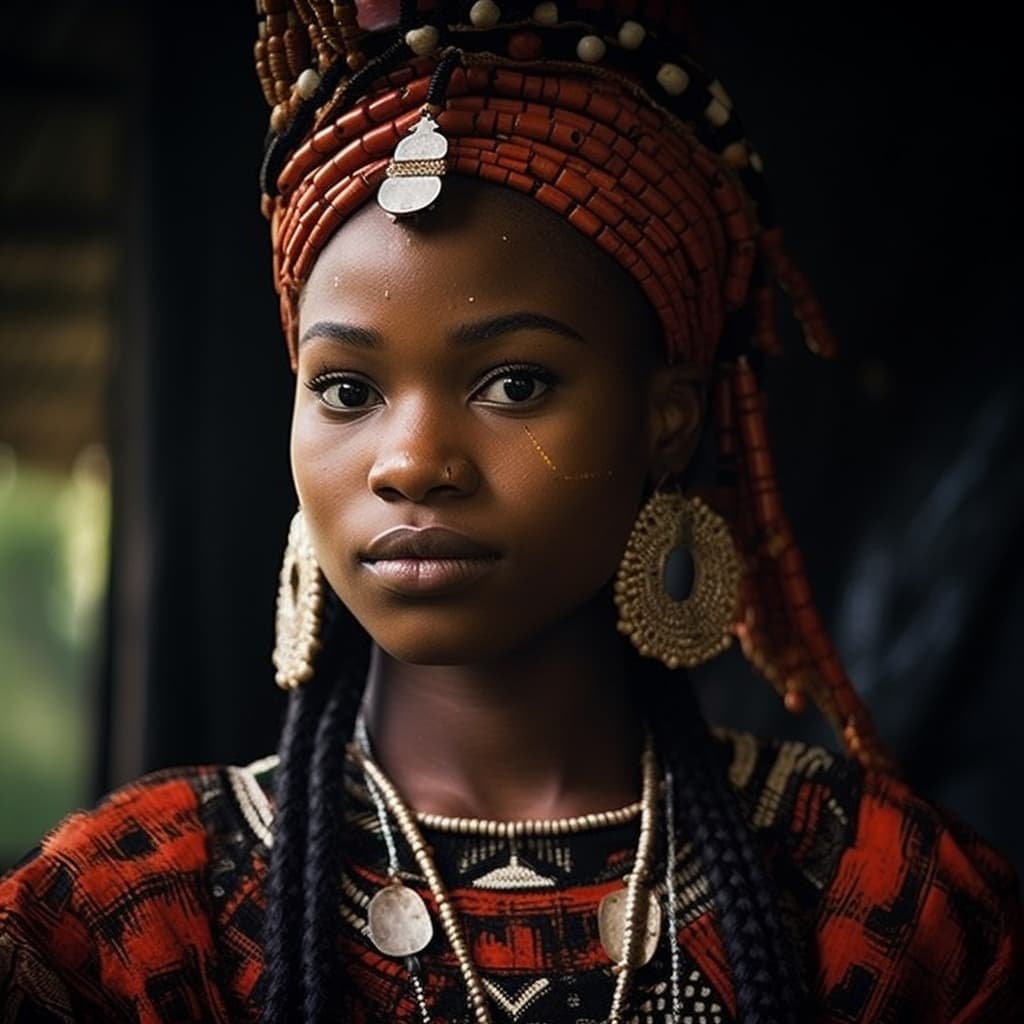
Ogoni Erotic
Ogoniland (Nigeria)
Niger–Congo / Cross River / Ogoni
Christianity
Baan, Eleme, Gokana, Tẹẹ
Western Africa
About Ogoni People
The Ogoni are a people of the eastern Niger Delta, packed into roughly a thousand square kilometres of low-lying farmland, creeks, and mangrove between Port Harcourt and the Atlantic. That density — among the highest in rural Nigeria — shapes nearly everything about them: land is scarce, lineage is closely tracked, and the relationship between a family and a particular patch of ground carries weight that outsiders routinely underestimate. They are not a single tribe in the strict sense but a federation of six kingdoms speaking four mutually distinct tongues — Khana, Gokana, Eleme, and Tẹẹ — all sitting inside the Ogoni branch of Cross River, itself a far-eastern outlier of the Niger–Congo family. A Khana speaker and an Eleme speaker often need a third language, usually Nigerian Pidgin or English, to talk freely. What unites them is not language but homeland, a shared name, and a political consciousness forged in the late twentieth century.
That consciousness is inseparable from oil. Shell began drilling in Ogoniland in 1958, and the spills, gas flares, and ruined farmland that followed gave rise in the 1990s to the Movement for the Survival of the Ogoni People under the writer Ken Saro-Wiwa. His execution by the Abacha regime in 1995, alongside eight others, made the Ogoni a reference point in global conversations about indigenous rights and extractive industry — a status the community itself takes seriously and continues to mobilize around. Cleanup efforts have been promised, contested, and slow.
Christianity, mostly Protestant with a strong Anglican and Pentecostal presence, is the dominant religious framework today, layered over older practices that have not entirely receded. Ancestral veneration, masquerade traditions tied to specific kingdoms, and the authority of traditional rulers — the gbenemene in Khana country, for instance — continue to operate alongside church life rather than in opposition to it. Funerals in particular remain elaborate, multi-day affairs that draw extended kin home from Port Harcourt, Lagos, and abroad. Subsistence farming of yam, cassava, and plantain persists, and fishing in the creeks remains both livelihood and cultural anchor, though both have been compromised by decades of contamination. The Ogoni are, in short, a small population by Nigerian standards — under a million — with an outsized presence in the country's politics of land, environment, and self-determination.
Typical Ogoni Phenotypes
Reference for AI generation — hair, eyes, skin, facial structure, build
The Ogoni present a phenotype consistent with the broader Niger Delta cluster of Cross River–speaking peoples, but with their own recognizable signature: deep skin tone, a relatively compact build, and facial proportions that read as more angular than the rounder Igbo or Yoruba norms to their west. Skin falls almost entirely in Fitzpatrick V–VI, with rich brown to near-black tones and warm red-brown undertones common after sun exposure in the riverine, equatorial climate of Ogoniland. Truly light-skinned Ogoni are rare; most of the range sits in the darker half of West African variation.
Hair is typically Type 4B–4C — tightly coiled, dense, with strong shrinkage. Natural color is uniformly black-brown; lighter shades and looser curl patterns appear only with admixture. Eyes are dark brown to near-black, set under a flat brow without an epicanthic fold, with the slightly downturned outer canthus and broad palpebral opening typical of Niger Delta groups.
The nose is the most distinctive facial feature: medium to broad alar width, low to medium bridge, with rounded nostrils that flare on smiling — less platyrrhine than coastal Yoruba, less narrow than Fulani. Lips are full but with a defined cupid's bow rather than the heavy eversion seen in some neighboring groups. Cheekbones sit high and wide, jawlines are square in men and softly rounded in women, and the overall facial impression is sculpted rather than soft. Footballer Joseph Yobo is a recognizable anchor for the male facial type.
Build tends toward mesomorphic and compact. Average male stature runs roughly 168–175 cm, shorter than Tutsi or Nilotic comparisons but with proportionally muscular shoulders and strong posterior chains — the body type that produces the goalkeepers and footballers the group is known for. Women carry a curved hourglass distribution with full hips and a narrower waist than the Yoruba average.
Across the Baan, Eleme, Gokana, and Tẹẹ subgroups phenotype is largely uniform; Eleme speakers, sitting closest to Igbo territory, show marginally lighter skin and slightly less broad nasal forms on average.
Data depth
0/100Coverage of image-grounded phenotype observations · drives AI generation diversity
- Sample size
- 0/40· 0 images
- Image quality
- 0/30· 0% high
- Confidence
- 0/20
- Source diversity
- 0/10
- ·No image observations yet
Explore phenotype categories
Structured taxonomy with peer-reviewed scales · 22 anatomical categories
Notable Ogoni People
17 reference figures — sourced from Wikipedia
- Timothy Paul Birabi — Nationalist & Elder Statesman
- Ken Saro-Wiwa — environmental activist, writer, and television producer
- Jim Wiwa — renowned Ogoni chief
- Lorraine Birabil — politician & Attorney
- John Noble Barinyima — Enyimba and Super Eagles goalkeeper
- Joseph Yobo — former professional footballer, captain, and current assistant coach of the S…
- Lee Maeba — Politician
- Owens Wiwa — Nigerian activist
- Magnus L. Kpakol — former Chief Economic Adviser to the President of Nigeria, former Project Coo…
- Fred Kpakol — Former Commissioner, Rivers State Ministry of Finance and Rivers State Minist…
- Kenneth Kobani — Former Minister of State, Trade and Commerce, Nigeria and Secretary to Govern…
- Ken Wiwa — Journalist & Writer
- Magnus Ngei Abe — Former Senator representing Rivers south-east senatorial district 2011-2019 a…
- Noo Saro-Wiwa — British-Nigerian author
- Barry Mpigi — Politician
- Dum Dekor — Member House of Representatives, National Assembly (Nigeria) Khana/Gokhana Co…
- Zina Saro-Wiwa — Artist & Filmmaker






Generate Ogoni AI Content
Use this ethnicity's phenotype data to create AI-generated content with accurate physical traits and cultural context.
Open Creator Studio