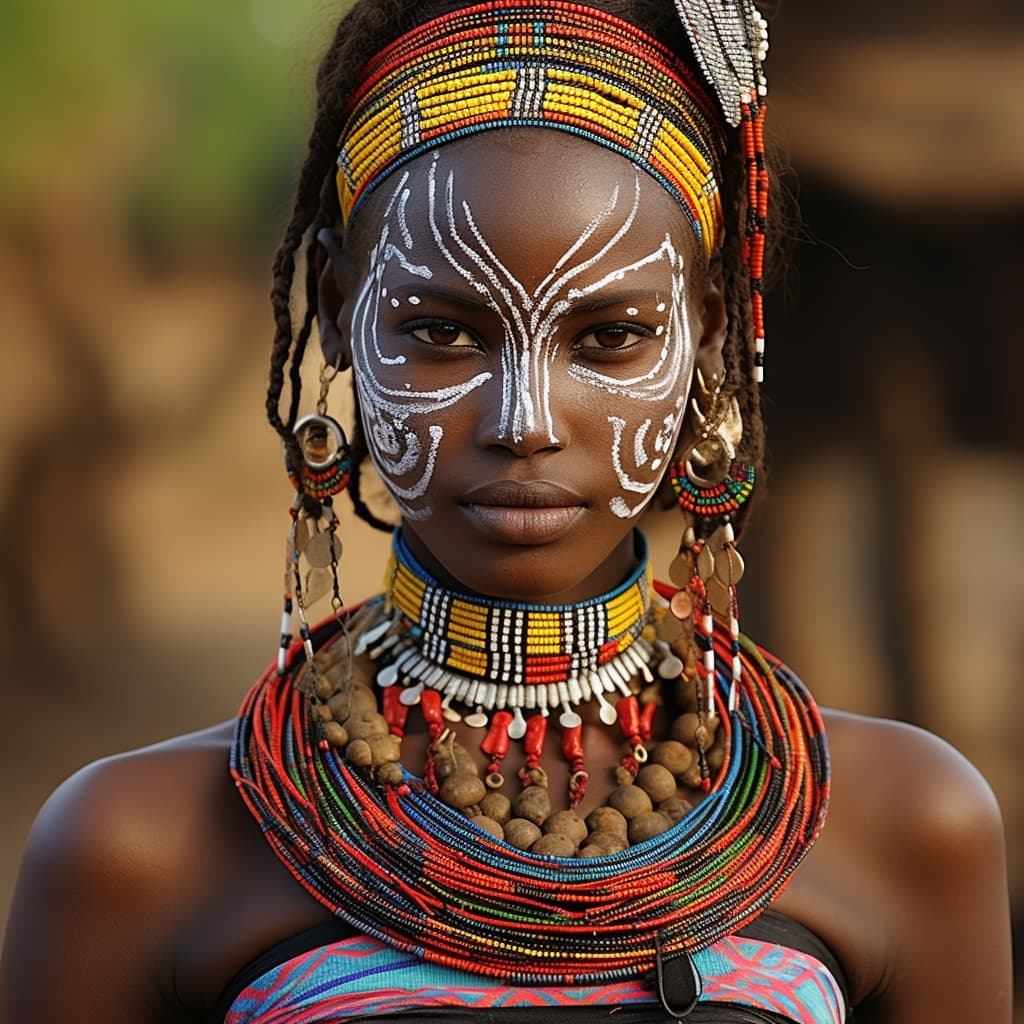
Nuer Erotic
Nuerland (South Sudan)
Nilo-Saharan / Nilotic / Nuer
Traditional African religions
Eastern Africa
About Nuer People
The Nuer call themselves Naath — "the people" — and their world for centuries has run on cattle. Not as livestock in the European sense, but as the medium through which kinship, marriage, feud, and reputation are negotiated. A young man takes an ox-name from a favored bull and is addressed by it for life. Bridewealth is reckoned in head of cattle. Disputes over a cow can escalate into generations-long feuds, and peace between lineages is sealed when cattle change hands. The anthropologist E. E. Evans-Pritchard built much of mid-twentieth-century social theory on what he saw among the Nuer in the 1930s, and the framework he described — segmentary lineages, the leopard-skin chief as ritual mediator rather than ruler — still shapes how outsiders read the society, for better and worse.
Their homeland sits across the swamps and grasslands of the Upper Nile, straddling the White Nile and the Sobat in what is now South Sudan and a sliver of western Ethiopia. The land floods half the year and bakes the other half, and Nuer life has long moved with it: rainy-season villages on higher ground, dry-season cattle camps down on the receding floodplains. The language, Thok Naath, belongs to the Western Nilotic branch and is closely related to Dinka — close enough that the two peoples understand fragments of each other, distant enough that the boundary between them has been one of the defining political fault lines of the region. Nuer society is organized into a dozen-odd major sections — Lou, Jikany, Gaawar, Lak, Thiang, and others — each with its own territory and internal politics, and historically expansionist, absorbing Dinka neighbors into Nuer identity through capture and assimilation.
Traditional religion centers on Kuoth Nhial, a sky-god, with lesser spirits attached to lineages, totems, and prophets. Prophets — figures who speak with the voice of a divinity — have repeatedly emerged in moments of crisis, from the colonial wars of the early twentieth century through the long Sudanese civil wars. Christianity, mostly Protestant, has made deep inroads since the 1990s, often layered over the older cosmology rather than replacing it. The civil wars and the ongoing conflict in South Sudan have scattered Nuer communities into refugee populations across Ethiopia, Kenya, and a sizable diaspora in the United States, particularly Nebraska and Minnesota, where churches and cattle-less marriages have had to reinvent obligations that the herd used to carry.
Typical Nuer Phenotypes
Reference for AI generation — hair, eyes, skin, facial structure, build
The Nuer are among the tallest peoples on Earth, and that single fact organizes most of what makes their phenotype distinctive. Adult men routinely reach 6'2" to 6'5", with documented averages historically clocked above 1.85m — the Dinka and Nuer together produce the highest mean stature of any ethnic group ever measured. The build that goes with it is unmistakably elongated: very long limbs relative to torso, narrow hips and shoulders, low body fat, and slender wrists and ankles. This is a classic Nilotic body plan, evolved for heat dissipation in the flat, hot floodplains of the Sudd — maximum surface area, minimum core mass.
Skin tone sits at the deepest end of the Fitzpatrick scale — Type VI, often with a cool blue-black or near-charcoal undertone rather than the warmer browns common in West Africa. Under direct sun the skin can appear almost matte black. Hair is tightly coiled Type 4C, worn close-cropped or shaved by most men; women's hair is similarly textured, often styled short or in small braids. Natural reddish or sun-bleached tints sometimes appear in children. Eyes are dark brown to near-black, set deep, with an open almond shape and no epicanthic fold.
Facial structure is where the Nuer read most clearly as a distinct Nilotic group rather than a generic East African profile. The face is long and narrow, the forehead high, the cheekbones prominent but not broad. Noses tend to be straight-bridged and relatively narrow for sub-Saharan Africa — less alar flare than Bantu averages, with a defined tip. Lips are full but proportioned to the long face rather than dominant. Jaws are clean and tapered. Many older men still carry the gaar — six horizontal scarification lines across the forehead, a traditional male initiation mark — though it has grown rarer among younger generations and the diaspora. Teeth are typically large, white, and well-aligned, with the lower incisors sometimes traditionally extracted in older cohorts.
Data depth
0/100Coverage of image-grounded phenotype observations · drives AI generation diversity
- Sample size
- 0/40· 0 images
- Image quality
- 0/30· 0% high
- Confidence
- 0/20
- Source diversity
- 0/10
- ·No image observations yet
Explore phenotype categories
Structured taxonomy with peer-reviewed scales · 22 anatomical categories



Generate Nuer AI Content
Use this ethnicity's phenotype data to create AI-generated content with accurate physical traits and cultural context.
Open Creator Studio