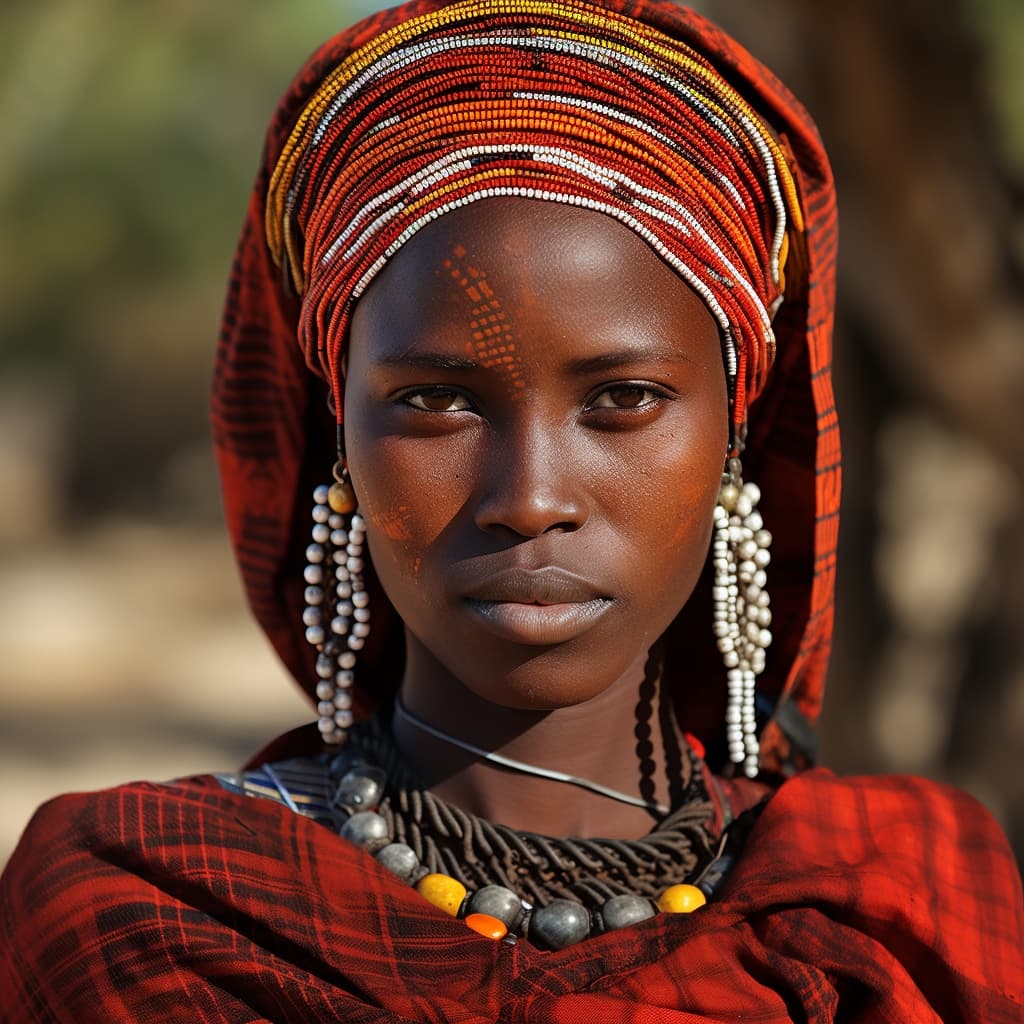
Mwera Erotic
Tanzania (Mtwara and Ruvuma Regions)
Niger–Congo / Bantu / Mwera
Islam
Eastern Africa
About Mwera People
The Mwera live across the Makonde Plateau's western slopes and the lowlands stretching toward the Ruvuma River, in the southeastern corner of Tanzania where Mtwara and Ruvuma Regions meet. They share this country with the Makonde, the Yao, and the Makua across the border in Mozambique, and centuries of proximity have made the four peoples something like cousins who argue about the family resemblance — overlapping vocabularies, shared cassava-and-sorghum agriculture, intermarried lineages, and a long habit of moving back and forth across what is now an international line. Cimwera, their language, sits in the same Bantu cluster as Yao and Makonde, close enough that an older speaker can usually follow a neighbor's conversation without effort.
Islam reached the Mwera from the coast — from Kilwa and the Swahili towns — and settled in slowly through trade rather than conquest, which is why Mwera Islam has a particular texture. It is the everyday faith: Friday prayer, Ramadan fasting, the naming of children, the rhythm of burials. But it coexists with older convictions about ancestors, about the spirits of place, about the work that healers and diviners do in the spaces medicine cannot reach. The two registers do not contradict each other in practice; they handle different categories of trouble.
Mwera society is matrilineal — descent and inheritance pass through the mother's line, and a child's most consequential adult male relative is often the maternal uncle rather than the father. This is the structural fact that distinguishes them from many of their Bantu-speaking neighbors to the north, and it shapes everything from land claims to marriage negotiations to whose advice carries weight at a funeral. Initiation rites for both boys and girls — unyago for the latter — remain meaningful occasions, though their form has shifted under generations of pressure from Islam, colonial administrators, and now the cash economy that pulls young people toward Mtwara town and the gas fields offshore.
The colonial period was harder on the Mwera than the textbooks usually note: the Maji Maji rebellion of 1905–07 swept through this country, and the German reprisal — scorched fields, deliberate famine — emptied villages that took a generation to refill. The cultural memory of that catastrophe has not entirely faded. It sits underneath the present, the way the older religion sits underneath the newer one.
Typical Mwera Phenotypes
Reference for AI generation — hair, eyes, skin, facial structure, build
The Mwera are a Bantu-speaking people of southeastern Tanzania, concentrated on the Makonde Plateau hinterland and the coastal lowlands of Mtwara and Ruvuma. Their phenotype reflects long settlement in equatorial East Africa with measurable Swahili-coast admixture — Arab, Shirazi Persian, and to a lesser extent Indian — layered onto a deeply pigmented Bantu substrate. Most Mwera fall in Fitzpatrick VI, with a meaningful coastal minority in deep V; undertones run warm-brown to red-brown rather than the cooler blue-black tones seen further south in Mozambique. Sun exposure is constant and shapes very little visible variation, since baseline melanin is already high.
Hair is almost uniformly Type 4 — tightly coiled, dense, with the springy 4B-to-4C texture typical of equatorial Bantu populations. Natural color is true black, occasionally with a warm brown cast in children that darkens by adolescence. Hairlines tend to be full and squared. Eyes are dark brown to near-black; the epicanthic fold is absent, and eye shape is moderately almond with thick lashes. Lighter eye colors are vanishingly rare and almost always trace to coastal Arab heritage.
Facial structure carries the broad Bantu signature softened by coastal admixture. Noses are typically medium-bridged with moderately wide alae — narrower than Central African averages, reflecting the Swahili genetic influence — and lips are full but not maximally so, with a well-defined cupid's bow. Cheekbones sit high and wide; jawlines are clean and somewhat tapered, giving faces an oval-to-heart proportion rather than the squarer set common among neighboring Makonde.
Build runs slim-to-athletic with relatively long limbs and narrow hips in men; women trend toward an hourglass distribution with prominent gluteal development, a regional anthropometric pattern shared with the Yao and Makonde. Average male stature falls around 170 cm, female around 158 cm — moderate by East African standards, shorter than Maasai pastoralists to the north but taller than forest-dwelling groups inland. Coastal Mwera show visibly more Afro-Arab features — slightly lighter skin, finer noses, looser curl pattern — than interior plateau Mwera, who retain a more uniform Bantu phenotype.
Data depth
0/100Coverage of image-grounded phenotype observations · drives AI generation diversity
- Sample size
- 0/40· 0 images
- Image quality
- 0/30· 0% high
- Confidence
- 0/20
- Source diversity
- 0/10
- ·No image observations yet
Explore phenotype categories
Structured taxonomy with peer-reviewed scales · 22 anatomical categories

Generate Mwera AI Content
Use this ethnicity's phenotype data to create AI-generated content with accurate physical traits and cultural context.
Open Creator Studio