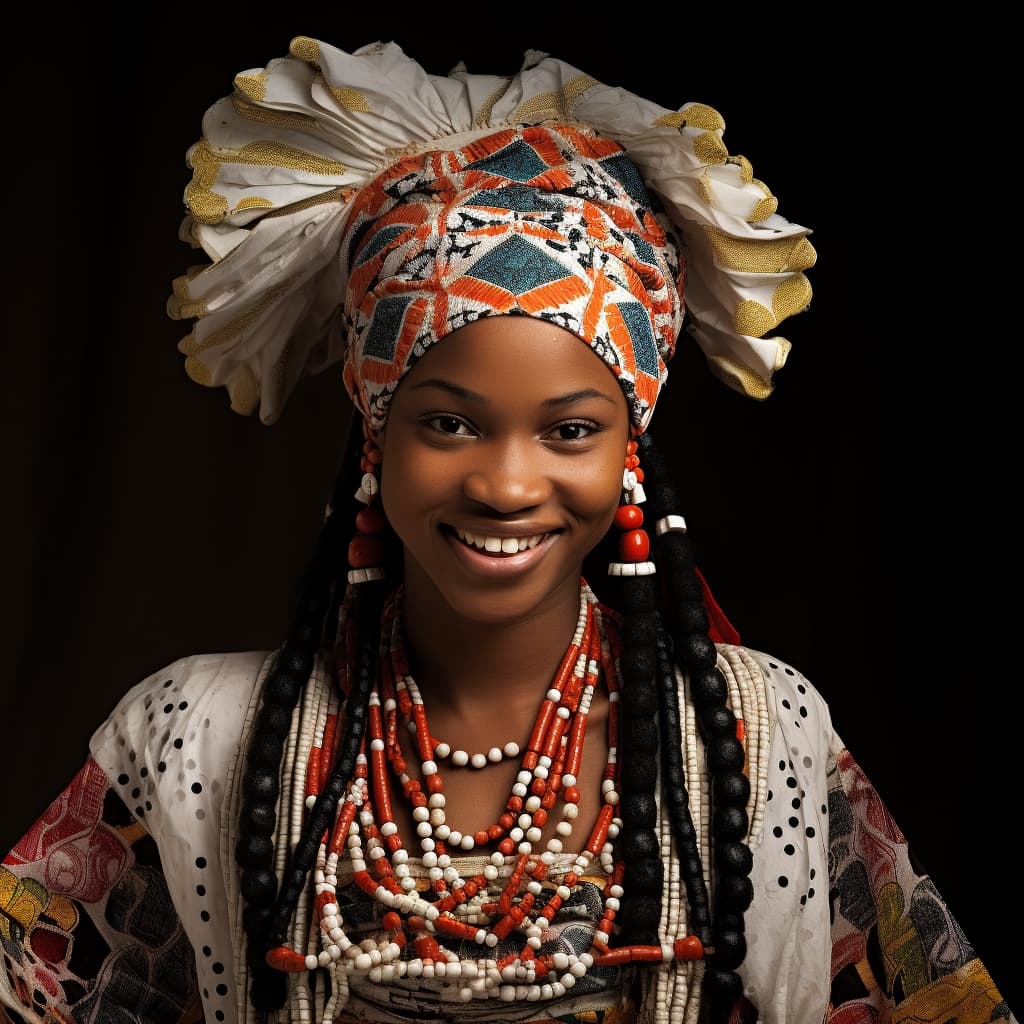
Mumuye Erotic
Taraba State (Nigeria)
Niger–Congo / Adamawa / Mumuye
Traditional African religions
Western Africa
About Mumuye People
The Mumuye live in the hills and broken plateau country of southern Taraba State, in northeastern Nigeria, between the Benue River and the Cameroon border. For most of their history they stayed there by choice — the rough terrain shielded them from the slave raids of the Sokoto Caliphate in the nineteenth century, and from the Fulani jihad that reshaped much of the surrounding region. They came to outside attention late, and remained one of the more autonomous peoples of the Middle Belt well into the colonial period.
Their language belongs to the Adamawa branch of Niger–Congo, a cluster spoken across a band running from northern Nigeria into Chad and the Central African Republic. Adamawa languages are among the less-documented in the family, and Mumuye itself is broken into several dialects that track the old clan territories. The Mumuye were never organized as a single kingdom or chiefdom; authority traditionally rested with elders, lineage heads, and the men of the vabong — a graded society that handled justice, initiation, and the regulation of ritual life. Decisions that elsewhere in Nigeria would have come from a chief came here from consensus among elders and the masking societies that enforced it.
Mumuye religion is built around ancestral spirits and a sky deity named La. Ritual life centers on the vadosu, the iron-staff ancestral figure kept in shrine houses, and on the carved wooden statuary the Mumuye are now best known for outside Nigeria — tall, elongated figures with fluted bodies, free-swinging arms, and stylized ear forms, used in divination and as embodied vessels for ancestral presence. Most pieces in Western collections were acquired only after the 1960s, when outside collectors first reached the area; before that, the figures rarely left the shrines. Christianity and Islam have made inroads since, particularly along the trade roads, but in the village interior traditional practice remains the working religion rather than a folkloric survival.
Day-to-day life is agricultural — sorghum, yams, groundnuts, and increasingly rice on the lower ground. Iron-working has a long history here, and Mumuye smiths supplied tools and ritual objects across the Middle Belt long before colonial trade routes arrived. Initiation grades, scarification patterns, and the ceremonies tied to harvest and burial still mark the rhythm of the year, even where the formal religion on the surface has changed.
Typical Mumuye Phenotypes
Reference for AI generation — hair, eyes, skin, facial structure, build
The Mumuye of Taraba State sit in Nigeria's middle belt, in the rugged country south of the Benue River, and their phenotype reads as classically Sudanic-Sahelian rather than coastal West African. Skin tones cluster in the deep brown to near-black range, Fitzpatrick VI dominant, with warm red-brown undertones common enough to be a marker — sun exposure on the open savanna highlands keeps surface tone uniformly dark with little gradient between covered and exposed areas. Hair is tightly coiled Type 4, typically 4B to 4C, jet black, with the dense low-porosity texture seen across the Adamawa-speaking belt. Premature greying at the temples in middle age is noticeably common in Mumuye men.
Eyes are dark brown to near-black, almond-shaped, set on the wide side with a flat upper-lid platform and no epicanthic fold. The brow ridge is moderate and the supraorbital area often projects more than in coastal Yoruba or Igbo populations, giving a deeper-set look. Noses are broad at the alar base with a low, wide bridge — the classic platyrrhine West African form, though slightly less flared than what you see in forest-zone groups further south. Lips are full, with the lower lip typically the more prominent of the two. Jaws are squared and gonial angles tend to be wide, producing strong lower-face structure; cheekbones are high and laterally projecting, which is part of why Mumuye sculptural traditions exaggerate vertical face elongation so dramatically.
Build runs tall and lean. Mumuye men commonly reach 175–185 cm with narrow hips, long limbs, and the linear body proportions characteristic of Nilo-Sudanic and northern Adamawa peoples — long lower legs relative to torso, low subcutaneous fat. Women are similarly tall by West African averages, with narrower waist-to-hip differentials than Igbo or Yoruba women and small-to-moderate breast size as the modal pattern. The defining structural impression is verticality — long faces, long limbs, and a build closer to the Sahelian Fulani neighbors than to coastal Nigerian populations.
Data depth
0/100Coverage of image-grounded phenotype observations · drives AI generation diversity
- Sample size
- 0/40· 0 images
- Image quality
- 0/30· 0% high
- Confidence
- 0/20
- Source diversity
- 0/10
- ·No image observations yet
Explore phenotype categories
Structured taxonomy with peer-reviewed scales · 22 anatomical categories






Generate Mumuye AI Content
Use this ethnicity's phenotype data to create AI-generated content with accurate physical traits and cultural context.
Open Creator Studio