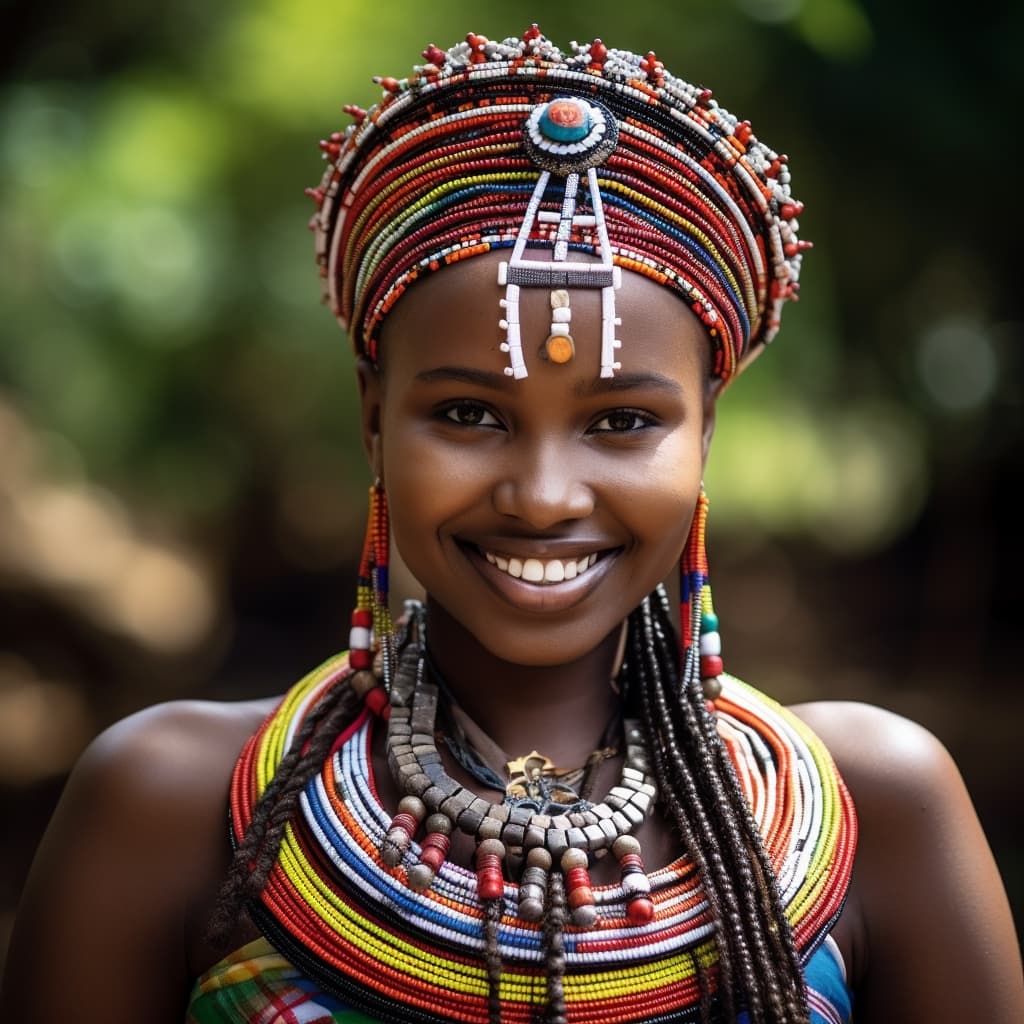
Mijikenda Erotic
Coast Province (Kenya)
Niger–Congo / Bantu / Mijikenda
Christianity
Chonyi, Giriama, Digo, Segeju
Eastern Africa
About Mijikenda People
The Mijikenda are nine related Bantu-speaking peoples of the Kenyan coast — the name itself means "the nine homesteads" in their own languages. They occupy the strip of country running inland from the Indian Ocean between the Tanzanian border and the Tana River: Mombasa, Malindi, Kilifi, Kwale. The branches usually counted are the Giriama, Digo, Duruma, Rabai, Ribe, Kambe, Kauma, Chonyi and Jibana, though the Segeju, who straddle the Kenya–Tanzania frontier, are often grouped with them by language and history. Each branch keeps its own dialect, but the dialects are mutually intelligible enough that "Mijikenda" functions as a working language as well as an ethnic label.
The defining institution of Mijikenda history is the kaya — fortified hilltop forest settlements established, by oral tradition, after the group migrated south from a place called Shungwaya sometime around the sixteenth century. Each branch had its own kaya, ringed by sacred forest and governed by councils of elders. The villages eventually moved down to lower ground, but the forests were left standing as shrines, and the elders' councils continued to meet inside them. Several of the surviving kaya forests are now UNESCO-listed, and they remain active ritual sites — burial grounds, oath-taking places, repositories of the wooden memorial posts known as vigango that mark the deaths of senior men.
Christianity is now the majority affiliation, the result of long missionary contact on the coast, but the older Mijikenda religion — focused on ancestor veneration and the authority of the kaya elders — has not been displaced so much as layered underneath. The Digo, the southernmost branch, are an exception: centuries of trade contact with Swahili and Arab merchants made Islam the dominant faith among them, and Digo culture sits closer to the Swahili coast than to the inland Mijikenda. The Giriama, the largest branch, are remembered politically for the 1913–1914 uprising led by the prophetess Mekatilili wa Menza against British attempts to conscript Giriama labor and tax their palm wine — one of the more sustained early resistances to colonial rule in East Africa.
Economically the coastal Mijikenda still farm coconut, cashew, and maize, tap palm wine, and fish; many work in Mombasa and the tourist towns. The relationship with the Swahili of the coastal strip is old and ambivalent — traders, neighbors, sometimes rivals — and much of what outsiders read as "Swahili coast" culture is in fact a long collaboration between the two.
Typical Mijikenda Phenotypes
Reference for AI generation — hair, eyes, skin, facial structure, build
The Mijikenda — nine closely related Bantu-speaking communities of Kenya's coastal hinterland — present a phenotype shaped by long settlement in the humid coastal belt and centuries of low-level admixture with Cushitic, Swahili, and Arab-trading populations along the Indian Ocean littoral. The result is a profile recognizably East African Bantu, but visibly distinct from the highland Kikuyu or Kalenjin further inland.
Hair is overwhelmingly Type 4 — tight coils, often 4B to 4C — and uniformly black or near-black. Mature greying tends to come late and stays salt-and-pepper rather than full white. Texture is dense and high-density across the scalp, with the close-cropped or short-braided styles common along the coast.
Eyes run dark brown to near-black, with a clean, slightly almond shape and no epicanthic fold. Brows are full and straight-set. Skin tone falls in a relatively narrow band — roughly Fitzpatrick V to VI — with warm reddish-brown to deep umber undertones rather than the cooler blue-black tones seen in some Nilotic populations. Sun exposure on the coast tends to deepen rather than redden, and lifelong outdoor work produces visible weathering on the hands and forearms more than the face.
Facial structure is moderate by African standards: nasal bridges are low to medium, alar width broad but not extreme, and the philtrum often pronounced. Lips are full and well-defined, jawlines are squared in men and softer-rounded in women, and cheekbones sit moderately high without the sharp prominence seen in Maasai phenotypes.
Build is medium — neither the tall, lean narrow-hipped frame of Nilotic groups nor the stockier highland Bantu pattern. Adult male stature typically lands in the 170–178 cm range, with women proportionally lower. Shoulders are moderate, hips fuller in women, and overall body composition tends mesomorphic.
Among the sub-groups, the southern Digo show the most visible Swahili-Arab influence — slightly lighter skin and finer features in some lineages — while the Giriama of the central coast and the inland Chonyi retain the most uniformly Bantu phenotype. The Segeju, smallest and most southerly, show occasional traces of older Cushitic admixture in narrower nose form.
Data depth
0/100Coverage of image-grounded phenotype observations · drives AI generation diversity
- Sample size
- 0/40· 0 images
- Image quality
- 0/30· 0% high
- Confidence
- 0/20
- Source diversity
- 0/10
- ·No image observations yet
Explore phenotype categories
Structured taxonomy with peer-reviewed scales · 22 anatomical categories






Generate Mijikenda AI Content
Use this ethnicity's phenotype data to create AI-generated content with accurate physical traits and cultural context.
Open Creator Studio