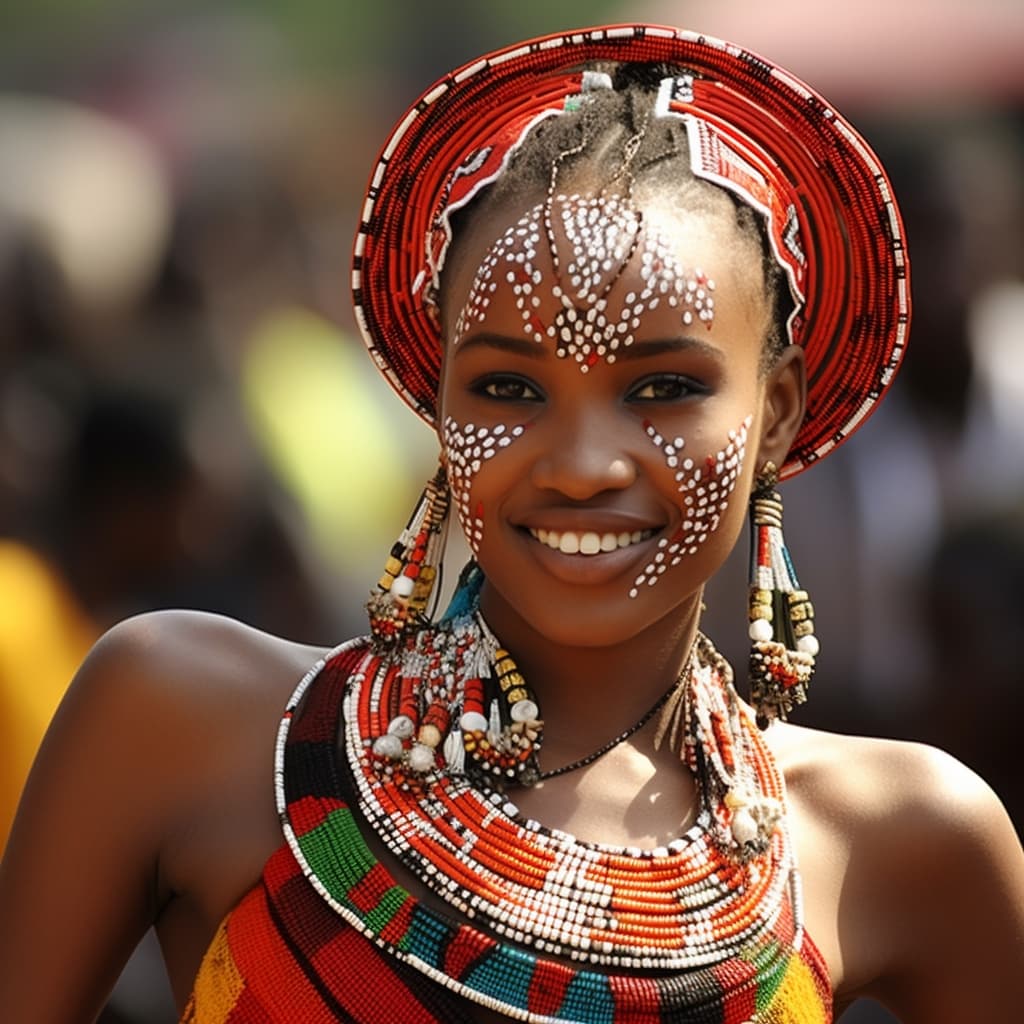
Luhya Erotic
Western Province (Kenya)
Niger–Congo / Bantu / Luhya
Christianity
Bukusu, Idakho, Isukha, Kabras, Khayo, Kisa, Marachi, Maragoli, Marama, Nyole, Samia, Tachoni, Tiriki, Tsotso, Wanga,
Eastern Africa
About Luhya People
The Luhya are not a single tribe so much as a coalition of related Bantu-speaking peoples who, over the twentieth century, came to recognize themselves under one name. Sixteen or so sub-groups — Bukusu, Maragoli, Wanga, Idakho, Isukha, Tachoni, Samia and the rest — live in the green, densely farmed hills of western Kenya between Mount Elgon and Lake Victoria. Each retains its own dialect of Luhya (Luyia), its own clan histories, its own stubborn local pride. A Bukusu speaker and a Maragoli speaker can usually understand each other with effort, but they will tell you, quickly and without apology, that they are not the same.
The land they occupy is one of the most fertile and most crowded in East Africa. Smallholder farms terrace the slopes; maize, beans, sugarcane, tea and bananas grow in tight rotation, and rural population density rivals anywhere on the continent. This pressure on land has shaped Luhya life as much as any cultural practice has — it pushes young people toward Nairobi, Kisumu and the diaspora, and it keeps inheritance disputes a permanent feature of family life. The Luhya are the second-largest ethnic community in Kenya after the Kikuyu, and that demographic weight gives them a steady, if often understated, presence in national politics.
Christianity arrived with British and American missionaries in the early 1900s and took deep root, particularly through the Church of God, the Friends (Quakers — the Maragoli highlands hold one of the largest Quaker populations in the world), Anglicans and Catholics. Practice tends to be devout and public, woven through funerals, weddings and the rhythm of the week, while older beliefs about ancestors and the spirit world still surface at the edges of family ritual rather than disappearing outright.
Among the Bukusu, circumcision remains the central rite of male adulthood — a public, bracing ceremony every even-numbered year, performed without anesthesia and attended by extended kin who judge the boy's composure. The Maragoli and Tiriki have their own variants. Isukuti, the fast triple-drum dance of the Idakho and Isukha, is the music most outsiders associate with the region; bullfighting in Khayega and Malinya, where two prize bulls are matched in a packed clearing while the crowd roars, is the spectacle most visitors don't expect. Football, rugby and a long tradition of boxing round out a sporting culture the Luhya take seriously.
Typical Luhya Phenotypes
Reference for AI generation — hair, eyes, skin, facial structure, build
The Luhya phenotype sits within the broader Bantu-speaking East African range but trends toward darker skin and heavier build than their Nilotic neighbors to the north. Skin tone clusters in Fitzpatrick V to VI — deep brown to near-black with warm, slightly red-brown undertones; the lighter olive-brown end seen in some Kikuyu or coastal Swahili populations is uncommon. Sun exposure rarely changes the baseline tone meaningfully — pigment is dense from infancy.
Hair is uniformly Type 4 — tightly coiled, with the densely packed 4B–4C pattern dominating. Natural color is black with occasional very dark brown; reddish or lighter shades are essentially absent outside dye and outside the brief reddish cast that protein-deficient hair sometimes takes on in childhood. Eyes are dark brown to near-black, almond-shaped to wide-set round, with no epicanthic fold and a clean, exposed upper lid.
Facial structure is the most distinctive register. Noses tend to be broad with a low-to-medium bridge and wide alar base — wider on average than Nilotic Luo or Kalenjin profiles. Lips are full, often with a pronounced everted lower lip. Cheekbones sit moderately high but are softened by fuller midface tissue rather than the angular planes typical of Nilotes; jaws are broad and rounded rather than tapered. Foreheads are often broad and high.
Build is where Luhya read as visibly different from their neighbors. They are, on average, shorter and stockier than Luo or Kalenjin — men commonly 5'7"–5'10", women 5'2"–5'5" — with broader shoulders, denser musculature, and a tendency toward thicker thighs and fuller hips on women. The Bukusu in the north skew tallest and most robust, with the rugby and wrestling traditions reflecting that build; the Maragoli in the south trend shorter and more compact. Tiriki and Idakho fall between. Across all sub-groups, the silhouette is solid and grounded rather than long-limbed — closer to West African Bantu proportions than to the rangier Nilotic frame next door.
Data depth
68/100Coverage of image-grounded phenotype observations · drives AI generation diversity
- Sample size
- 32/40· 31 images
- Image quality
- 21/30· 42% high
- Confidence
- 15/20· mean 0.82
- Source diversity
- 0/10· wikipedia
- ·Wikipedia-only source — not population-representative
Observed Distribution — Image Sample
Empirical observations from analyzed photographs · supplementary signal, not population truth
Sample: 31 images analyzed (31 wikipedia). Quality: 13 high, 16 medium, 2 low, 0 very_low. Avg analyzer confidence: 0.82.
Skin tone (Fitzpatrick): V (6%), VI (94%)
Hair color: black (52%), gray/white (42%), blonde (3%), unclear (3%)
Hair texture: straight (3%), coily (90%), covered (6%)
Eye color: dark brown (100%)
Epicanthic fold: 0% present, 100% absent, 0% unclear
Caveats: Sample is 100% Wikipedia notable people — skews toward male, public-life, and modern figures, not population-representative.
Last aggregated: May 7, 2026
Explore phenotype categories
Structured taxonomy with peer-reviewed scales · 22 anatomical categories
Notable Luhya People
79 reference figures — sourced from Wikipedia
- Francis Atwoli — trade unionist and long serving secretary general of the Central Organization…
- Moody Awori — ninth Vice President of Kenya.
- Aggrey Awori — Ugandan politician and former cabinet minister.
- Nancy Makokha Baraza — first Deputy Chief Justice of Kenya.
- Zacchaeus Chesoni — former Chief Justice of Kenya.
- Cyrus Jirongo — businessman and politician.
- Mukhisa Kituyi — former Secretary General of the United Nations Conference on Trade and Develo…
- Musikari Kombo — former cabinet minister and party leader.
- Kenneth Marende — former Speaker of the National Assembly of Kenya.
- Musalia Mudavadi — Prime Cabinet Secretary of Kenya and former vice president.
- Masinde Muliro — independence era politician and minister.
- Nabongo Mumia — king of the Wanga kingdom and early colonial collaborator.
- Ababu Namwamba — Kenyan politician and cabinet secretary.
- Burudi Nabwera — diplomat and politician.
- Phyllis Omido — environmental activist and Goldman Environmental Prize winner.
- Paul Otuoma — governor of Busia County and former cabinet minister.
- Wycliffe Oparanya — former governor of Kakamega County and chair of the Council of Governors.
- Martin Shikuku — veteran politician and former leader of the opposition.
- Edwin Sifuna — Nairobi County senator and party secretary general.
- Amos Wako — long serving Attorney General of Kenya and former senator.
- Moses Wetangula — Speaker of the National Assembly of Kenya and former foreign minister.
- George Wajackoyah — lawyer and 2022 presidential candidate.
- Michael Wamalwa — former Vice President of Kenya under Mwai Kibaki and Member of Parliament
- KRA — Humphrey Wattanga, KRA Commissioner General.
- Laban Ayiro — academic and vice chancellor of Daystar University.
- Calestous Juma — professor of the practice of international development at Harvard University.
- Francis D. Imbuga — playwright and literature scholar.
- Filemona F. Indire — professor, diplomat and former member of parliament.
- Susane Nabulindo — consultant anesthesiologist.
- Catherine Nyongesa — radiation oncologist and founder of Texas Cancer Centre in Nairobi.
- Nanjala Nyabola — writer and political analyst.
- Ken Walibora — novelist and Kiswahili scholar.
- Gideon Were — historian and professor.
- Miriam Were — public health physician and recipient of the first Hideyo Noguchi Africa Prize.
- John Nikola Bwire Osogo — historian and educationist.
- Blasio Vincent Oriedo — epidemiologist and researcher in tropical medicine.
- Bien-Aimé Baraza — member of the band Sauti Sol.
- Daudi Kabaka — benga musician.
- Elsa Majimbo — comedian and social media personality.
- Pamella Makotsi-Sittoni — journalist and editor.
- Gloria Muliro — gospel musician.
- Azziad Nasenya — actress and media personality.
- Hilary Ng'weno — historian and journalist.
- Mary Kavere — actress known as Mama Kayai.
- Nonini — musician.
- Winfred Adah Omwakwe — Miss Earth 2002.
- Daddy Owen — gospel musician.
- Khadambi Asalache — poet and artist.
- Willy Paul — musician.
- Eugine Micah — Kenyan journalist and media personality.
- Festo Habakkuk Olang' — first African Archbishop of the Anglican Church of Kenya.
- Maurice Michael Otunga — Catholic cardinal.
- Eliud Wabukala — former Anglican Archbishop of Kenya and chair of the Ethics and Anti Corrupti…
- Joseph W. Sitati — general authority of the Church of Jesus Christ of Latter day Saints.
- Anne Wafula Strike — Paralympic wheelchair racer.
- Allan Wanga — footballer.
- Ayub Masika — footballer.
- Benjamin Ayimba — rugby player and coach.
- Biko Adema — rugby union player.
- Brian Tanga — professional rugby player
- Collins Injera — rugby sevens player.
- Clifton Miheso — footballer.
- Dennis Abukuse — rugby player.
- Emmanuel Wanyonyi — middle-distance athlete.
- Ferdinand Omanyala — sprinter and African record holder in the 100 metres.
- Humphrey Kayange — rugby player.
- Josephat Ababu — cricketer.
- Johnstone Olindi — rugby professional
- Joe Kadenge — footballer.
- Joe Masiga — footballer and doctor.
- Kevin Wekesa — professional rugby player.
- McDonald Mariga — footballer and politician.
- Paul Wekesa — tennis player.
- Paul Were — footballer.
- Robert Wangila — Olympic boxing champion.
- Violet Barasa — volleyball player.
- Victor Wanyama — footballer.
- Vincent Onyala — professional rugby player.
- Willy Ambaka — rugby player.
Generate Luhya AI Content
Use this ethnicity's phenotype data to create AI-generated content with accurate physical traits and cultural context.
Open Creator Studio