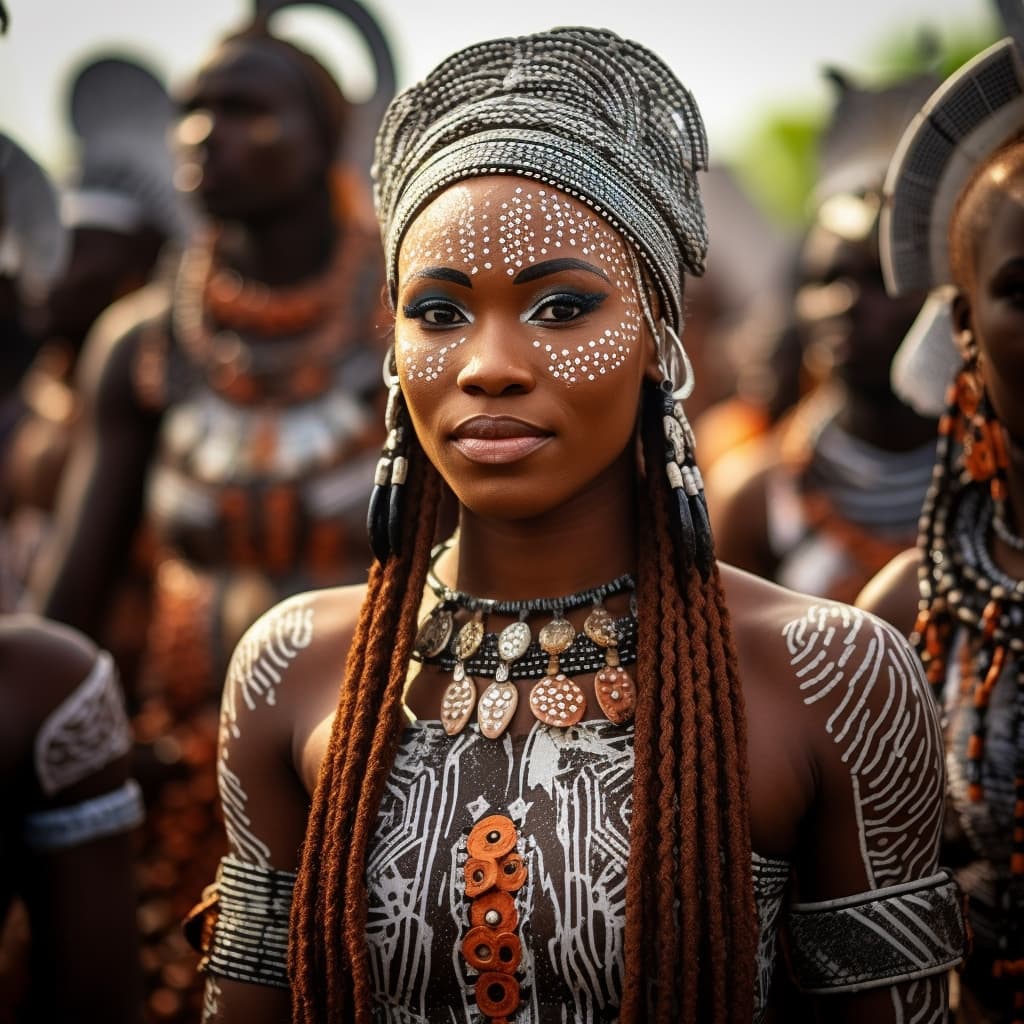
Kuteb Erotic
Taraba State (Nigeria)
Niger–Congo / Jukunoid / Kuteb
Christianity
Western Africa
About Kuteb People
The Kuteb live in the broken hill country of southern Taraba State, in the borderland where the Benue plains rise toward the Cameroon highlands. They are one of the Jukunoid peoples — a small cluster of related groups whose languages branch off the larger Benue–Congo family and don't sit easily with the Hausa-Fulani world to the north or the Tiv-speaking populations immediately west. Their own name for themselves is Kutev, and the older colonial label "Mbarike" still surfaces in ethnographic literature, though the community itself has largely retired it.
Oral tradition places Kuteb origins much further east, with a long migration through the Cameroon grasslands before settlement around the Takum and Ussa areas where most Kuteb communities are found today. That migration history matters because it shaped a society organized around clan groupings rather than a single centralized chieftaincy — the Ukwe Kuteb, the paramount ruler based in Takum, is a relatively recent consolidation that emerged in part from the political pressures of the colonial and post-colonial periods. Kuteb identity has had to be defended in unusually direct terms: the community has been at the center of intermittent and sometimes violent disputes over chieftaincy and land in Takum since the 1990s, particularly with neighboring Chamba and Jukun populations.
Christianity arrived through the Sudan United Mission in the early twentieth century and took deep root; today the Kuteb are overwhelmingly Christian, with strong Protestant and Catholic followings and a notable concentration of clergy and educators relative to the size of the population. Older masquerade traditions and ancestor-related observances have not disappeared so much as receded into the background — they survive in funerary practice and in named cult societies, but the public face of Kuteb cultural life is church-shaped. The Kucheb language is taught and used liturgically, which has helped it remain vigorous despite the dominance of Hausa as the regional lingua franca and English in formal education.
Kuteb households are typically agrarian — yam, guinea corn, rice and increasingly cash crops on the better-watered slopes — but the community punches above its demographic weight in Nigerian academia, the military and the civil service, a pattern often traced back to the early mission schools at Lupwe and Takum. It is a small group, careful about its boundaries, and conscious of being small.
Typical Kuteb Phenotypes
Reference for AI generation — hair, eyes, skin, facial structure, build
The Kuteb are a Jukunoid-speaking population concentrated in the Takum and Ussa areas of southern Taraba State, on the Nigeria–Cameroon borderlands. Their phenotype sits within the broader Central-Nigerian/Middle-Belt cluster — visibly West African, but with the somewhat more elongated craniofacial proportions common to populations along the Benue trough rather than the rounder facial geometry of coastal Yoruba or Igbo groups.
Hair is uniformly Type 4 — tightly coiled, dense, with the small curl diameter typical of West and Central African groups. Natural color is jet black to very dark brown; premature graying is uncommon. Most adults wear it cropped close, braided, or covered for women in church or market contexts.
Eyes are dark brown to near-black, almond-shaped, with no epicanthic fold and generally well-defined upper eyelid creases. Brows tend to be thick and low-set. Skin tones cluster in Fitzpatrick V–VI — deep brown to very dark brown, with warm red-brown to neutral undertones rather than the bluer-black undertones seen further south in the Niger Delta. Sun exposure in the savanna belt produces little visible variation; even tone across the body is the norm.
Facial structure leans toward medium-to-long faces with relatively narrow nasal bridges by West African standards, moderate alar width, and full but not maximally everted lips. Cheekbones are prominent and the jawline is often squared in men, more tapered in women. Foreheads tend to be high.
Build is generally tall and lean. Men commonly fall in the 175–183 cm range, women 162–170 cm, with long limbs and narrow hips relative to shoulders — the elongated Nilo-Saharan-adjacent body proportions found across the Middle Belt rather than the shorter, broader morphology of forest-zone groups. Subcutaneous fat distribution favors the gluteofemoral region in women, though less pronounced than in southern Nigerian populations.
Sub-group variation is modest: the Kuteb of Takum, Lissam, and Lumbu show no major phenotypic divergence, only the dialect and clan differences that structure Kuteb identity internally.
Data depth
0/100Coverage of image-grounded phenotype observations · drives AI generation diversity
- Sample size
- 0/40· 0 images
- Image quality
- 0/30· 0% high
- Confidence
- 0/20
- Source diversity
- 0/10
- ·No image observations yet
Explore phenotype categories
Structured taxonomy with peer-reviewed scales · 22 anatomical categories





Generate Kuteb AI Content
Use this ethnicity's phenotype data to create AI-generated content with accurate physical traits and cultural context.
Open Creator Studio