Kru Erotic
Liberia (Grand Kru and Maryland Counties)
Niger–Congo / Kru
Christianity
Aizi, Bété, Bakwé, Grebo, Krahn (including Sapo), Kuwaa
Western Africa
About Kru People
The Kru are a maritime people of the West African coast, concentrated in southeastern Liberia's Grand Kru and Maryland counties but spread across a belt that runs into Côte d'Ivoire. What set them apart historically — and what their neighbors and the European traders who met them in the seventeenth century recognized first — was the sea. Kru men crewed ships up and down the Atlantic coast for two centuries, working as deckhands, surfboatmen, and longshoremen on European vessels from Freetown to the Cape. The "Krooboy" became a fixture in colonial port cities, and remittances from that work shaped Kru villages well before Liberia existed as a state.
Their language belongs to the Kru branch of Niger–Congo, a small and distinct family that doesn't sit comfortably with the Mande or Kwa languages on either side. The branch holds together a wide cluster of related peoples — Grebo, Krahn (with the Sapo as a sub-branch), Bété and Bakwé in Côte d'Ivoire, the Kuwaa and Aizi — most of whom speak mutually unintelligible languages but share a recognizable cultural template: decentralized political organization, age-grade societies, and a strong tradition of refusing centralized authority. Unlike many of their neighbors, the Kru were never absorbed into a precolonial kingdom, and they resisted the slave trade with enough consistency that European captains generally avoided buying Kru captives — a reputation the Kru themselves cultivated and traded on.
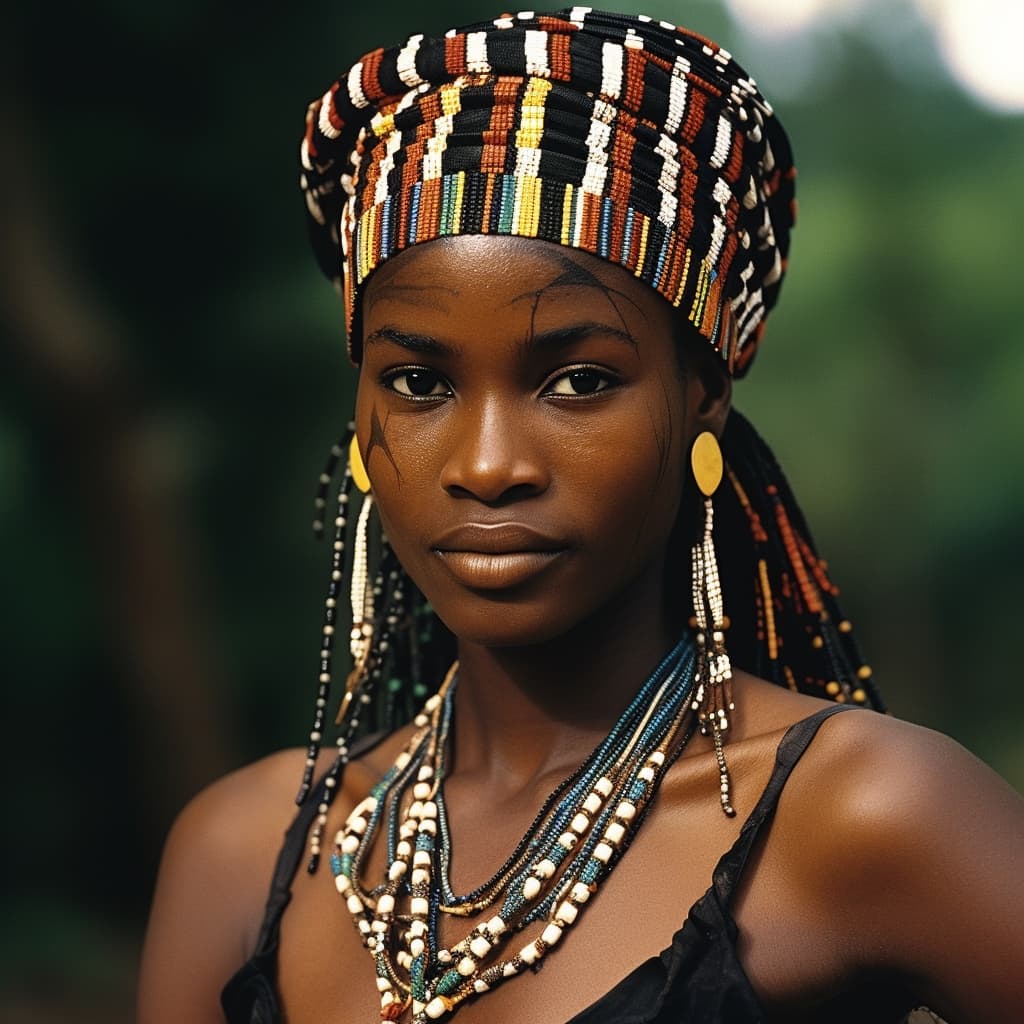
Christianity is the dominant affiliation today, layered over older practices rather than replacing them entirely. Methodist and Episcopal churches established footholds in the nineteenth century through Americo-Liberian missionary work, but bush schools, masking traditions, and the secret societies that govern initiation still operate in parallel. The Krahn became politically prominent in the late twentieth century when Samuel Doe, himself Krahn, took power in the 1980 coup — a period that reshaped Liberia's ethnic politics violently and left the Krahn and Grebo communities marked by the civil wars that followed. Among the distinctive customs worth knowing: the Kru practice of facial scarification — a vertical line down the forehead, traditionally given to young men — was once a deliberate sign to slavers that the bearer would be unsellable, a quiet form of resistance written into the body.
Typical Kru Phenotypes
Reference for AI generation — hair, eyes, skin, facial structure, build
The Kru cluster of southeastern Liberia and the Ivorian forest belt presents a phenotype shaped by long residence in equatorial coastal rainforest. Skin tone sits firmly in Fitzpatrick VI — deeply melanated brown to near-black, with cool blue-black or neutral undertones rather than the reddish or yellow casts more typical of Sahelian groups to the north. Year-round high UV exposure and low rates of historical admixture have kept the population at the darker end of the West African range, comparable to coastal Akan and Ga neighbors.
Hair is almost uniformly Type 4 — tightly coiled, with a fine to medium strand diameter and a dense, springy curl pattern that draws up close to the scalp. Color is black, occasionally with a warm brown cast in strong sunlight; greying tends to come late. Eyes are dark brown to near-black, set under moderately heavy brow ridges, with no epicanthic fold and a broad, open palpebral aperture. Lashes are typically short and tightly curled.
Facial structure is the most regionally distinctive trait. Noses are short with a low, broad bridge and notably wide alar bases — among the widest mean nasal indices recorded in West Africa. Lips are full on both upper and lower, with a well-defined philtrum and a forward-set dental arcade giving mild bimaxillary prognathism. Cheekbones are broad but not high-set; jaws are square in men, softer and rounded in women. Foreheads tend to be moderate in height with a gentle backward slope.
Build is medium-statured and lean — men typically 168–175 cm, women 158–165 cm — with long limbs relative to torso, narrow hips, and the wiry, well-defined musculature historically tied to the Kru's reputation as ocean-going boatmen and surfmen along the Pepper Coast. Among sub-groups, the inland Krahn and Sapo tend slightly taller and more robust than the coastal Grebo and Bakwé, while the Bété of central Côte d'Ivoire show somewhat softer facial features and a marginally lighter mean skin tone reflecting forest-interior rather than coastal residence.
Data depth
0/100Coverage of image-grounded phenotype observations · drives AI generation diversity
- Sample size
- 0/40· 0 images
- Image quality
- 0/30· 0% high
- Confidence
- 0/20
- Source diversity
- 0/10
- ·No image observations yet
Explore phenotype categories
Structured taxonomy with peer-reviewed scales · 22 anatomical categories






Generate Kru AI Content
Use this ethnicity's phenotype data to create AI-generated content with accurate physical traits and cultural context.
Open Creator Studio