Kposo Erotic
Plateaux (Togo), Ghana
Niger–Congo / Kwa / Ghana–Togo Mountain / Kposo
Christianity / Catholicism
Western Africa
About Kposo People
The Kposo — also called Akposso or Ikposo — live along the wooded ridges and steep valleys of Togo's Plateaux Region, with a smaller community spilling across the border into eastern Ghana. Their homeland is the kind of country that shaped them: the Akposso Plateau rises sharply out of the surrounding lowlands, cool and damp by West African standards, broken into pockets by ravines and watercourses. That terrain is why the Kposo are still here as a distinct people. The hills sheltered them from the slave-raiding that hollowed out the plains below in the eighteenth and nineteenth centuries, and the community settled into farming villages tucked into the slopes, growing cocoa, coffee, maize, and yams in soils the altitude keeps generous.
Their language, which they call Ikposso, belongs to a small and somewhat overlooked branch of Kwa known as the Ghana–Togo Mountain languages — sometimes still labelled Central Togo or Togo Remnant in older literature, a name that captures the linguists' guess that these tongues are the survivors of an older West African layer that the better-known Akan and Ewe languages later spread over. Ikposso has two main dialects, Uwi in the north and Litime in the south, distinct enough that speakers notice the difference immediately. Most Kposo today are also fluent in Ewe, the regional lingua franca, and educated speakers in French; the language nonetheless holds on at home and in the markets, transmitted to children without much fuss.
Catholic Christianity is the dominant religion, the legacy of German and later French missionary work during the colonial period, and it sits comfortably alongside older practices that haven't disappeared so much as found a quieter register. Funerals in particular remain elaborate, multi-day affairs that draw the diaspora home and that say more about Kposo social life than any Sunday Mass. Lineage matters. So does the village of origin, even for those who have long since moved to Lomé or Accra or further afield. The annual Ovazu yam festival, held to mark the new harvest, is the most visible communal occasion — a moment when chiefs, elders, and returning kin gather and the calendar of the agricultural year is publicly closed and reopened.
Typical Kposo Phenotypes
Reference for AI generation — hair, eyes, skin, facial structure, build
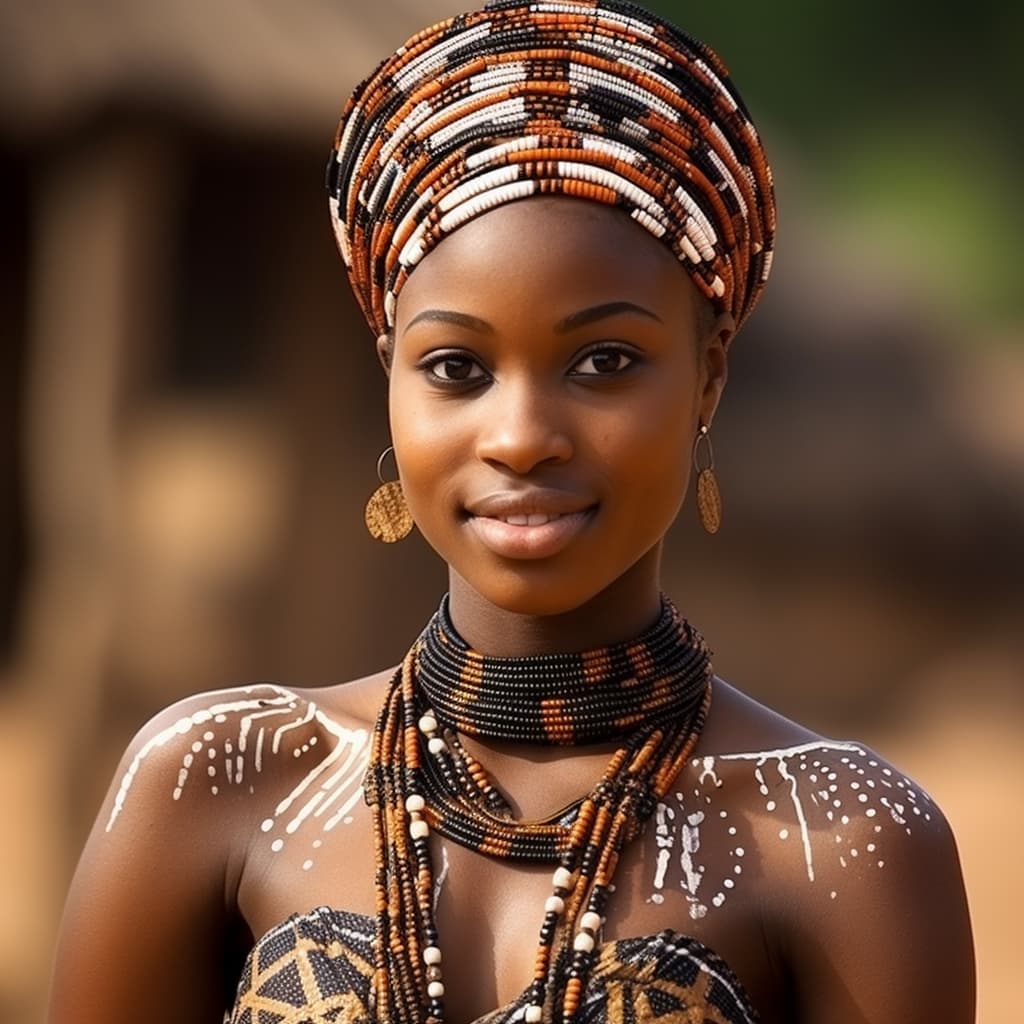
The Kposo (Akposso) are a small Ghana-Togo Mountain people of the Plateaux highlands straddling eastern Togo and the Volta Region of Ghana, and their phenotype reads as classic forest-belt West African with the slightly leaner, more elongated build common to upland Kwa-speaking groups rather than the heavier-set physique of coastal Ewe or Akan neighbors.
Hair is uniformly Type 4 — tightly coiled, springy, often Type 4B to 4C with very tight zigzag patterning and limited length retention without protective styling. Color is true black across nearly the entire population; the rust-tinged or copper hair occasionally seen in malnourished children is a marker of protein deficiency, not a heritable variant. Beard growth in men is light to moderate, denser around the chin than the cheeks.
Eyes are dark brown to near-black, with no epicanthic fold and a generally horizontal palpebral fissure — almond-shaped rather than rounded, set under modest brow ridges. Sclera tends to read warm, with a mild yellow cast common across forest-belt populations.
Skin sits in the Fitzpatrick V–VI range, with most Kposo falling at the deep end — a dark brown to near-black tone with cool, slightly blue-black undertones rather than the redder undertones seen in some Sahelian groups. Sun exposure adds depth rather than tan lines; ashiness on extensor surfaces is the visible marker of dryness.
Facial structure shows a moderately broad nose with a low-to-medium bridge and full alae, lips that are full on both upper and lower (the upper lip noticeably fuller than European norms), and a softly squared jawline. Cheekbones are present but not high or sharply angled; the overall face shape tends round-to-oval.
Build is medium-statured — men commonly 168–175 cm, women 158–165 cm — wiry to athletic, with relatively long limbs for trunk length, narrow hips in men and a defined waist-to-hip ratio in women. Subsistence farming on hilly terrain keeps body composition lean; obesity is uncommon outside the urbanized diaspora in Kpalimé, Atakpamé, and Accra.
Data depth
0/100Coverage of image-grounded phenotype observations · drives AI generation diversity
- Sample size
- 0/40· 0 images
- Image quality
- 0/30· 0% high
- Confidence
- 0/20
- Source diversity
- 0/10
- ·No image observations yet
Explore phenotype categories
Structured taxonomy with peer-reviewed scales · 22 anatomical categories






Generate Kposo AI Content
Use this ethnicity's phenotype data to create AI-generated content with accurate physical traits and cultural context.
Open Creator Studio