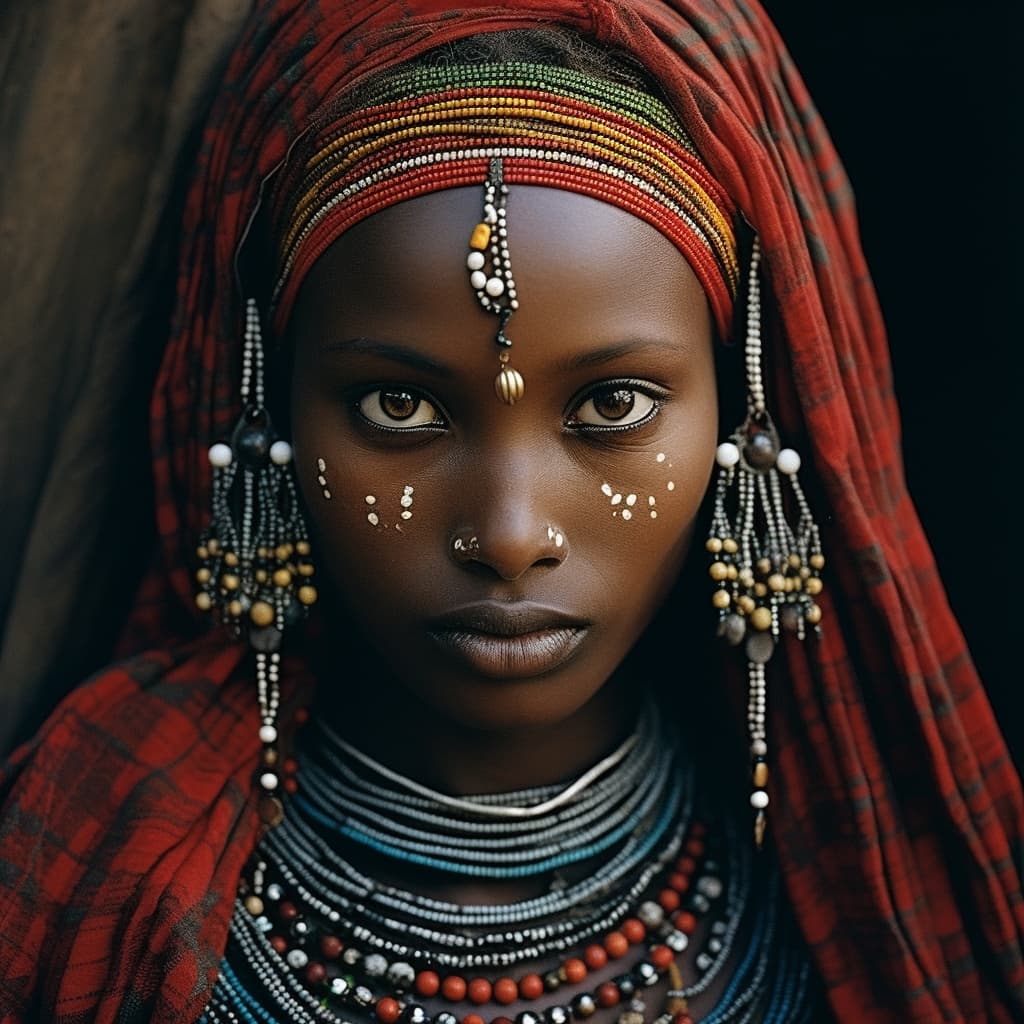
Konso Erotic
Konso (Ethiopia)
Afroasiatic / Cushitic / Konso
Traditional African religions
Eastern Africa
About Konso People
The Konso live on a stony plateau in Ethiopia's southern highlands, between the Rift Valley lakes and the lowlands that drop toward Kenya. What they are best known for is what they have done to the land itself: centuries of dry-stone terracing, walled hilltop towns, and a system of intensive mixed cropping that turned thin, eroding soil into a working agricultural landscape. UNESCO listed the cultural landscape as a World Heritage site in 2011, but the terraces are not heritage — they are still maintained, still farmed, still rebuilt after the rains.
Their language, also called Konso (or Af-Konso), belongs to the Lowland East Cushitic branch of Afroasiatic, a close relative of Oromo and somewhat further from Somali. Speakers number a few hundred thousand, and the language has held its ground despite Oromo and Amharic pressing in from the surrounding regions. Konso society is organized through a generation-grading system — a regionally distinctive form of age-set politics in which men move through ranked stages tied to public office, ritual responsibility, and the right to speak in council. Decisions about land, dispute, and ceremony pass through these grades rather than through hereditary chiefs.
The walled settlements — paletas in their own usage — are built tight, with narrow lanes between clustered houses and central public squares where the community meets. In those squares stand daga-hela, large stones erected to mark the passage of generation cycles, alongside the carved wooden grave markers known as waka: anthropomorphic figures planted over the graves of distinguished men, often surrounded by smaller figures representing wives and defeated enemies. The waka are among the more recognizable objects in East African material culture, though most outside the Konso area now stand in museums rather than on graves.
Religiously, Konso practice has historically centered on a sky deity, Waaqa, alongside ancestor veneration and ritual specialists tied to specific clans and lineages. Christianity and Islam have made inroads, particularly through schooling and trade, but the indigenous ritual calendar — tied to the agricultural year and the generation grades — remains the framework most people live by. The Konso are not an isolated remnant; they are a working society that has organized itself, deliberately and for a long time, around a piece of difficult land.
Typical Konso Phenotypes
Reference for AI generation — hair, eyes, skin, facial structure, build
The Konso are a Cushitic-speaking agricultural people of the southwestern Ethiopian highlands, and their phenotype reflects the long Cushitic presence in the Horn of Africa overlaid with stronger sub-Saharan African admixture than is typical of more northern Cushitic groups like the Oromo or Somali. The result is a population that reads as visibly East African rather than Horn-of-Africa Afro-Asiatic — narrower-featured than Nilotic neighbors, but darker and rounder-featured than highland Amhara or Tigrayan populations.
Hair is almost uniformly black and tightly coiled — Type 4B to 4C — worn close-cropped by men and often braided, plaited, or shaved in age-grade patterns by women. Soft texture or looser curl is rare. Eyes are dark brown to nearly black; the epicanthic fold is absent, and the eye shape tends to be medium-set and slightly almond, without the very wide-set Nilotic carriage. Skin tones cluster in the deep-brown to dark-brown range, Fitzpatrick V to VI, with warm red-brown undertones common — lighter coppery skin sometimes appears in older highland Konso, but very dark sub-Saharan tones predominate.
Facial structure is the most distinguishing feature. Konso faces are typically rounder and broader than the long, narrow Cushitic face seen further north — cheekbones are prominent and high-set, the jaw is moderately squared rather than tapered, and the chin is often short. Noses sit between Cushitic and West African forms: the bridge is low to medium, the alar base moderately wide, the tip rounded but not flared. Lips are full, with the lower lip especially pronounced. Foreheads are broad and slightly rounded.
Build runs short and compact. Konso men average roughly 165–170 cm, women noticeably shorter, with a wiry, agriculturally-conditioned musculature — the terraced farming that defines Konso life produces lean, strong legs and shoulders rather than the tall, gracile build of the Nilotic lowland peoples to their west. Body fat patterning is low, hips relatively narrow, posture upright.
Data depth
0/100Coverage of image-grounded phenotype observations · drives AI generation diversity
- Sample size
- 0/40· 0 images
- Image quality
- 0/30· 0% high
- Confidence
- 0/20
- Source diversity
- 0/10
- ·No image observations yet
Explore phenotype categories
Structured taxonomy with peer-reviewed scales · 22 anatomical categories






Generate Konso AI Content
Use this ethnicity's phenotype data to create AI-generated content with accurate physical traits and cultural context.
Open Creator Studio