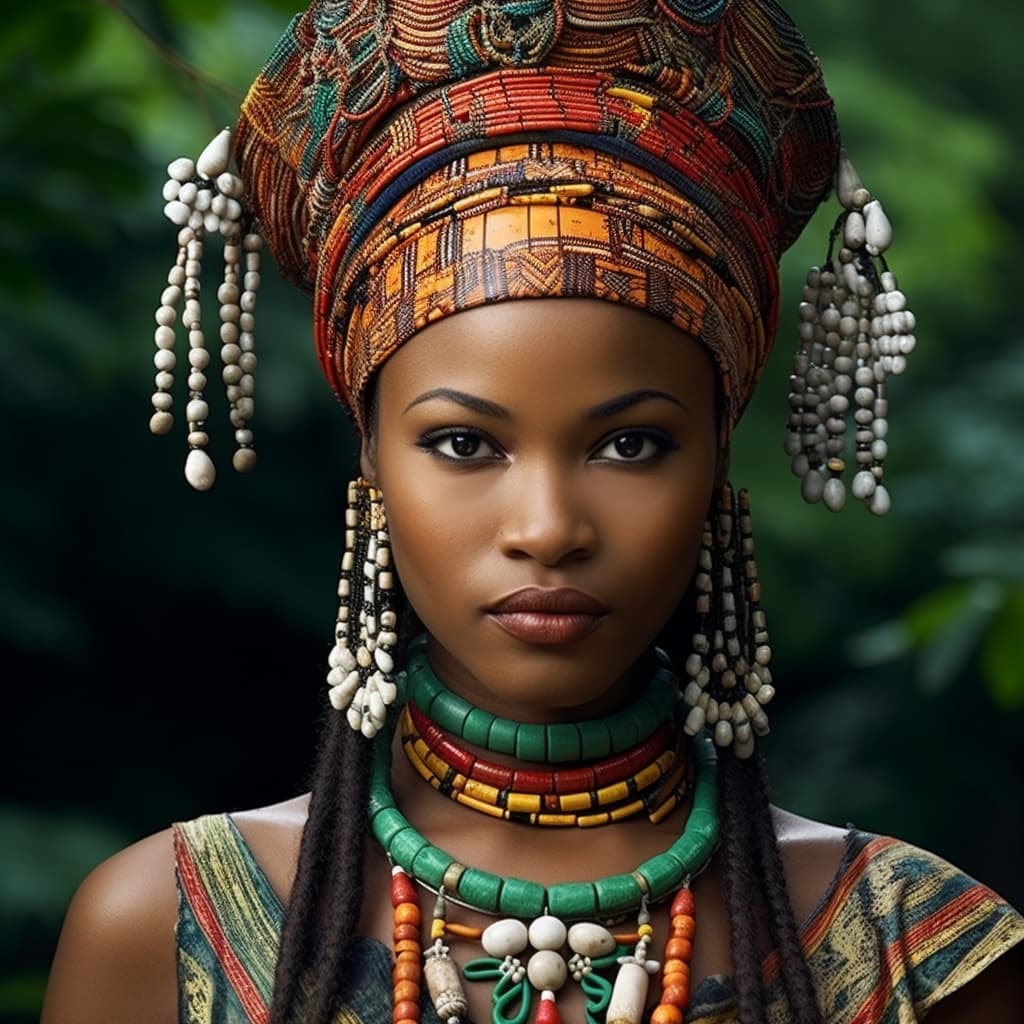
Kapsiki Erotic
Mandara Mountains (Nigeria, Cameroon)
Afroasiatic / Chadic / Kapsiki
Islam
Western Africa
About Kapsiki People
The Kapsiki live in the volcanic peaks and basalt spires of the Mandara Mountains, straddling the border between northeastern Nigeria and far northern Cameroon. On the Nigerian side they are usually called Higi or Kamwe; Kapsiki is the name that has stuck on the Cameroonian slope. The mountains are not incidental — they are the reason the group exists in its present form. For centuries the Mandara range served as refuge country for peoples who refused incorporation into the Islamic emirates of the plains, and Kapsiki villages cluster on the high terraces above narrow gorges, with millet and sorghum grown on hand-built stone walls that step up the slopes.
The language belongs to the Chadic branch of Afroasiatic, the same broad family as Hausa, though Kapsiki sits in a quieter corner of it and shares more with the cluster of small Mandara-mountain languages around it than with the regional lingua franca. Hausa is widely spoken as a second language for trade, and French or English follows depending on which side of the border one is reading from.
The religious picture is more layered than a single label suggests. Islam has made real inroads, particularly in market towns and along the lowland margins, but the mountain villages have historically held to indigenous practice — a system organized around clan ancestors, smith-caste specialists, and the divinatory crab, in which a small freshwater crab is consulted by reading the way it disturbs an arrangement of sticks and stones. Christianity arrived through twentieth-century mission work and has its own constituency. In practice many households move between frames depending on the occasion, and Islam in the Kapsiki context tends to coexist with older obligations rather than displace them outright.
The blacksmith caste, the rerhe, is one of the more distinctive features of Kapsiki social life. Smiths are endogamous and handle iron, pottery, music, divination, and the burial of the dead — a concentration of ritually charged work that makes them indispensable and socially set apart at the same time. Beyond the forge, the Kapsiki are known for elaborate funeral dances, in which the corpse is propped upright and moved through the village before burial, and for a sustained tradition of figurative sculpture in clay. The Dutch anthropologist Walter van Beek has worked with the community since the early 1970s, and much of what outsiders know about Kapsiki ritual life passes through that long collaboration.
Typical Kapsiki Phenotypes
Reference for AI generation — hair, eyes, skin, facial structure, build
The Kapsiki are a Chadic-speaking mountain people of the Mandara range, and their phenotype reflects that long isolation on volcanic highland terrain straddling the Nigeria–Cameroon border. They sit phenotypically between the Sahelian Chadic populations to their north and the forest-edge groups of the Adamawa plateau to their south, with traits that lean toward the leaner, sharper-featured Sahelian end of that gradient rather than the broader West African coastal type.
Hair is dark brown to black, tightly coiled Type 4 — usually 4B to 4C — with the dense, springy texture common across Chadic-speaking populations. Greying tends to come late and stays concentrated at the temples. Eyes are almost uniformly dark brown to near-black, set deep under a moderately pronounced brow ridge; epicanthic folds are absent, and the eye opening tends to be narrow and almond-shaped rather than round. Skin tone runs Fitzpatrick V to VI, typically a deep cool-brown with reddish-mahogany undertones rather than the bluer-black undertone seen further south in equatorial Africa. Highland UV and dry-season dust leave many older Kapsiki with weathered, matte skin texture earlier than lowland neighbors.
Facial structure is the most distinctive feature: narrow faces, high cheekbones, and notably narrow noses with a higher, straighter bridge than is typical for West Africa — a Chadic trait shared with Hausa and Kanuri neighbors. Lips are medium-full rather than pronounced, the jaw is angular, and the chin often projects slightly. Foreheads tend to be high and sloping.
Build is wiry and lean. Mountain subsistence farming and goat herding produce low body fat, long limbs relative to torso, and visible musculature without bulk. Average male stature sits around 168–172 cm, females around 158–162 cm; obesity is rare in traditional rural communities. Among women, the Kapsiki are known for an unusually erect carriage developed from a lifetime of headloading water and grain up steep terrain, which shapes posture and shoulder line in ways visible even at rest.
Data depth
0/100Coverage of image-grounded phenotype observations · drives AI generation diversity
- Sample size
- 0/40· 0 images
- Image quality
- 0/30· 0% high
- Confidence
- 0/20
- Source diversity
- 0/10
- ·No image observations yet
Explore phenotype categories
Structured taxonomy with peer-reviewed scales · 22 anatomical categories






Generate Kapsiki AI Content
Use this ethnicity's phenotype data to create AI-generated content with accurate physical traits and cultural context.
Open Creator Studio