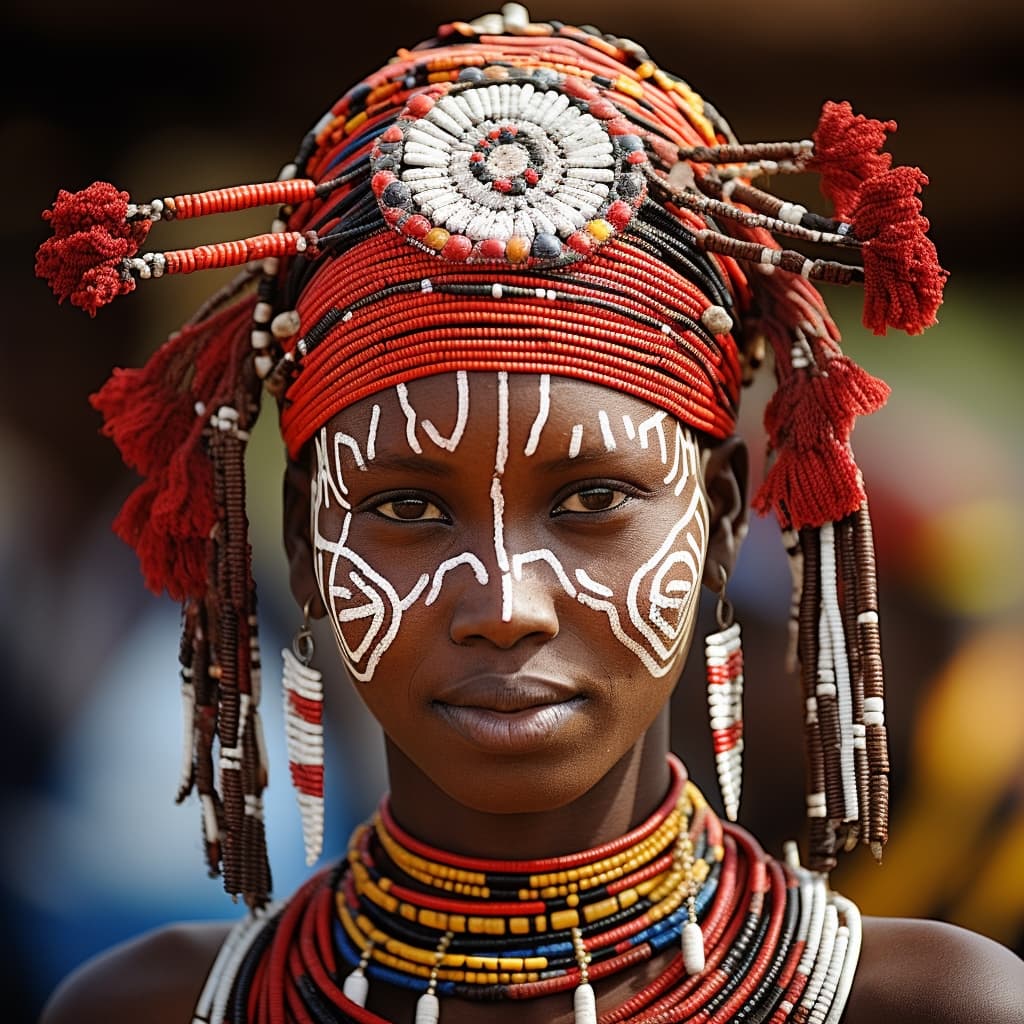
Kalenjin Erotic
Rift Valley Province (Kenya)
Nilo-Saharan / Nilotic / Kalenjin
Christianity
Keiyo, Tugen, Marakwet, Nandi, Kipsigis, Sabaot, Pökoot, Okiek, Terik
Western Africa
About Kalenjin People
The Kalenjin are a cluster of closely related peoples in Kenya's western highlands, spread across the Rift Valley and the escarpments that rise on either side of it. The name itself is recent — a twentieth-century coinage meaning roughly "I tell you" — adopted as a shared political identity by groups that had long recognized one another as kin without using a single label: Nandi, Kipsigis, Tugen, Keiyo, Marakwet, Pökoot, Sabaot, Terik, and the forest-dwelling Okiek. The umbrella was forged largely through radio broadcasts in the 1940s and consolidated through the long political career of Daniel arap Moi, Kenya's second president, who governed for twenty-four years.
Their language belongs to the Southern Nilotic branch — a relative of Maasai and Samburu only in the most distant sense, much closer to the Datooga of Tanzania. The Kalenjin sit linguistically and culturally between the Bantu farming peoples to their west and south and the cattle-driving Nilotes of the lowlands; the highland niche they occupy, between roughly 1,500 and 2,500 metres, has shaped most of what is distinctive about them. Mixed cattle-keeping and cultivation has been the economic baseline for centuries, with maize and tea now overlaid on older patterns of millet and sorghum. The Kipsigis and Nandi in particular dominate Kenya's smallholder tea belt around Kericho.
The institution that organizes Kalenjin life most visibly is the age-set. Boys are initiated together into a named generation — the cycle runs through eight names that repeat roughly every century — and that cohort becomes a lifelong unit of mutual obligation, marriage regulation, and informal authority. Initiation traditionally involved a long period of seclusion in the forest and remains widely practiced, though now usually compressed and supervised by churches or clinics. Most Kalenjin are Christian, with a strong evangelical and Africa Inland Church presence, but the age-set system, clan exogamy, and the standing of elders have not been displaced by it; they run in parallel.
The group is best known internationally for distance running. The concentration of Olympic and world-record middle- and long-distance medalists from a few highland districts — Iten, Kapsabet, Eldoret — is one of the most studied phenomena in modern sport, and while the explanations remain contested (altitude, childhood running to school, body morphology, training culture, economic incentive), the result is that a Kalenjin identity is, for many outsiders, the first thing they encounter under the more familiar label of Kenyan runner.
Typical Kalenjin Phenotypes
Reference for AI generation — hair, eyes, skin, facial structure, build
The Kalenjin phenotype is shaped by Nilotic ancestry, distinguishing them sharply from the Bantu majority that surrounds them in Kenya. The defining structural traits are linear build, long limbs relative to torso, and a narrow frame — the body composition that has made this group the most dominant distance-running population on Earth, with Eliud Kipchoge and Faith Kipyegon as familiar reference points. Stature trends tall, particularly among Nandi and Kipsigis men, with average heights commonly in the 175–183 cm range and exceptionally low body fat retained even outside athletic populations. Shoulders are narrow, hips slim, calves notably slender — the slim lower-leg morphology is a documented anthropometric marker of the group.
Skin tone runs dark brown to deep brown-black, generally Fitzpatrick V to VI, with warm reddish or coppery undertones rather than the bluer undertones common in West African populations. Hair is tightly coiled Type 4, almost universally black, kept short by most men and often closely cropped or braided by women. Greying patterns are typical of African populations — late onset, often concentrated at the temples.
Eyes are dark brown to near-black, with no epicanthic fold; the eye opening tends to be moderately almond-shaped, set under a relatively flat brow ridge. Facial structure is the clearest Nilotic signature: a long, narrow face with a high forehead, prominent but not broad cheekbones, and a notably narrow nose — the alar base is slimmer and the bridge straighter or more elevated than in neighboring Bantu groups. Lips are full but proportionate, less everted than in many West African phenotypes. Jawlines are typically defined rather than heavy.
Sub-group variation is modest. Highland Nandi, Kipsigis, and Keiyo share the classic tall, lean Nilotic build most strongly. The Okiek (forest-dwelling former hunter-gatherers) and Sabaot trend slightly shorter and more compactly built, reflecting older substrate populations absorbed into the Kalenjin cluster.
Data depth
65/100Coverage of image-grounded phenotype observations · drives AI generation diversity
- Sample size
- 20/40· 11 images
- Image quality
- 30/30· 82% high
- Confidence
- 15/20· mean 0.80
- Source diversity
- 0/10· wikipedia
- ·Modest sample (n<25)
- ·Wikipedia-only source — not population-representative
Observed Distribution — Image Sample
Empirical observations from analyzed photographs · supplementary signal, not population truth
Sample: 11 images analyzed (11 wikipedia). Quality: 9 high, 2 medium, 0 low, 0 very_low. Avg analyzer confidence: 0.80.
Skin tone (Fitzpatrick): VI (91%), unclear (9%)
Hair color: black (91%), unclear (9%)
Hair texture: coily (73%), shaved (18%), unclear (9%)
Eye color: dark brown (91%), unclear (9%)
Epicanthic fold: 0% present, 91% absent, 9% unclear
Caveats: Sample size 11 is modest — secondary patterns may not be reliable. Sample is 100% Wikipedia notable people — skews toward male, public-life, and modern figures, not population-representative.
Last aggregated: May 7, 2026
Explore phenotype categories
Structured taxonomy with peer-reviewed scales · 22 anatomical categories
Notable Kalenjin People
59 reference figures — sourced from Wikipedia
- Daniel arap Moi — 1924–2020), second President of Kenya (Longest-serving president in Kenya)
- William Samoei Ruto — fifth president of Kenya
- Eliud Kipchoge — two-time Olympic marathon champion & former world record holder for men's mar…
- Willy Bett — former Cabinet Secretary in the Ministry of Agriculture, Livestock and Fisheries
- Paul Bitok — two-time Olympic silver medalist in the 5,000 m (1992 and 1996)
- Mike Boit — Professor, Kenya's first Commissioner for Sport and Olympic bronze medalist i…
- Amos Biwott — winner of the 3000 metres steeplechase at the 1968 summer Olympic Games
- Nicholas Biwott — 1940–2017), politician
- Jonathan Bii — Governor of Uasin Gishu County
- Vivian Cheruiyot — Kenyan long-distance runner
- Emmanuel Chemengich — Anglican Bishop of Kitale
- Joyce Chepchumba — Kenyan long distance athlete
- Joshua Cheptegei — 10,000 m world champion (Uganda)
- Joyciline Jepkosgei — Kenyan female long-distance runner
- Priscah Jeptoo — Kenyan long-distance runner
- Ben Jipcho — Olympic silver medalist in the 3000 metres steeplechase, 1972 Summer Olympic …
- Kipchoge Keino — born 1940), former 1500 m world record holder
- Mary Jepkosgei Keitany — former professional long-distance runner
- Ezekiel Kemboi — multiple world and Olympic 3000 m steeplechase champion
- Jonathan Kimetet arap Ng'eno — 4th Speaker of the National Assembly of Kenya
- Emmanuel Kipchirchir Mutai — Kenyan long-distance runner
- Wilson Kipketer — multiple world champion and world record holder in 800 meter
- Edna Kiplagat — Kenyan professional long-distance runner
- Moses Kiprono arap Keino — 3rd Speaker of the National Assembly of Kenya
- Amos Kipruto — Kenyan long-distance runner
- Chris Kiptoo — Principal Secretary for National Treasury in Kenya
- Kelvin Kiptum — 1999–2024), world men's marathon record holder between 2023 and 2026
- Faith Kipyegon — 1500 m world and Olympic running champion; record holder in 1500 m, mile, and…
- Timothy Kitum — Kenyan middle-distance runner
- Benjamin Kogo — Kenyan athlete
- Betty Korir — Kenyan lawyer and corporate executive, Credit Bank
- Cornelius Korir — Catholic Bishop of the Diocese of Eldoret
- Paul Korir — inaugural Anglican Bishop of Kapsabet
- Brigid Kosgei — record holder in women's marathon
- Pamela Kosgei — Kenyan track and field and cross-country athlete
- Sally Kosgei — former Minister for Higher Education in Kenya
- Felix Koskei — Head of Public Service (Kenya)
- Joyce Laboso — Governor of Bomet County, Kenya
- Martin Lel — Kenyan professional long distance and marathon runner
- Felix Limo — former long-distance runner
- Paul Malakwen Kosgei — Kenyan long-distance runner and marathoner
- Jackson Mandago — first Governor of Uasin Gishu County
- Paul Masaba — Anglican Bishop of Sebei
- Gideon Moi — former Kenyan Senator, Baringo County
- Mercy Moim — Kenyan volleyball player
- Alexander Muge — former Anglican Bishop of the Diocese of Eldoret
- Kipchumba Murkomen — Cabinet Secretary, Ministry of Interior & National Administration of Kenya
- Ernest Ng'eno — Anglican Bishop of Kericho
- Henry Rotich — former Cabinet Secretary for National Treasury (Kenya)
- Wisley Rotich — Governor of Elgeyo Marakwet County
- Rachel Ruto — First Lady of Kenya
- Isaac Ruto — first Governor of Bomet County
- Lonah Chemtai Salpeter — born 1988), Kenyan-born Israeli Olympic marathon runner
- Koitalel Arap Samoei — the Orkoiyot and leader of the Nandi resistance against British colonialism
- Patrick Sang — Kenyan running coach
- Jemima Sumgong — Kenyan long-distance runner
- Taaitta Toweett — former Minister of Education, Kenya
- Oscar Kipchumba Sudi — member of the Kenyan National Assembly representing Kapseret constituency
- Aaron Kipkirui Cheruiyot — Majority Leader of the senate, senator for Kericho County






Generate Kalenjin AI Content
Use this ethnicity's phenotype data to create AI-generated content with accurate physical traits and cultural context.
Open Creator Studio