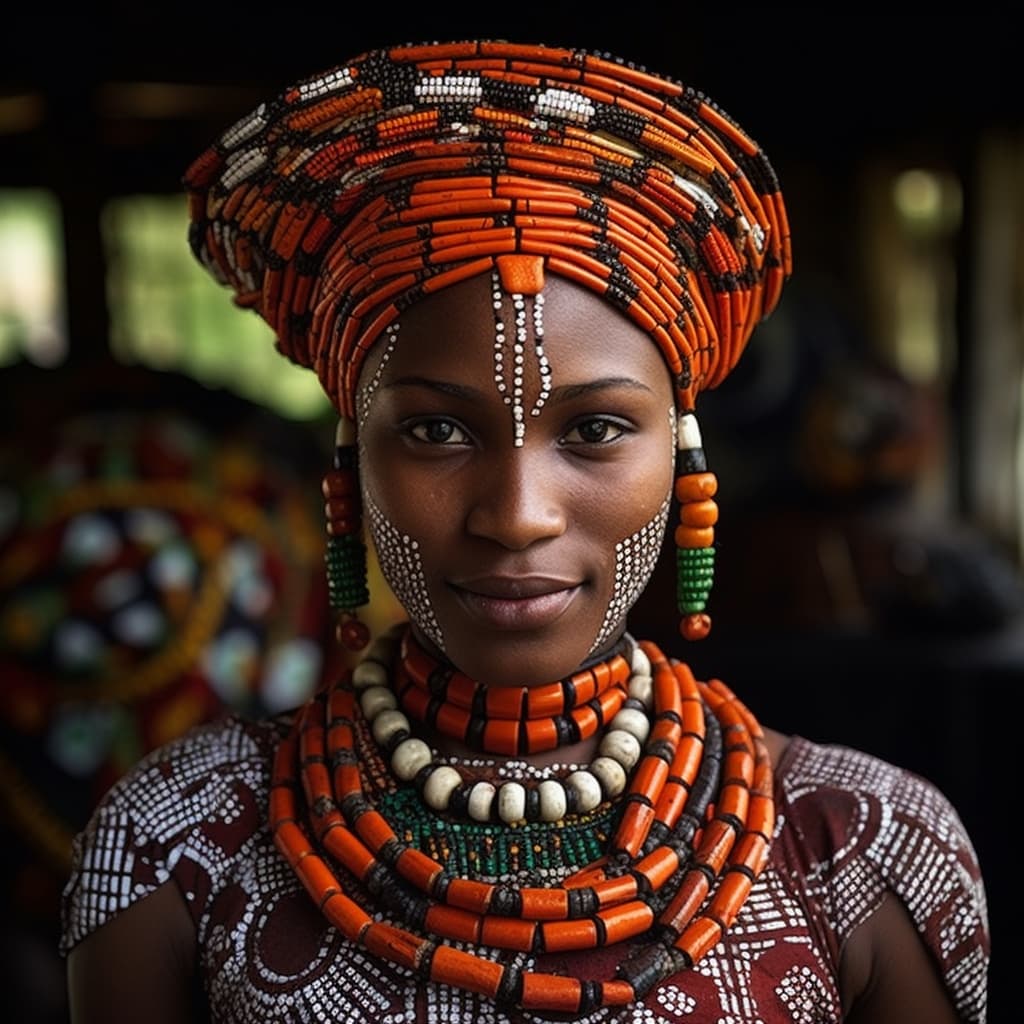
Jukun Erotic
Wukari (Nigeria)
Niger–Congo / Jukun Takum
Traditional African religions
Wannu
Western Africa
About Jukun People
The Jukun are most readily identified by their connection to Wukari, the small town in Taraba State that still functions as the ceremonial seat of the Aku Uka — a divine-king figure whose office predates the colonial map of Nigeria by several centuries. The Jukun trace their political memory to Kwararafa, a confederacy that pressed northward against the Hausa city-states in the seventeenth century before fragmenting under successive pressures. That history matters because it explains the Jukun's posture today: a relatively small population with the institutional self-image of a much larger one, scattered across the Benue valley and into pockets of Cameroon, but anchored by a court whose rituals are still observed.
The Jukun language belongs to the Jukunoid branch of Benue–Congo, a cluster of closely related but mutually distinct tongues. Jukun Takum, spoken to the south around the Takum area, is one of the principal varieties; Wukari Jukun (Wapan) is the other reference point, and the Wannu are counted among the related sub-groups along the river systems that thread this region. Speakers of one Jukunoid variety often cannot follow another without effort, which is part of why the group has historically been described in the plural — Jukun peoples — rather than as a single bloc.
Religious life is the area where Jukun distinctiveness shows most clearly. While Christianity and Islam have made inroads, a substantial body of traditional practice persists, organized around the figure of the Aku Uka and a calendar of agricultural and ancestral observances. The king is not merely a political head but a sacral one: certain rites historically required his seclusion from public view, and his person was understood to mediate between the community and unseen powers. Puje, the principal annual festival, gathers the dispersed Jukun back to Wukari and remains the clearest expression of this older ritual order.
Daily life in Jukun country is shaped by the floodplain — yam, guinea corn, fishing along the Benue — and by an uneasy modern history of communal disputes with neighboring Tiv farmers over land, which has flared periodically since the 1990s. The Jukun today are negotiating the same pressures most middle-belt Nigerian peoples face: a shrinking agricultural base, urban migration, and the slow erosion of ritual authority by competing religious and political institutions.
Typical Jukun Phenotypes
Reference for AI generation — hair, eyes, skin, facial structure, build
The Jukun of the Benue valley around Wukari sit phenotypically within the broader Central-Sudanic Nigerian middle belt, distinct from both the taller Sahelian peoples to their north and the shorter forest-zone Igbo and Yoruba to their south. Hair is uniformly Type 4 — tightly coiled, dense, with the high shrinkage ratio characteristic of West African keratin structure. Natural color is black; brown sun-bleaching at the tips is common in older men and field workers. Premature greying at the temples is documented anecdotally as relatively frequent.
Eyes are dark brown to near-black, set under moderately heavy supraorbital ridges. No epicanthic fold. The eye shape tends to be almond, neither as round as is common in some forest-zone groups nor as narrowly set as among certain Chadic neighbors. Skin tone clusters in Fitzpatrick V to VI, with warm red-brown undertones rather than the cooler blue-black sometimes seen further south among riverine Niger Delta populations. The Jukun's long agricultural history along the Benue produces strong sun-exposure deepening on shoulders and forearms relative to torso.
Facially, the Jukun show a moderate-width nose with a low-to-medium bridge and rounded, fairly broad alae — less broad than coastal Yoruba averages, less narrow than Fulani. Lips are full, with the upper lip notably defined. Cheekbones sit moderately high; the jaw is square in men, softer and more oval in women, and the overall face shape trends rectangular rather than round.
Build is mid-range for West Africa: men commonly 170–178 cm, women 158–165 cm, with proportionally long limbs and lean musculature shaped by farming and fishing livelihoods. Body fat distribution in women tends toward a defined waist with full hips and thighs. The Wannu branch around Takum shows no consistent phenotypic divergence from the Wukari core — the variation visible across Jukun populations tracks individual lineage and intermarriage with neighboring Tiv, Chamba, and Kuteb communities more than any internal subgroup line.
Data depth
0/100Coverage of image-grounded phenotype observations · drives AI generation diversity
- Sample size
- 0/40· 0 images
- Image quality
- 0/30· 0% high
- Confidence
- 0/20
- Source diversity
- 0/10
- ·No image observations yet
Explore phenotype categories
Structured taxonomy with peer-reviewed scales · 22 anatomical categories






Generate Jukun AI Content
Use this ethnicity's phenotype data to create AI-generated content with accurate physical traits and cultural context.
Open Creator Studio