Jola Erotic
Jolaland (Senegal)
Niger–Congo / Atlantic / Senegambian / Jola
Traditional African religions
Banjaal, Bayot, Fogni, Gusilay, Karon, Kasa, Kuwaataay, Mlomp
Western Africa
About Jola People
The Jola are the people of the lower Casamance — the green, water-laced country south of the Gambia River, cut off from the rest of Senegal by both geography and history. They are rice farmers above almost anything else: the bolong-fed paddies behind every village are not just food but inheritance, status, and the physical record of a family's relationship to a place. A Jola without a rice field is a Jola in the abstract.
Linguistically they are part of the Atlantic branch of Niger–Congo, related at a distance to Wolof and Serer but mutually unintelligible with both, and more strikingly fragmented internally than outsiders tend to realize. The names listed as "sub-groups" — Kasa, Fogni, Bayot, Banjaal, Gusilay, Karon, Kuwaataay, Mlomp — are partly geographic and partly linguistic, and the speech of one Jola village can be hard going for someone from another twenty kilometres away. There is no single Jola standard; the unity is cultural and ritual rather than linguistic.
That ritual life is anchored in the boekin, shrines tied to specific lineages, forests, and water sources, and in the bukut, the male initiation cycle held roughly once a generation. Bukut still draws men home from Dakar, Banjul, and Europe; missing it is a serious thing. Christianity and Islam have both made real inroads — the Kasa in particular have a strong Catholic presence around Oussouye, while northern groups lean Muslim — but the older religion has not been displaced so much as layered under, and a Jola Catholic priest and a Jola elder consulting a shrine are not necessarily different people.
Politically the Jola are famous for two things. The first is a tradition of decentralised, almost stateless governance — no chiefs in the precolonial sense, authority diffused through age-grades and ritual specialists, with the priest-king of Oussouye standing as a rare and deliberately constrained exception. The second is the long, grinding Casamance separatist conflict that began in 1982, in which Jola identity and grievance have been central, and which has shaped a generation's relationship to the Senegalese state. Add to this the hospitality codes, the funerary wrestling, the palm-wine economy, and the women's rice-cultivation societies, and what emerges is a people who have managed something difficult: staying recognisably themselves while everything around them changed.
Typical Jola Phenotypes
Reference for AI generation — hair, eyes, skin, facial structure, build
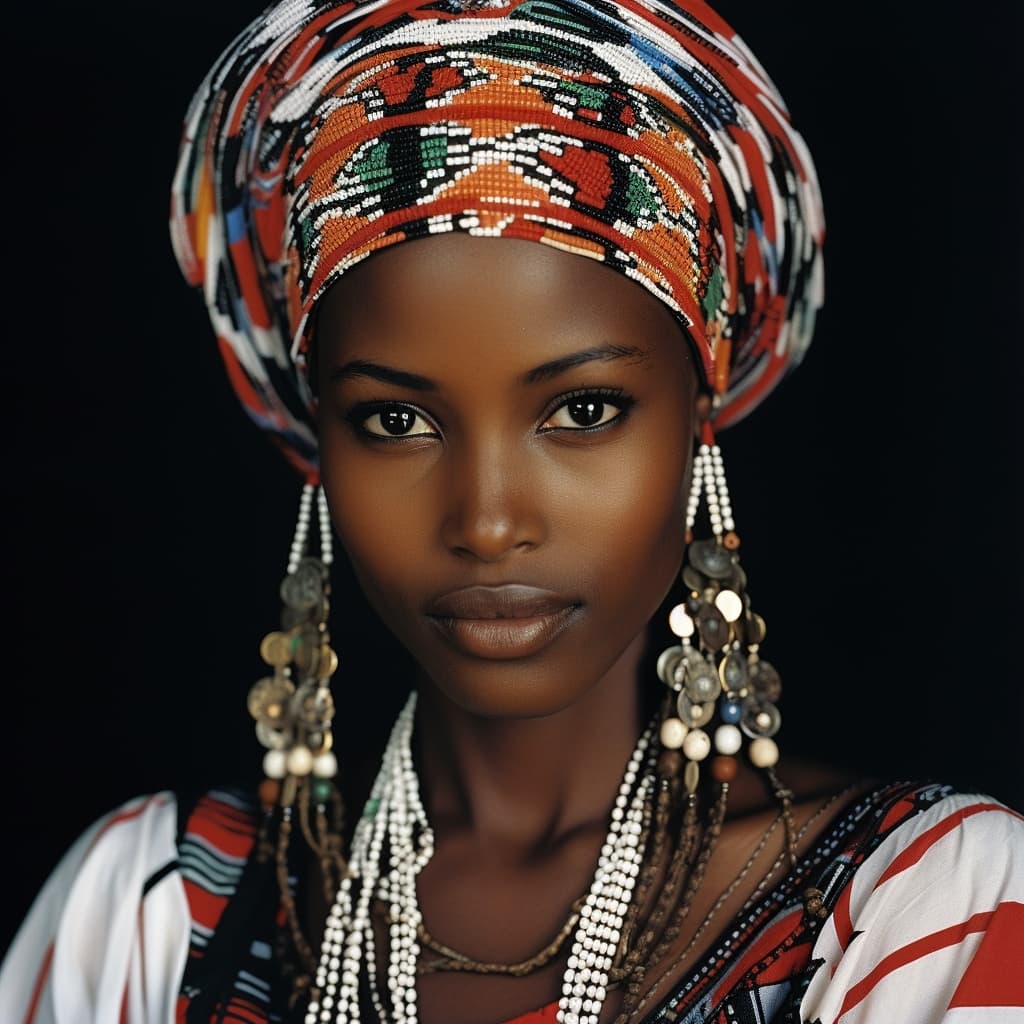
The Jola phenotype is shaped by deep West African coastal ancestry along the Casamance and lower Gambia rivers, with relatively little of the Sahelian admixture that softens features further north. The result is a population that reads as structurally West African in a fairly concentrated way: dark skin, tightly coiled hair, broad mid-face, and a build that runs lean and long-limbed.
Hair is almost universally Type 4, ranging from springy 4A coils to dense 4C with tight zigzag patterning; natural color is true black, occasionally with a warm dark-brown cast in sun-bleached ends. Texture is uniform across sub-groups — Fogni, Kasa, Karon, and Bayot communities show very little of the looser curl patterns seen in some Senegambian neighbors. Eyes are dark brown to near-black, almond-shaped with a clean upper lid and no epicanthic fold, set under a moderately prominent brow. Skin sits firmly in Fitzpatrick VI, with cool blue-black or warm red-brown undertones depending on individual; the rural Casamance sun keeps tone deeply saturated rather than uneven.
Facial structure is the most distinctive feature. Noses are typically broad with a low-to-medium bridge and notably wide alae; lips are full and well-defined, often with a pronounced cupid's bow on the upper lip. Cheekbones are wide-set but not high or sharp — the mid-face reads broad and flat rather than angular, with a strong squared jaw in men and a softer rounded jawline in women. Foreheads tend to be high and smooth.
Build runs tall and slim, with documented stature among the higher ranges in West Africa; men commonly clear 180 cm and footballers like Bacary Sagna and Jules Bocandé illustrate the long-limbed, narrow-hipped, athletically-shouldered frame that's typical. Women share the same long-boned proportions, with relatively narrow shoulders, defined waists, and rounded hip and gluteal contours rather than broad ones. Fat distribution is generally low and peripheral. Sub-group variation across Banjaal, Mlomp, Gusilay, and Kuwaataay is linguistic far more than phenotypic — visually, they're a tightly coherent population.
Data depth
62/100Coverage of image-grounded phenotype observations · drives AI generation diversity
- Sample size
- 17/40· 8 images
- Image quality
- 30/30· 75% high
- Confidence
- 15/20· mean 0.84
- Source diversity
- 0/10· wikipedia
- ·Small sample (n<10)
- ·Wikipedia-only source — not population-representative
Observed Distribution — Image Sample
Empirical observations from analyzed photographs · supplementary signal, not population truth
Sample: 8 images analyzed (8 wikipedia). Quality: 6 high, 2 medium, 0 low, 0 very_low. Avg analyzer confidence: 0.84.
Skin tone (Fitzpatrick): III (13%), V (38%), VI (50%)
Hair color: black (75%), gray/white (25%)
Hair texture: straight (13%), coily (63%), covered (25%)
Eye color: dark brown (88%), unclear (13%)
Epicanthic fold: 0% present, 88% absent, 13% unclear
Caveats: Sample size 8 is small — observed distribution should be treated as suggestive, not definitive. Sample is 100% Wikipedia notable people — skews toward male, public-life, and modern figures, not population-representative.
Last aggregated: May 7, 2026
Explore phenotype categories
Structured taxonomy with peer-reviewed scales · 22 anatomical categories
Notable Jola People
27 reference figures — sourced from Wikipedia
- Banjaal — spoken in a small area south of the Casamance River.
- Bayot — spoken around Ziguinchor.
- Oussouye — KuDiola spoken in a handful of villages south of Oussouye.
- Fogni — Kujamaat) spoken around Bignona.
- Gusilay — spoken in the village of Thionck Essyl.
- Karon — spoken along the coast of Casamance south of Diouloulou.
- Kasa — spoken around Oussouye.
- Kuwaataay — spoken along the coast south of the Casamance River.
- Mlomp — spoken in the village of Mlomp.
- handle — Bakiti: like two maracas without the handle attached with one cord
- raining — Efemme: a calebasse reversed in a container full of water. Used by women to i…
- dance — Etantang: used for Koumpo dance and wrestling festivities
- drum — Fouindoum: drum used during initiation
- horn — Gabilene: sound make with a horn of an animal
- Pierre Goudiaby Atepa — [fr], architectural engineer in Senegal.
- Jules Francois Bocandé — footballer
- Bruma — footballer
- John Carew — footballer
- Maixent Coly — Bishop of Ziguinchor (1995–2010)
- Yahya Jammeh — President of the Gambia (July 1994 to 2017)
- Mansa Suling Jatta — King of Kombo (Gambia)
- Q-Tip (musician) — rapper from the band A Tribe Called Quest
- Augustin Sagna — Bishop of Ziguinchor (1966–1995)
- Bacary Sagna — footballer
- Robert Sagna — politician
- Jill Scott — musician
- Lang Tombong Tamba — former army chief of staff of the Gambia
Generate Jola AI Content
Use this ethnicity's phenotype data to create AI-generated content with accurate physical traits and cultural context.
Open Creator Studio