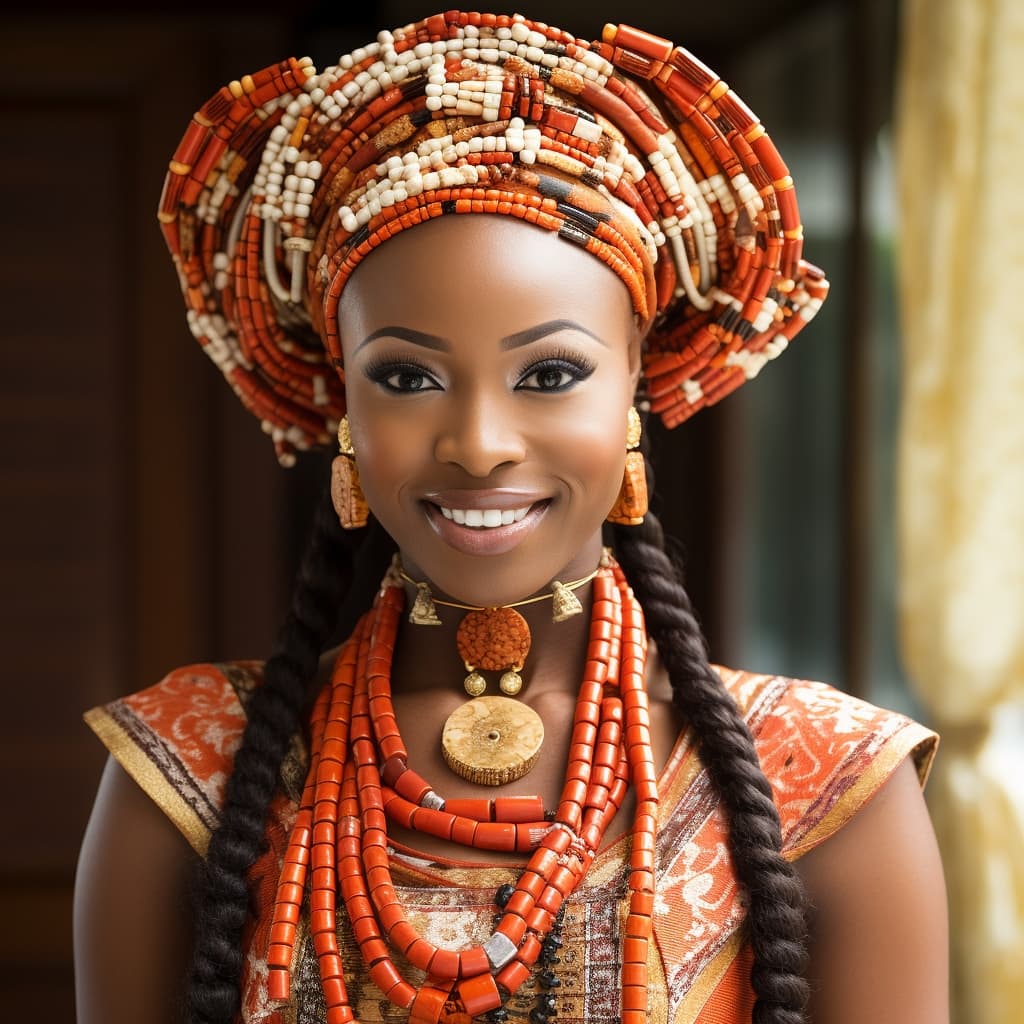
Ijaw Erotic
Nigeria (Rivers, Bayelsa, and Delta States)
Niger–Congo / Ijaw
Christianity
Bille, Engenni, Ibani, Kalabari, Kula, Nkoro, Nkoroo, Obolo
Western Africa
About Ijaw People
The Ijaw live where Nigeria runs out of land. The Niger Delta — the immense, fraying mouth where the Niger River breaks into a thousand creeks before reaching the Atlantic — is home territory, and the Ijaw have shaped their lives around water in ways most West African peoples have not. They are fishermen, boatbuilders, traders of salt and palm oil, dwellers of stilt towns and mangrove islands. To call them "riverine" is accurate but undersells it: the creeks are their roads, their cemeteries, their borders. Bayelsa State, carved out in 1996, is essentially an Ijaw homeland; sizeable populations also fill out southern Rivers and parts of Delta State, with smaller communities along the coast as far as Akwa Ibom.
The Ijaw language is one of the older puzzles of Niger–Congo classification. It sits oddly within the family — distinct enough from neighboring Igbo, Edo, and Yoruba branches that linguists have sometimes treated Ijoid as its own primary sub-branch, a holdover from a deeper West African past. Internally the language splinters: the Kalabari, Ibani, Nkoro, Bille, and Kula along the eastern delta speak varieties that aren't always mutually intelligible with the central Izon dialects spoken further west, and Engenni and Obolo sit at further removes still. This linguistic fragmentation tracks with the geography — communities separated by tidal channels developed in their own directions.
Christianity, mostly Anglican and Pentecostal, is now the dominant faith, the legacy of nineteenth-century missions that arrived through the same delta ports — Bonny, Brass, Nembe, Buguma — that earlier handled the slave trade and later the palm oil trade. But the older water cosmology has not disappeared. Owuamapu and other water-spirit traditions persist in masquerades and festivals, and figures like Egbesu, a war deity associated particularly with the central Ijaw clans, have taken on contemporary political weight as well as religious meaning.
The modern Ijaw story is inseparable from oil. The crude that fuels Nigeria's economy is pumped from beneath their fishing grounds, and the resulting tension — environmental degradation, revenue allocation, militancy, amnesty programs — has dominated delta politics for a generation. Isaac Boro's brief 1966 secession declared a Niger Delta Republic; decades later, Ijaw activism remained central to the conversation about who the delta's wealth belongs to. It is a people defined, still, by the water and what runs underneath it.
Typical Ijaw Phenotypes
Reference for AI generation — hair, eyes, skin, facial structure, build
The Ijaw phenotype reads as quintessentially Niger Delta West African, shaped by millennia of riverine and coastal life rather than the Sahelian or forest-belt patterns seen in their northern neighbors. Skin tone clusters in the deep brown to very dark brown range — Fitzpatrick V to VI predominate, with rich red-brown and blue-black undertones common; genuinely lighter complexions are uncommon outside mixed parentage. The skin tends to be thick and slow to mark, with visible sheen rather than matte texture.
Hair is almost uniformly Type 4 — tight coils to densely kinked Z-pattern (4B/4C), jet black, with the high shrinkage and low porosity typical of West African coil structure. Straight or loosely wavy hair is essentially absent without admixture. Eyes run dark brown to near-black; the epicanthic fold is absent, and eye shape tends toward almond with a slight upward outer canthus, often set under heavy, well-defined upper lids. Sclera frequently carries a warm ivory tint rather than stark white.
Facial structure shows what's often called the coastal Niger Delta look: broader alar base with a low-to-medium nasal bridge, fuller everted lips with pronounced vermilion border, and well-developed zygomatic prominence sitting over a square or rounded jaw rather than a tapered one. Foreheads are typically broad. Build trends athletic and powerfully muscled in men — the footballing lineage of Finidi George, Taribo West, and Tammy Abraham is phenotypically representative — while women carry the curvier, gluteofemoral fat distribution characteristic of West African populations, with Agbani Darego's tall, long-limbed proportions sitting at the slimmer end of that range. Average male stature lands around 170–175 cm, females around 160–163 cm, though coastal Ijaw subgroups tend slightly taller than inland.
Across the Kalabari, Ibani, Nembe, and Engenni branches, phenotype variation is modest — mostly a question of facial breadth and complexion depth, with Kalabari and Bonny lineages sometimes showing slightly finer features from centuries of coastal trading contact, while interior Engenni and Nkoro communities present the broader, deeper-toned end of the range.
Data depth
69/100Coverage of image-grounded phenotype observations · drives AI generation diversity
- Sample size
- 24/40· 16 images
- Image quality
- 30/30· 75% high
- Confidence
- 15/20· mean 0.80
- Source diversity
- 0/10· wikipedia
- ·Modest sample (n<25)
- ·Wikipedia-only source — not population-representative
Observed Distribution — Image Sample
Empirical observations from analyzed photographs · supplementary signal, not population truth
Sample: 16 images analyzed (16 wikipedia). Quality: 12 high, 3 medium, 1 low, 0 very_low. Avg analyzer confidence: 0.80.
Skin tone (Fitzpatrick): V (25%), VI (75%)
Hair color: black (69%), gray/white (25%), unclear (6%)
Hair texture: straight (6%), coily (81%), covered (13%)
Eye color: dark brown (88%), unclear (13%)
Epicanthic fold: 0% present, 88% absent, 13% unclear
Caveats: Sample size 16 is modest — secondary patterns may not be reliable. Sample is 100% Wikipedia notable people — skews toward male, public-life, and modern figures, not population-representative.
Last aggregated: May 7, 2026
Explore phenotype categories
Structured taxonomy with peer-reviewed scales · 22 anatomical categories
Notable Ijaw People
34 reference figures — sourced from Wikipedia
- Goodluck Jonathan — politician and 14th President of Nigeria
- J.P. Clark — poet and playwright
- Gabriel Okara — poet and novelist
- Owoye Andrew Azazi — Nigerian Chief of Defense Staff and National Security Adviser
- Patience Faka Jonathan — First Lady Of Nigeria (2010-2015)
- King Frederick William Koko — Mingi VIII) King of Nembe-Brass Kingdom (1853–1898)
- Olu Benson Lulu-Briggs OON — 1930-2018) businessman and elder statesman
- Timi Dakolo — Nigerian singer-songwriter
- Harold Dappa-Biriye — Nigerian politician and arts administrator
- Ibinabo Fiberesima — Nigerian Nollywood actress
- Ben Murray-Bruce — Nigerian media mogul and senator
- Ebikabowei Victor Ben — MEND general
- Kingsley Kuku — former chairman, Niger Delta presidential amnesty program
- Eruani Azibapu Godbless — businessman and former Bayelsa Commissioner for Health
- Patience Torlowei — artist and fashion designer
- Finidi George — Nigerian footballer and coach
- Taribo West — Nigerian former footballer and pastor
- Samson Siasia — Nigerian footballer and coach
- Inetimi Odon Timaya — Nigerian singer
- Damini Ogulu (Burna Boy) — Nigerian singer and Grammy award winner
- Ideye Brown — Nigerian footballer
- King Alfred Diete-Spiff — former Military Governor of Rivers State and Amanayabo (King) of Twon-Brass
- Grand Bonny Kingdom — King Edward Asimini William Dappa Pepple III, Perekule XI, Amanayabo (King) o…
- Government Oweizide Ekpemupolo — Nigerian freedom fighter (ex-militant) commander
- Jeremiah Omoto Fufeyin — clergyman
- Tammy Abraham — professional footballer.
- Agbani Darego — professional model and beauty queen
- Gentle Jack — professional Nollywood actor
- Dakore Egbuson Akande — Nollywood actress
- Kingsley Otuaro — Former Deputy Governor of Delta State
- Timini Egbuson — Nollywood actor
- Henry Seriake Dickson — politician and former governor
- Timipre Sylva — politician and former governor of Bayelsa State, former Minister of State for…
- Edwin Kiagbodo Clark — Nigerian Ijaw leader and politician






Generate Ijaw AI Content
Use this ethnicity's phenotype data to create AI-generated content with accurate physical traits and cultural context.
Open Creator Studio