Ibibio Erotic
Akwa Ibom State (Nigeria)
Niger–Congo / Cross River / Ibibio-Efik / Ibibio
Christianity
Eket, Aro
Western Africa
About Ibibio People
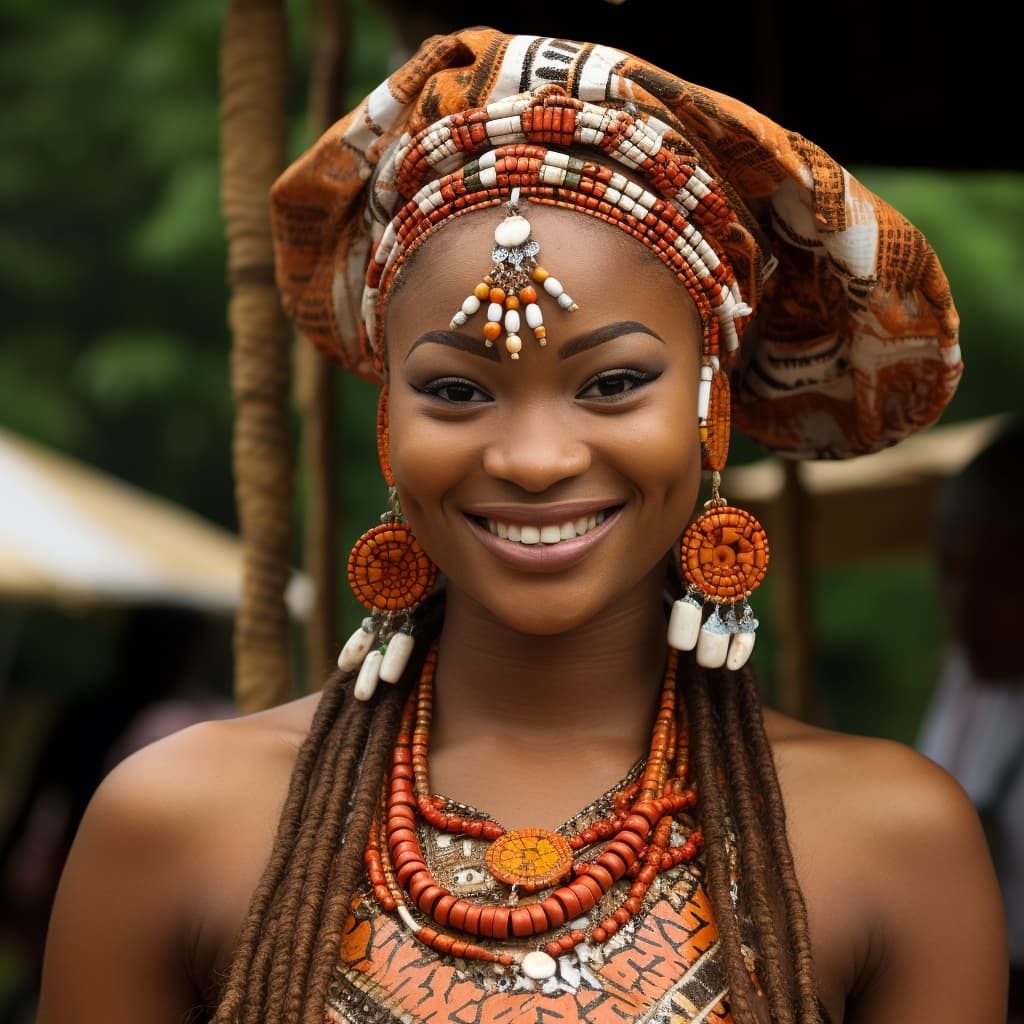
The Ibibio are one of the older settled peoples of the Nigerian coastal lowlands, concentrated today in Akwa Ibom State between the Cross River and the Imo. Most reckonings put them among the earliest established communities in this stretch of the Bight of Biafra — long enough that neighboring groups, including the Efik and Annang, share enough linguistic and ceremonial ground with them to be considered close kin rather than foreign neighbors. The country itself is dense forest cut by tidal creeks and palm bush, and the older village layouts still reflect that: compounds clustered along ridges, farmland radiating outward, footpaths to the water.
Their language, Ibibio, sits inside the Cross River branch of Niger–Congo and is mutually intelligible to varying degrees with Efik, which historically functioned as the prestige written form thanks to nineteenth-century Presbyterian missionary work in Calabar. That missionary contact is also why Christianity — predominantly Protestant, with a strong Catholic presence and a proliferation of independent and Pentecostal churches — is now the default religious frame, though older practices around ancestral veneration, the earth, and the lineage compound have not so much disappeared as gone quiet beneath the church calendar. The internal divisions are real but soft-edged: the Eket sit toward the southern coast, the Annang to the west, the Oron along the estuary; the Aro are a related Igbo-speaking trading network whose historical reach overlapped Ibibio country deeply. Whether to count any given subgroup as Ibibio, neighbor, or distinct people is a question that gets answered differently depending on who is asked and when.
The cultural signature most outsiders register is the masquerade tradition — Ekpo and Ekpe societies in particular — whose carved masks and graded ranks once handled much of what a modern observer would call governance: dispute resolution, debt enforcement, the policing of social conduct. Those societies still exist, attenuated but not vestigial. The other thing worth knowing is the role of women's wealth and women's councils in Ibibio social life, which has historically been substantial: lineage land, market authority, and the right to convene against errant men were not afterthoughts but institutions. The 1929 Aba Women's War, though usually narrated as an Igbo event, drew heavily on Ibibio and Annang women and on exactly these older organizational habits — a useful reminder that the political instincts of this corner of southeastern Nigeria did not begin with the colonial encounter and did not end with it either.
Typical Ibibio Phenotypes
Reference for AI generation — hair, eyes, skin, facial structure, build
The Ibibio phenotype is a coastal Cross River variant of West African appearance — close to neighboring Efik and Annang populations, generally darker-skinned and rounder-featured than the Yoruba to the west, less angular than the Igbo to the immediate north. Skin tone clusters in the Fitzpatrick V–VI range, with deep brown to near-black being the modal presentation; warm red-brown undertones are common, and the high humidity of Akwa Ibom rather than direct sun exposure tends to produce an even, glossy finish to the skin rather than the weathered look seen in Sahelian groups.
Hair is uniformly Type 4 — tightly coiled to kinky-coily, with 4B and 4C textures dominating. Natural color is true black; reddish casts under sunlight are common but red or brown variants are vanishingly rare. Hairlines tend to sit relatively low and full, and traditional grooming has long favored close cropping for men and braided or threaded styles for women.
Eyes are dark brown to near-black, almond-shaped, set under a moderately pronounced supraorbital ridge. The epicanthic fold is absent. Lashes are typically dense and tightly curled.
Facial structure leans toward the rounder, softer end of the West African range. Noses are broad with a low-to-moderate bridge and noticeably wide alae — flatter in profile than Yoruba or Hausa norms. Lips are full, with the lower lip often markedly everted. Cheekbones are present but well-padded; jawlines are square in men and softly rounded in women, and the overall facial impression is wide rather than long.
Build runs medium-statured — men typically 5'6"–5'9", women 5'2"–5'5" — with a tendency toward broader hips, fuller gluteal development and shorter limb-to-torso ratios than the taller, leaner Sahelian groups. Mesomorphic and endomorphic body compositions both occur naturally.
Sub-group variation is mild. The Eket are essentially indistinguishable from core Ibibio. The Aro, with their long Cross River trading reach and historical intermarriage with Igbo and Efik communities, occasionally show slightly narrower noses and longer faces, but the overlap is large enough that no reliable visual marker separates them.
Data depth
0/100Coverage of image-grounded phenotype observations · drives AI generation diversity
- Sample size
- 0/40· 0 images
- Image quality
- 0/30· 0% high
- Confidence
- 0/20
- Source diversity
- 0/10
- ·No image observations yet
Explore phenotype categories
Structured taxonomy with peer-reviewed scales · 22 anatomical categories



Generate Ibibio AI Content
Use this ethnicity's phenotype data to create AI-generated content with accurate physical traits and cultural context.
Open Creator Studio