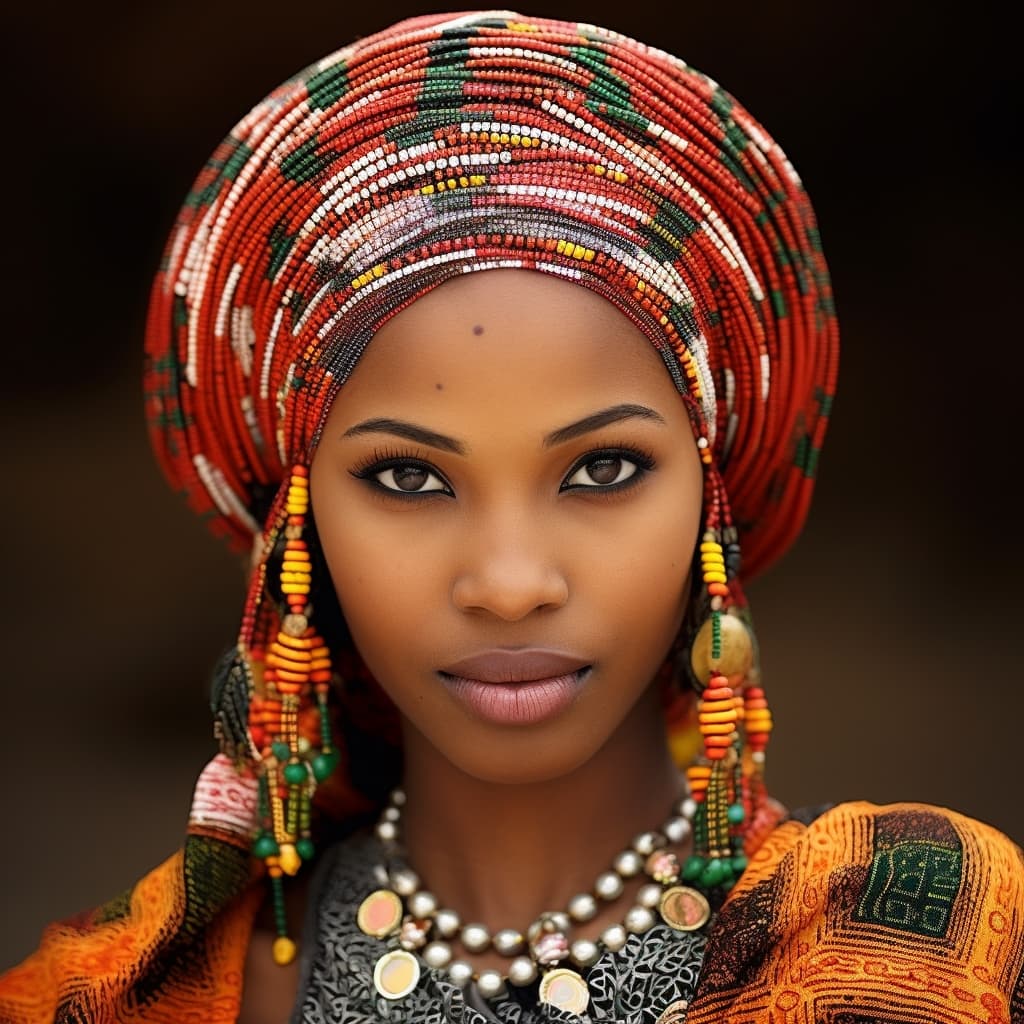
Hausa Erotic
Hausaland (Niger, Nigeria)
Afroasiatic / Chadic / Hausa
Islam / Sunni Islam
Western Africa
About Hausa People
The Hausa are the largest ethnic group in West Africa by population, anchored across the savanna belt that straddles northern Nigeria and southern Niger — a territory they call Kasar Hausa, Hausaland. They are also one of the few sub-Saharan groups whose language has functioned for centuries as a regional lingua franca: Hausa is spoken as a first or second language across a swath of the Sahel from Chad to Ghana, and trader networks carried it well beyond the homeland. Linguistically it sits inside the Chadic branch of Afroasiatic, which makes it a distant cousin of Arabic, Hebrew, and Amharic rather than of the Niger-Congo languages that surround it on most sides. That genealogical oddity matters: it reflects a much older population history than the political map suggests.
Hausa identity coalesced around a constellation of city-states — Kano, Katsina, Zaria, Daura, Gobir among them — whose walled towns dominated trans-Saharan trade in cloth, leather, kola, and slaves from roughly the eleventh century onward. Islam arrived gradually with merchants and scholars and was nominally established among the ruling classes well before the decisive rupture of 1804, when the Fulani scholar Usman dan Fodio launched a jihad that toppled the Hausa kings and folded the city-states into the Sokoto Caliphate. The political fusion that followed — Hausa commoners, Fulani aristocracy, shared Sunni Islam of the Maliki school — produced what is often called Hausa-Fulani society, though many Hausa today insist on the distinction. The British absorbed the caliphate into Northern Nigeria a century later through indirect rule, leaving the emirate structures intact under colonial supervision; many of those emirates still exist as traditional institutions.
Daily Hausa life carries the imprint of all of this. Religious observance is woven through the calendar and the working day rather than confined to Friday; the practice of kulle, the seclusion of married women in some households, coexists with a long tradition of women running independent businesses from inside the home, particularly in cooked food and textiles. The leather and indigo-dyed cloth from Kano have been famous across the Sahel for half a millennium, as has the distinctive hausa architecture — flat-roofed mud-brick houses with elaborate molded façades, built without timber in a region that has little of it. Music, especially the praise-singing of court griots accompanied by the long-necked kuntigi and the talking kalangu drum, remains a living craft rather than a heritage performance.
Typical Hausa Phenotypes
Reference for AI generation — hair, eyes, skin, facial structure, build
Hausa phenotype sits at a Sahel crossroads: dominantly West African substrate with measurable Saharan, Berber, and trans-Saharan Arab admixture absorbed over a thousand years of caravan trade and Islamic scholarship. The result is a population that reads recognizably West African but trends leaner in build and finer in feature than the forest-belt Yoruba or Igbo to the south.
Hair is near-universally Type 4 — tightly coiled, dense, and dark brown to black. True jet-black with a slight reddish cast under sun is common. Beard growth in men is typically moderate, often patchy at the cheeks but full at the chin, reflecting that northern admixture. Eye color runs dark brown to near-black; lighter hazel or amber tones appear occasionally and are unremarkable rather than rare. Eye shape is almond, set under a relatively flat brow, with no epicanthic fold.
Skin tone spans Fitzpatrick V to VI — deep brown through to very dark brown — with warm red-bronze undertones that distinguish Hausa complexions from the cooler, more blue-black tones common further south. The Saharan exposure shows: sun-darkening on the face and forearms is pronounced, and lighter-toned individuals (closer to V) are not unusual, particularly in clerical and merchant lineages with deeper Arab-Berber roots.
Facial structure is the most distinctive marker. Noses are notably narrower than the West African average — straight to slightly aquiline bridges, moderate alar width, often with a defined tip. Lips are full but not as broad as Yoruba norms, frequently with a sharper vermilion border. Cheekbones sit high; jawlines in men are often angular rather than square, and faces tend toward oval or long rather than round.
Build skews tall and lean — adult male stature commonly 175–183 cm, with narrow shoulders, long limbs, and low body fat typical of Sahelian populations. Women carry similar proportional length with fuller hip structure. The combined signature — very dark skin, narrow nose, lean Sahelian frame — is the phenotype that most reliably reads as Hausa rather than generically West African.
Data depth
31/100Coverage of image-grounded phenotype observations · drives AI generation diversity
- Sample size
- 6/40· 2 images
- Image quality
- 25/30· 50% high
- Confidence
- 0/20· mean 0.00
- Source diversity
- 0/10· wikipedia
- ·No image observations yet
- ·Low overall confidence
- ·Wikipedia-only source — not population-representative
Explore phenotype categories
Structured taxonomy with peer-reviewed scales · 22 anatomical categories
Notable Hausa People
3 reference figures — sourced from Wikipedia
- Bayero University — Attahiru Jega Abubakar Adamu Rasheed Muhammad Yahuza Bello
- Ahmadu Bello University — Abdullahi Mustapha Ibrahim Garba
- National Open University of Nigeria — Abdalla Uba Adamu






Generate Hausa AI Content
Use this ethnicity's phenotype data to create AI-generated content with accurate physical traits and cultural context.
Open Creator Studio