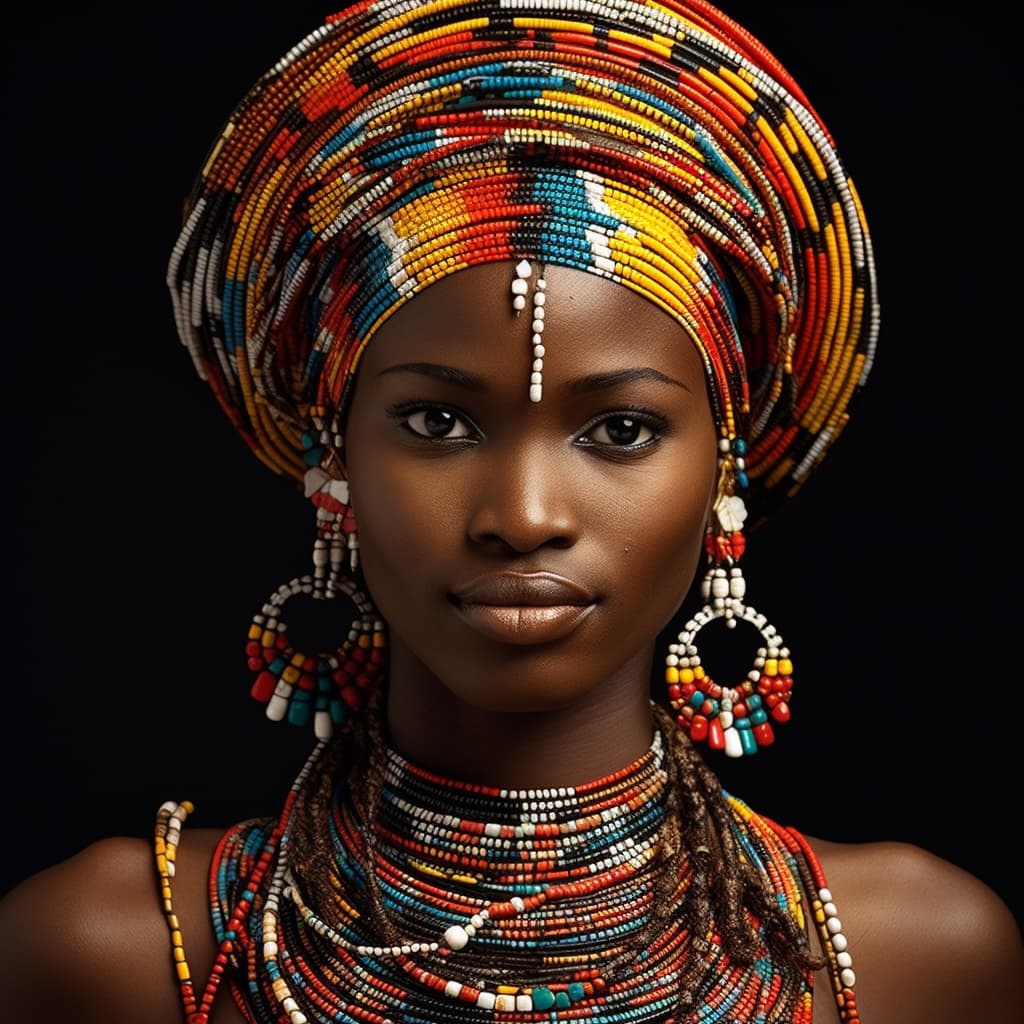
Gurunsi Erotic
Burkina Faso, Ghana, Togo
Niger–Congo / Gur / Gurunsi
Traditional African religions
Lukpa, Kabye, Tem, Lamba, Delo, Bago-Kusuntu, Chala, Lyélé, Nuna, Kalamsé, Pana, Kassena, Winye, Deg, Puguli, Paasaal, Sisaala, Chakali, Siti, Tamprusi, Vagla
Western Africa
About Gurunsi People
The Gurunsi are not a single people so much as a cluster of related communities strung along the savanna belt where Burkina Faso, Ghana, and Togo meet. They share a language family — the Gurunsi branch of Gur, itself part of the wider Niger–Congo group — and a long history of settlement in the open country south of the Volta tributaries, but they have rarely been politically unified. The name itself was largely imposed from outside, by neighbors and by colonial administrators, to describe peoples who would more readily identify as Kassena, Nuna, Lyélé, Sisaala, Winye, or one of a dozen other branches. Even the linguistic boundary is loose: speakers of Sisaala in northern Ghana and speakers of Lyélé in central Burkina Faso may struggle to follow each other without effort.
What does run through the cluster is a particular relationship to the land and to the ancestors who worked it. Most Gurunsi communities have stayed organized around lineages tied to founding earth-shrines, with an earth-priest — usually drawn from the descendants of the first settlers — holding ritual authority over the soil itself, distinct from any chiefly office. Disputes over farmland, hunting boundaries, and the placement of new compounds traditionally pass through this figure. The arrangement gave Gurunsi villages a famously horizontal politics: powerful states grew up on every side of them — Mossi to the north, Dagomba and Mamprusi to the south, Gonja to the southwest — but the Gurunsi themselves built no comparable centralized kingdom, which made them frequent targets of slave raids in the eighteenth and nineteenth centuries, particularly under the Zabarima warlord Babatu in the 1880s and 1890s.
Traditional religion remains genuinely current here, not residual. Earth-shrines, divination, and rites tied to the agricultural calendar coexist with Islam and Christianity rather than being displaced by them; many Gurunsi households move between systems without treating the boundary as a contradiction. The Kassena and Nuna are also known beyond the region for the painted earthen architecture of compounds like Tiébélé, where exterior walls are decorated by women in geometric black, white, and ochre designs renewed before each dry season. The motifs are not decorative in the loose sense — they reference cosmology, lineage, and the protective work the house is expected to do.
Typical Gurunsi Phenotypes
Reference for AI generation — hair, eyes, skin, facial structure, build
The Gurunsi cluster is a Voltaic farming population spread across the savannas of southern Burkina Faso, northern Ghana, and Togo, and the phenotype tracks closely with other West African Sahel-savanna groups rather than with coastal forest populations like the Akan or Yoruba. Skin tone sits firmly in Fitzpatrick VI — deep brown to near-black, with warm red-brown undertones in the Kassena and Nuna heartland and slightly cooler, darker tones among the Sisaala and Vagla further south. Sun exposure from open-field agriculture deepens the surface tone but rarely shifts the underlying chroma.
Hair is uniformly black and tightly coiled — Type 4B and 4C predominates, with the dense, springy texture typical of Sahelian Gur-speakers. Greying tends to come late and concentrates first at the temples. Eyes are dark brown to near-black; the epicanthic fold is absent, the palpebral fissure is wide and slightly almond-set, and the sclera often shows the warm ivory cast common across West Africa rather than pure white.
Facial structure is where Gurunsi groups read as distinct from their southern forest neighbors. Cheekbones are broad and high-set, the jaw is square rather than tapered, and the forehead is moderately rounded. Noses run medium-to-wide at the alae with a low, softly-rounded bridge — flatter on average than Mande or Fulani profiles, but not as broad as Akan. Lips are full and well-defined, with a pronounced vermilion border; the upper lip is typically shorter than the lower.
Build is lean and wiry, shaped by subsistence farming. Men cluster around 170–175 cm, women around 158–163 cm, with long limbs relative to torso, narrow hips, and low body fat well into middle age. Among sub-groups, the Kassena and Nuna of the Burkina–Ghana border tend toward taller, leaner frames with the most angular facial geometry, while the Sisaala, Vagla, and Chakali to the south carry slightly broader shoulders and rounder facial features — a gradient that mirrors the climatic shift from Sahel to Guinea savanna.
Data depth
0/100Coverage of image-grounded phenotype observations · drives AI generation diversity
- Sample size
- 0/40· 0 images
- Image quality
- 0/30· 0% high
- Confidence
- 0/20
- Source diversity
- 0/10
- ·No image observations yet
Explore phenotype categories
Structured taxonomy with peer-reviewed scales · 22 anatomical categories






Generate Gurunsi AI Content
Use this ethnicity's phenotype data to create AI-generated content with accurate physical traits and cultural context.
Open Creator Studio