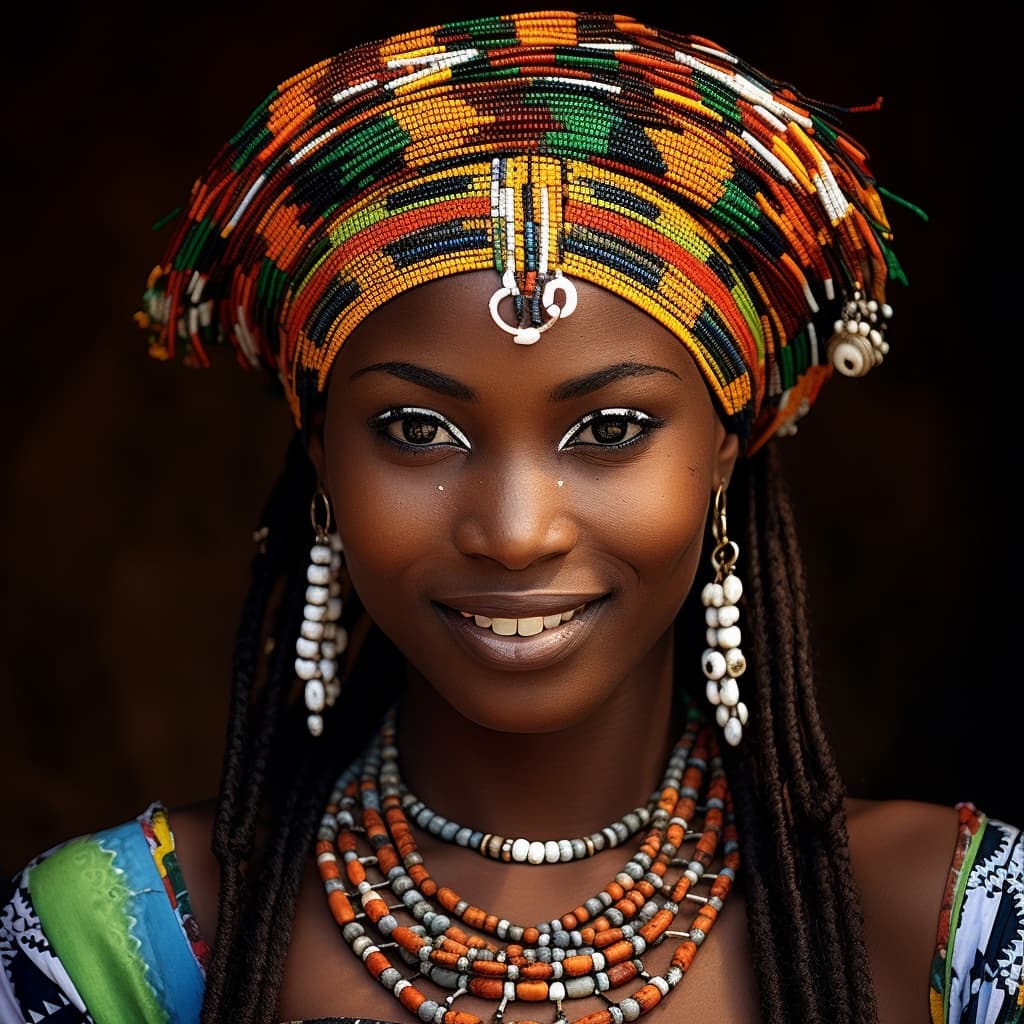
Gurma Erotic
Gurmaland (Burkina Faso, Ghana)
Niger–Congo / Gur / Gourmanché
Islam
Ntcham, Bimoba
Western Africa
About Gurma People
The Gurma are a Voltaic people whose heartland straddles the eastern savanna of Burkina Faso and the northern reaches of Togo, Ghana, Benin, and Niger — a stretch of bush and farmland once organized around the precolonial kingdom of Gourma, with its old seat at Nungu (now Fada N'Gourma). They take their name from that polity, and the territory is still called Gurmaland in regional shorthand, though no modern border honors it. The core group speaks Gourmanché, a Gur language inside the broader Niger–Congo family; it sits as a near neighbor to Mooré, the language of the Mossi, with whom the Gurma share centuries of frontier history, intermarriage, and intermittent rivalry. The Ntcham and Bimoba branches, found mostly on the Togo–Ghana side of the range, are usually counted as Gurma kin — culturally adjacent, linguistically related, but with their own chiefs, their own dialects, and an identity they don't necessarily fold into the Burkinabè mainstream.
Islam is the dominant affiliation today, carried in over generations through Hausa and Fulani trade networks rather than imposed by conquest, and it coexists in practice with older ritual habits — household-level offerings, divination, the authority of certain lineage elders over things that mosques don't touch. Society is patrilineal and rural in its center of gravity. Most Gurma still live by farming sorghum, millet, and increasingly cotton, with the agricultural calendar shaping everything from marriage timing to the cycle of public festivals. Chieftaincy survived the colonial period and remains socially live: village chiefs are not ceremonial relics but real arbiters in land disputes, succession questions, and the administration of customary law alongside the state.
The Gurma are not a small people — estimates run to well over a million speakers of Gourmanché alone — but they sit at the demographic margin of every country they inhabit, and that has shaped a particular self-understanding: confident in their internal institutions, watchful of capitals far to the west or south. Eastern Burkina Faso, their main territory, has in recent years become one of the hardest-hit zones of the Sahel insurgency, which has displaced communities, emptied markets, and put long-standing patterns of mobility and pastoral exchange under strain. It is the most consequential thing happening in Gurmaland right now, and any honest portrait has to register it.
Typical Gurma Phenotypes
Reference for AI generation — hair, eyes, skin, facial structure, build
The Gurma sit within the Voltaic (Gur-speaking) cluster of the West African savanna belt, and their phenotype tracks closely with neighboring Mossi, Dagomba, and other Oti-Volta peoples rather than with the coastal Akan or forest groups to the south. Skin tone is predominantly Fitzpatrick VI — deep brown to near-black with cool, slightly blue-violet undertones rather than the reddish or ochre undertones common further north in the Sahel. Sun-weathered matte finish on exposed skin is typical given the dry savanna environment; lighter palms and soles contrast sharply with the body tone.
Hair is almost uniformly Type 4 — tight coils ranging from springy 4A through dense 4B/4C — and jet black, with graying that often holds off into the fifth decade. Eyes are dark brown to near-black; the epicanthic fold is essentially absent, and the eye shape tends toward almond with a moderate outer canthal tilt. Eyebrows sit thick and arched.
Facial structure is the most distinctive feature. Gurma faces tend toward a broader, more rounded cranial base than the elongated Fulani profile, with prominent malar bones, a relatively flat-bridged nose with wide alae, and full everted lips — the lower lip often fuller than the upper. Jaws are square in men and softly tapered in women, with strong chins. Traditional facial scarification — vertical or radiating cheek lines — is still encountered among older Gurma and shapes how the face reads even when absent.
Build is medium-to-tall and lean: men commonly 170–180 cm, women 160–168 cm, with long limbs relative to torso, narrow hips on men, and a tendency toward a high gluteal shelf and defined waist-to-hip ratio in women. Subcutaneous fat distribution favors hips and thighs over the midsection. Between the sub-groups, Bimoba populations on the Ghana side trend slightly shorter and more compactly built than the Ntcham, but the difference is subtle and individual variation dominates.
Data depth
0/100Coverage of image-grounded phenotype observations · drives AI generation diversity
- Sample size
- 0/40· 0 images
- Image quality
- 0/30· 0% high
- Confidence
- 0/20
- Source diversity
- 0/10
- ·No image observations yet
Explore phenotype categories
Structured taxonomy with peer-reviewed scales · 22 anatomical categories





Generate Gurma AI Content
Use this ethnicity's phenotype data to create AI-generated content with accurate physical traits and cultural context.
Open Creator Studio