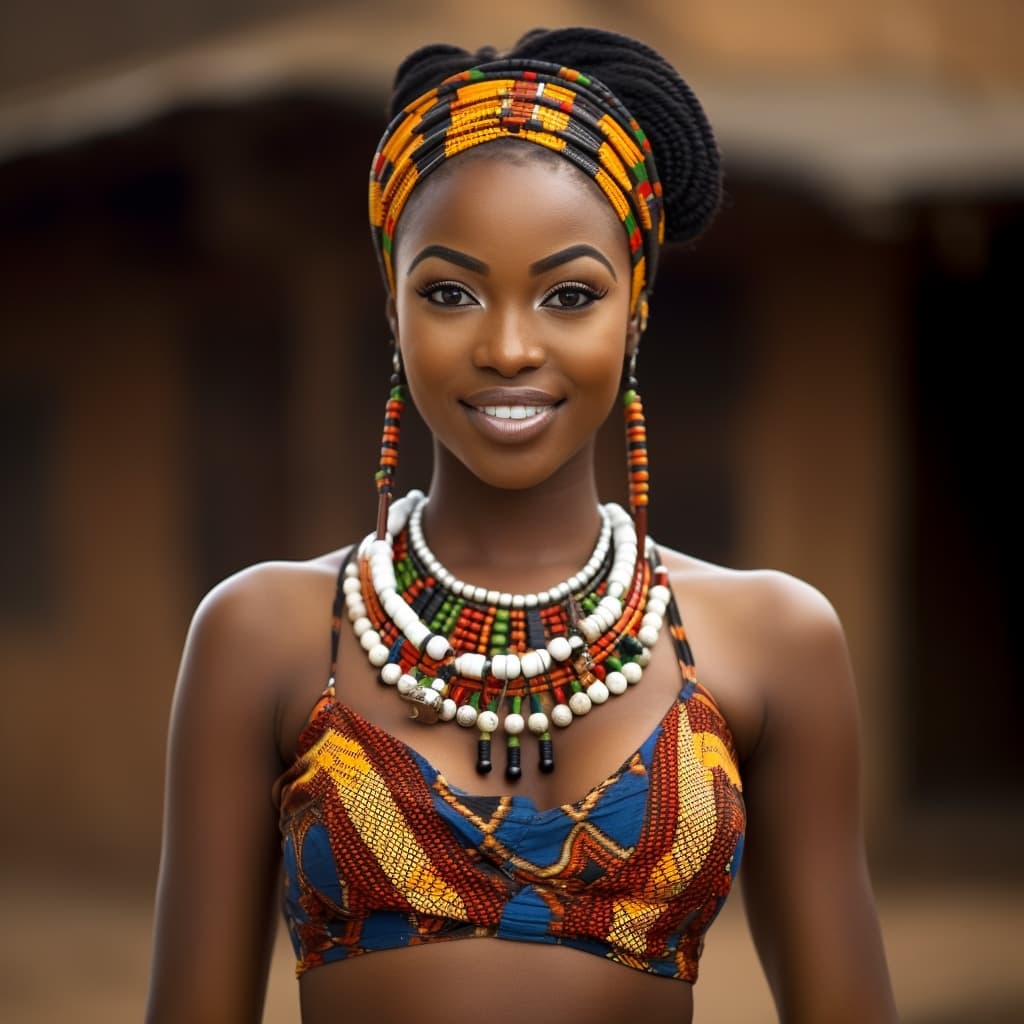
Guan Erotic
Ghana (Brong-Ahafo and Volta Regions)
Niger–Congo / Kwa / Guang
Christianity
Gonja, Kyode, Cherepon, Efutu, Anyanga, Larteh, Chumburung, Krache, Anum-Boso
Western Africa
About Guan People
The Guan are often described as Ghana's oldest layer — the people who were already in the forests and along the Volta when the Akan, Ewe, and Ga-Dangme migrations arrived and reshaped the map around them. That priority is more than a footnote. It explains why Guan communities turn up in scattered pockets from the Brong-Ahafo plateaus down through the Volta basin and onto the coastal plain near Winneba, rather than as a single contiguous territory. Centuries of being absorbed, pressed against, and bordered by larger neighbors have left the Guan as a constellation rather than a bloc: Gonja in the north, Nawuri and Krache in the central reaches, Cherepon and Larteh on the Akuapem ridge, Efutu on the coast, and a dozen smaller communities in between.
Their languages reflect the same story. The Guang branch of Kwa is one of the older divisions in the family, but each community speaks a distinct variety — Gonja, Nchumuru, Nkonya, Gichode, Efutu — often unintelligible to other Guans and frequently spoken alongside the dominant regional language, whether Twi, Ewe, or Hausa. Most Guans today are bilingual or trilingual as a matter of practical life, and several of the smaller varieties are under real pressure from Akan expansion.
Christianity is the majority affiliation across most southern Guan communities, with Islam dominant among the Gonja in the north — a legacy of the savanna trade routes and the Muslim clerics who attached themselves to the Gonja court from the seventeenth century onward. Beneath both, older practice persists in recognizable form. The Efutu Aboakyer, the annual deer hunt at Winneba, is the most visible example: two rival warrior companies race into the bush to capture a live antelope for the chief priest of Penkye Otu. The Larteh shrine of Akonedi has functioned as a regional oracle for generations and still draws petitioners from across the diaspora.
Politically, the Guan tend toward smaller chieftaincies rather than the centralized kingdoms of their Akan neighbors — Gonja being the conspicuous exception, having organized itself into a sizable Islamic state in the late 1500s under a cavalry-led ruling class of Mande origin. That pattern of local autonomy, multilingualism, and quiet cultural retention is much of what being Guan looks like in practice: not a unified nation so much as a network of communities that have held onto their own ground, in their own ways, while the larger groups around them did the louder work of nation-building.
Typical Guan Phenotypes
Reference for AI generation — hair, eyes, skin, facial structure, build
The Guan are among Ghana's oldest established populations, predating Akan migrations into the forest belt, and their phenotype reflects long settlement across both the savanna fringe of Brong-Ahafo and the Volta corridor — producing more internal variation than outsiders usually expect from a single group.
Hair is uniformly Type 4, with tight coil patterns ranging from springy 4A among coastal Efutu and Larteh communities to denser 4B–4C textures common in northern Gonja and Krache populations. Natural color sits in true black to deep brown-black; significant graying tends to arrive late, often past fifty. Eyes are almost universally dark brown to near-black, set under a smooth supraorbital ridge with no epicanthic fold and a clean, open almond shape — the wide-set eye placement visible in figures like John Dramani Mahama is characteristic.
Skin tone spans Fitzpatrick V to VI, leaning darker overall than neighboring Akan groups. Northern Gonja and Chumburung branches trend toward deep cool-brown undertones with blue-black depth in unexposed areas; southern Efutu and Anum-Boso skew slightly warmer, with reddish-bronze undertones from Atlantic coastal admixture. Even tone retention is strong; sun-induced hyperpigmentation is minimal.
Facial structure shows a moderately broad nasal base with a low-to-medium bridge — narrower than typical Mande or Mossi profiles but broader than Fulani. Lips are full and well-defined, with a pronounced vermilion border. Cheekbones sit high and forward, jawlines are square in men and oval-tapered in women, and foreheads tend to be vertical rather than sloped. Dental prognathism is mild.
Build is generally medium-tall — men cluster around 170–178 cm, women 160–168 cm — with naturally lean, long-limbed proportions in northern Gonja populations and stockier, more muscular frames among the southern Efutu and Cherepon, where Michael Essien's compact, powerfully built physique sits well within range. Shoulder breadth is moderate; gluteal projection and thigh development are pronounced in women.
Data depth
61/100Coverage of image-grounded phenotype observations · drives AI generation diversity
- Sample size
- 18/40· 9 images
- Image quality
- 28/30· 56% high
- Confidence
- 15/20· mean 0.78
- Source diversity
- 0/10· wikipedia
- ·Small sample (n<10)
- ·Wikipedia-only source — not population-representative
Observed Distribution — Image Sample
Empirical observations from analyzed photographs · supplementary signal, not population truth
Sample: 9 images analyzed (9 wikipedia). Quality: 5 high, 2 medium, 2 low, 0 very_low. Avg analyzer confidence: 0.78.
Skin tone (Fitzpatrick): VI (100%)
Hair color: black (56%), gray/white (33%), unclear (11%)
Hair texture: coily (78%), bald (11%), covered (11%)
Eye color: dark brown (89%), unclear (11%)
Epicanthic fold: 0% present, 89% absent, 11% unclear
Caveats: Sample size 9 is small — observed distribution should be treated as suggestive, not definitive. Sample is 100% Wikipedia notable people — skews toward male, public-life, and modern figures, not population-representative.
Last aggregated: May 7, 2026
Explore phenotype categories
Structured taxonomy with peer-reviewed scales · 22 anatomical categories
Notable Guan People
18 reference figures — sourced from Wikipedia
- Theodosia Salome Okoh — Designer of the national flag of Ghana.
- Alex Quaison-Sackey — Ghanaian diplomat and the first Black African to serve as President of the Un…
- Michael Essien — former International footballer
- Hannah Kudjoe — Prominent political activist during Ghana’s independence struggle..
- Obed Yao Asamoah — Ghana’s longest-serving Minister for Foreign Affairs and later Minister of Ju…
- John Dumelo — Actor, entrepreneur, and politician.
- John Jinapor — Politician and energy expert.
- Otiko Afisa Djaba — Former Minister for Gender, Children and Social Protection.
- John Dramani Mahama — President of Ghana (2012–2016; re-elected in 2024); also served as Vice Presi…
- Ibrahim Mahama — Business magnate and founder of Engineers & Planners.
- Okomfo Anokye — 17th-century spiritual leader, priest, and lawgiver of the Ashanti Empire; co…
- Kow Nkensen Arkaah — Former Vice President of Ghana (1993–1997).
- Clemence Jackson Honyenuga — Supreme Court Justice and former Court of Appeal Judge.
- Gertrude Torkornoo — Gertrude Torkornoo – Chief Justice of Ghana (appointed in 2023); third female…
- Constance Edjeani-Afenu — Ghana’s first female Brigadier General; notable for her leadership in the Gha…
- Kwaw Ansah — Award-winning filmmaker, producer, and cultural advocate; known for African c…
- Melody Millicent Danquah — Ghana’s first female pilot; a pioneer for women in the military and aviation …
- Letitia Obeng — First Ghanaian woman to earn a doctorate in science (zoology); also the first…






Generate Guan AI Content
Use this ethnicity's phenotype data to create AI-generated content with accurate physical traits and cultural context.
Open Creator Studio