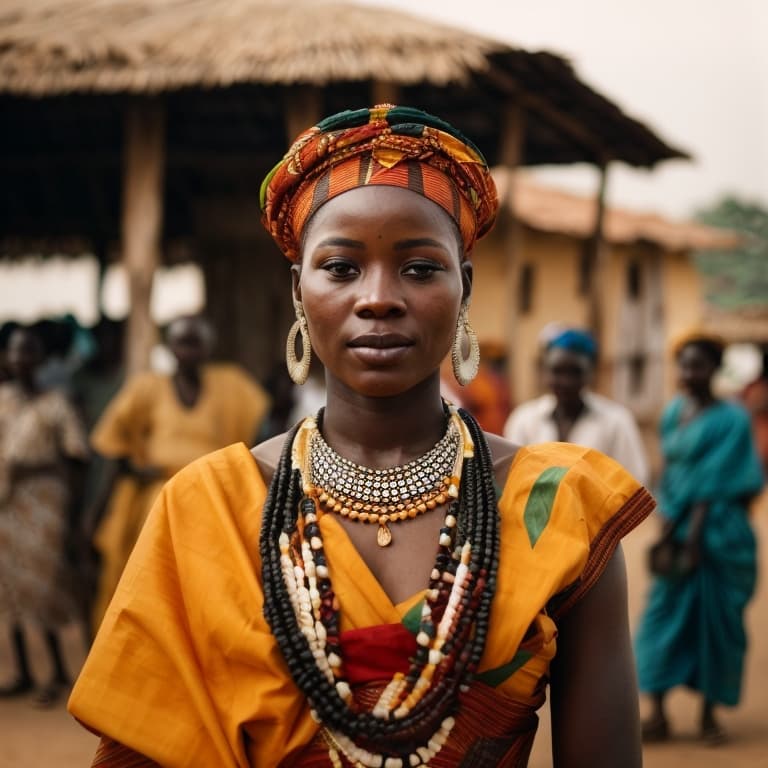
Ewe Erotic
Togo, Ghana
Niger–Congo / Kwa / Gbe / Ewe
Christianity
Anlo Ewe, Waci
Western Africa
About Ewe People
The Ewe live in the corner where Ghana's Volta Region meets southern Togo and folds into Benin — a stretch of coast, lagoon and inland savanna divided by colonial borders that the people themselves largely ignore. They number somewhere around six or seven million, and the most useful thing to know about them is that "Ewe" is less a single tribe than a confederation of polities — Anlo on the coast, Waci further inland, and dozens of smaller chieftaincies — bound together by a shared language and the memory of a common flight. Oral history places that flight in the seventeenth century, when the ancestral group fled the tyrannical king Agokoli of Notsie, in present-day Togo, and scattered south and west. The escape narrative, with its image of women wearing down a mud wall by repeatedly washing against it, is still recited at festivals and still doing political work: it explains why Ewe identity is decentralized by design, suspicious of strongman rule, and organized around clan elders rather than a paramount throne.
The language belongs to the Gbe cluster of Kwa, which makes Ewe mutually navigable with Fon across the border in Benin and with Aja in between — a continuum more than a set of separate tongues. It is heavily tonal, rich in proverbs, and carries one of the more developed written traditions in West Africa thanks to nineteenth-century Bremen missionaries who reduced it to a standard orthography. That missionary contact is also the reason most Ewe today identify as Christian, predominantly Evangelical Presbyterian and Roman Catholic, with growing Pentecostal congregations. But Christianity here sits on top of a still-active indigenous substrate: the Vodun tradition that the wider world knows through its Haitian and Beninese cousins is Ewe in origin, and shrines to deities like Mawu-Lisa and Heviosso remain part of the religious furniture even in households that attend church on Sunday.
The Anlo, on the Keta lagoon and the strip of sand between it and the Atlantic, are the branch most often encountered in ethnographic literature — fishermen, salt-makers, and the architects of Agbadza, the war-drum dance that has become the cultural shorthand for Ewe-ness abroad. Inland Ewe communities lean more toward yam and maize agriculture and toward kente weaving, which they practice in a recognizably distinct register from their Asante neighbors to the west. Funerals, not weddings, are the social events that organize the calendar.
Typical Ewe Phenotypes
Reference for AI generation — hair, eyes, skin, facial structure, build
The Ewe phenotype sits within the broader Gbe-speaking West African coastal cluster, but carries enough internal variation that a single description flattens it. Skin tones run from medium-brown through deep umber to near-black, mostly Fitzpatrick V–VI, with warm red-brown and cool blue-black undertones both well-represented. Coastal Anlo Ewe communities, with longer histories of trade-route mixing along the Bight of Benin, show a slightly broader range toward the lighter end; inland Waci populations tend darker and more uniform.
Hair is almost universally Type 4 — tightly coiled to densely kinky — black or near-black, with the soft halo texture characteristic of the Gulf of Guinea coast rather than the wirier coil seen further south. Premature graying in the temples is common in middle age. Eyes are dark brown to black; the eye shape is typically almond with a clean, unhooded upper lid and no epicanthic fold. Whites of the eyes often carry a slight bluish or yellow-tinged cast that reads warm against the deep skin.
Facial architecture is the most distinctive register. Ewe faces tend toward broader, rounder craniofacial proportions than the more elongated Akan or Yoruba norms — wider zygomatic arches, fuller cheeks, and a relatively short midface. Noses are moderately broad at the alae with a low-to-medium bridge; very narrow noses are uncommon. Lips are full, with a pronounced vermilion border and often a heart-shaped upper lip. Jawlines are softer and more rounded in women, square and prominent in men. Boxer Isaac Dogboe is a useful anchor for the compact, broad-shouldered male morphology this group commonly produces.
Build trends toward medium height — men typically 5'7" to 5'10", women 5'2" to 5'6" — with strong, athletic proportions, a relatively short torso, and well-developed gluteal and thigh musculature. Footballers like Cody Gakpo and Christian Atsu illustrate the lean-muscular end; everyday Ewe builds tend stockier and more powerfully set through the shoulders and hips.
Data depth
70/100Coverage of image-grounded phenotype observations · drives AI generation diversity
- Sample size
- 32/40· 30 images
- Image quality
- 23/30· 47% high
- Confidence
- 15/20· mean 0.79
- Source diversity
- 0/10· wikipedia
- ·Wikipedia-only source — not population-representative
Observed Distribution — Image Sample
Empirical observations from analyzed photographs · supplementary signal, not population truth
Sample: 30 images analyzed (30 wikipedia). Quality: 14 high, 13 medium, 3 low, 0 very_low. Avg analyzer confidence: 0.78.
Skin tone (Fitzpatrick): V (27%), VI (73%)
Hair color: black (63%), gray/white (33%), unclear (3%)
Hair texture: coily (83%), shaved (7%), covered (10%)
Eye color: dark brown (97%), unclear (3%)
Epicanthic fold: 0% present, 97% absent, 3% unclear
Caveats: Sample is 100% Wikipedia notable people — skews toward male, public-life, and modern figures, not population-representative.
Last aggregated: May 7, 2026
Explore phenotype categories
Structured taxonomy with peer-reviewed scales · 22 anatomical categories
Notable Ewe People
65 reference figures — sourced from Wikipedia
- Sylvanus Olympio — First Togolese President
- Nicolas Grunitzky — Second president of Togo
- Jerry John Rawlings — Former President of The Republic of Ghana and Flight Lieutenant of the Ghana …
- Emmanuel Kwasi Kotoka — Former Military Lieutenant General
- Joseph Kokou Koffigoh — Former prime minister of Togo
- Edem Kodjo — Former Secretary General of the Organisation of African Unity and Togolese Pr…
- Nicephore Soglo — Former president of Benin
- Komla Agbeli Gbedemah — Ghanaian politician
- John Willie Kofi Harlley — Ghanaian politician
- Anthony Deku — Ghanaian politician
- Bella Bellow — Togolese musician
- Willie Klutse — Ghanaian footballer
- Raphael Armattoe — First ever African nominee for a Nobel Prize
- Esther Ocloo — Ghanaian businesswoman
- Philip Gbeho — Composer of Ghana's national anthem
- Ephraim Amu — Musician and composer
- Fred Kwasi Apaloo — Ghanaian politician
- Kofi Awoonor — Ghanaian politician
- Annie Ruth Jiagge — Ghanaian politician
- Isaac Dogboe — World Champion boxer
- Monica Amekoafia — Beauty queen
- Sefadzi Abena Amesu — Musician
- Kofi Adjorlolo — Kofi Adjorlolo - Veteran Ghanaian actor, producer and media personality
- Marie Thérèse Metoyer — Businesswoman
- Edward Doe Adjaho — Ghanaian politician
- Junior Agogo — Ghanaian footballer
- Cody Gakpo — Footballer
- Alexander Djiku — Footballer
- Romeo Lavia — Footballer
- Bradley Barcola — Footballer
- Corentin Tolisso — Footballer
- Patrick Attipoe — World War II veteran and former Corporal
- MzVee — Musician
- M.anifest — Musician and record producer
- E.L. — Musician and producer
- Stonebwoy — Musician
- Feli Nuna — Musician and producer
- Francis Amuzu — Footballer
- Christian Atsu — Footballer
- Constance Ama Emefa Edjeani-Afenu — First female brigadier general of the Ghana Armed Forces and, posthumously, t…
- Edward Kwaku Utuka — Former Major General of Ghana Armed Forces
- Seth Anthony — Former Army Major and the first black African-born soldier to be commissioned…
- Virgil Abloh — Ghanaian-American fashion designer and founder of OFF-WHITE
- Komla Dumor — Journalist
- Nyaho Nyaho-Tamakloe — Former president Ghana Football Association and politician
- Victoria Zormelo-Gorleku — First woman prison Officer in Ghana
- Ben Akafia — Former Lieutenant General and Chief of defence staff
- G.K. Agama — Former economist and governor of the bank of Ghana
- Kofi Anyidoho — Poet and Professor of Literature
- Charity Zormelo — First Woman to graduate from the Gold Coast
- Ferdinand Kwasi Fiawoo — Religious minister and Educator
- Ferdinand K. D. Goka — Volta region minister and politician
- Christian Baëta — Presbyterian minister Synod Clerk
- V. Kofi Agawu — Musicologist and music theorist
- El Anatsui — Sculptor
- Gnonnas Pedro — Singer and Musician
- Mac Sarbah — Foundation executive
- Isaac Yao Dogbo — A leading figure in bringing local African beats into Ghanaian choir and pian…
- Victoria Anyediventor — The first woman reportedly credited to have discovered ”gob3”, the popular Gh…
- Joe Atiso (Joseph Atiso) — Vocalist key member of the Ramblers International Band. He’s recognized as on…
- Felix Amenudah — Saxophone, flute, assistant leader) Band member of the Pan Ghanaian band The …
- Tsatsu Tsikata — Ghanaian academic and lawyer
- Jones Victor Mawulorm Dotse — Ghanaian judge
- OCLC — Dzobo, N.K. (1997) [1973]. African proverbs: the moral value of Ewe proverbs.…
- ISBN — Cottrell, Anna (2007). Once Upon a Time in Ghana: Traditional Ewe Stories Ret…


Generate Ewe AI Content
Use this ethnicity's phenotype data to create AI-generated content with accurate physical traits and cultural context.
Open Creator Studio